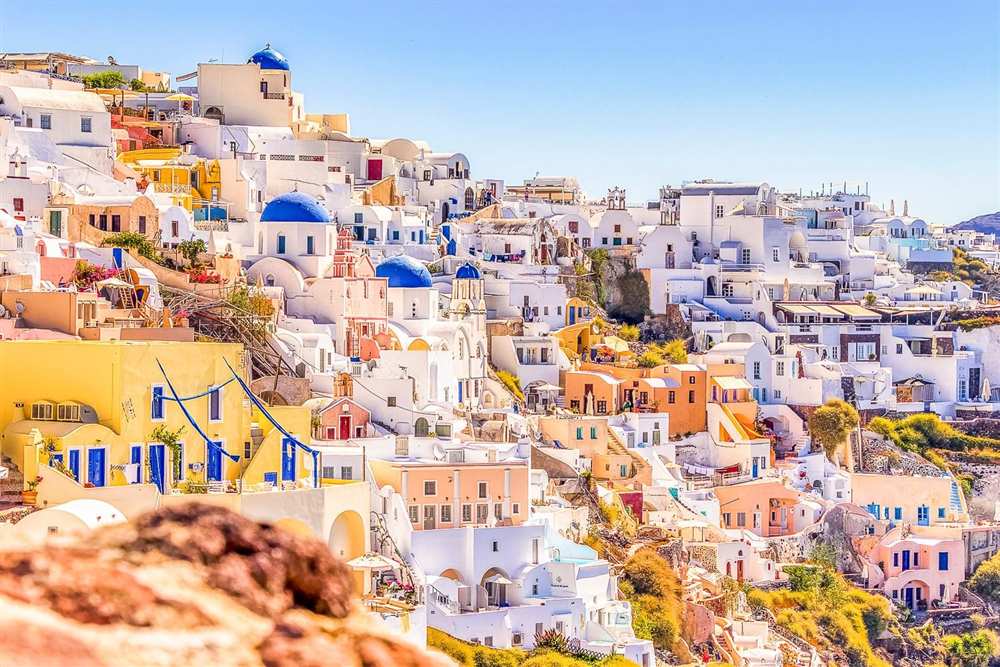
This 4 day Santorini Greek tour takes the ferry from Piraeus to Santorini and sleeps three nights on the island. Browse our tours in Greece for more trips that start in Athens.
4 Day Greece Santorini Tour
What does a 4 day Santorini Greek tour include?
A 4 day Santorini Greek tour covers ferry tickets, three hotel nights and transfers in Athens and Santorini. Three breakfasts and hotel taxes are on the list too. The tour promises nothing more.
The ferry tickets run from Piraeus to Santorini and back to Piraeus, in tourist class. An upgrade is possible at an extra charge. Piraeus is the port closest to the centre of Athens. Flights are not on the list of this 4 day Santorini Greek tour.
The transfers wrap around the ferry ride. In Athens, they run from your hotel to the port and back to the hotel. On Santorini, they run from the port to your hotel and back to the port. A 4 day Santorini Greek tour names no other transfers.
The core of the tour is three nights in a hotel on Santorini. The list names hotel nights on Santorini only, so an Athens hotel is not part of it. Hotel taxes are the last item on the list.
Breakfast is the only meal on the list, and it comes three times. Lunches and dinners are not on the list either. Plan them as part of your own days on a 4 day Santorini Greek tour.
A comparable four-day package from a Greek sightseeing operator lists round trip ferry tickets and round trip island transfers. It adds three-star hotel accommodation with breakfast. Its days one, two and three each end with an overnight stay on Santorini.
In that package, the transfer on arrival takes you directly to your hotel. Days two and three are open to explore the island. Day four starts with a morning at leisure. Then a pickup collects you from the hotel and takes you to the port for your departure.
That package treats Athens differently from a 4 day Santorini Greek tour. It lists Athens transfers to and from the port as not included. It offers a hotel round trip transfer at extra cost.
It also names meals, gratuities and personal expenses as excluded. It lists the accommodation tax per room per night as not included. The list of a 4 day Santorini Greek tour names hotel taxes, so compare the two lists line by line.
Your stay on Santorini in that package is un-escorted, and the package lists no excursion. Likewise, the list for this 4 day Santorini Greek tour names no excursion and no tour leader.
A small group tour with a leader is a different product. A travel site lists one that begins with a ferry ride from Piraeus Port to the island of Santorini. Its first day is a morning ferry and a transfer to the hotel.
Beauty & Romance
Completely different from the rest of the Cyclades, this fabulous island shrouded in myth, is believed by many to be the lost Atlantis and has an exciting history that goes back centuries. Brilliant sunsets and spectacular views of the volcanic islands on the west side, where towering cliffs are crowned by tiny white houses curved into the rock, make it a lover’s paradise and a favourite honeymoon destination. The famous black sandy beaches are on the east side of the island. The island, also known for its good local wine, offers quality accommodation, delicious cuisine and lively entertainment. You can get there from Athens by plane (1 hour), normal ferry (about 9 hours) or fast boat (about 4.5 hours, available only in high season).
TOUR INCLUDES:
- Transfers in Athens (hotel – port – hotel)
- Ferry tickets Piraeus – Santorini – Piraeus in Tourist class (upgrade is possible at extra charge)
- 3 nights hotel accommodation in Santorini
- Transfers in Santorini (port – hotel – port)
- Meals: 3 breakfasts
- Hotel taxes
How do you reach your hotel on a 4 day Santorini Greek tour?
Your ferry lands at Athinios, the island’s ferry port, and a transfer takes you to your hotel. The list names transfers from the port only. They run from the port to the hotel and back to the port on a 4 day Santorini Greek tour.
Athinios goes by two other names, the New Port and Thira Port. It lies on the southwest side of the island. Ferry arrivals and departures all centre on this main hub. The port lies right below the caldera cliffs, and a single steep switchback road leads in and out.
The port is small and can get chaotic when ferries arrive together. In summer the little port gets extremely crowded. The island leg of this 4 day Santorini Greek tour begins in this busy place.
From Athinios port, these are the main distances for a 4 day Santorini Greek tour:
- Fira: about 8 km by road, and about 20 minutes by car.
- Santorini airport: about 7 km.
- Oia: about 20 km, or about half an hour by car on a good day. In peak season, the trip can take twice as long, so allow extra time.
Oia is the farthest of these three places from the port.
Taxis are in short supply on Santorini, and demand jumps the moment a ferry arrives. A private transfer service on the island says its driver monitors your ferry for delays. It also says you are met at the port with a sign.
The list does not say the same for this 4 day Santorini Greek tour. Ask the operator for the meeting point.
All bus lines begin and end in Fira, where the main bus station stands. There is no direct bus from the port to Oia, so you change in Fira. Including the change, the trip takes from an hour up to an hour and a half.
Buses can be packed around ferry arrivals. Check the current schedule if you take a bus during a 4 day Santorini Greek tour.
Roads on the island are busy, narrow and windy. Parking in Fira and Oia is frustrating. It is harder to find a parking place when you stay in a caldera side village. The list names transfers, not a hired car, on this 4 day Santorini Greek tour.
- The island is roughly 16 km long and 1 to 5 km wide.
- You can drive from one end to the other in under an hour in light traffic.
The airport sits on the island’s east side. It is about 5 km from Fira and about 7 km from Athinios port. In normal traffic, the drive from the airport to Oia takes 25 to 30 minutes.
How do you get around Santorini on a 4 day Santorini Greek tour?
Transfers in Santorini from port to hotel and back are the only island transport named on the tour list. Every other trip on the island during a 4 day Santorini Greek tour is yours to plan. Choose the public bus, a taxi, a hired vehicle or your own feet.
The bus network on a 4 day Santorini Greek tour centres on Fira bus station. Almost all the lines branch out from it, says Wikivoyage. Its route list names these destinations:
- Oia, through Imerovigli and Firostefani
- Perissa, through Pyrgos
- The airport, through Karterados and Megaria
- Kamari
- The Akrotiri museum, through Megalochori and Akrotiri village
- The ferry terminal
To go from one side of the island to the other, you change buses at Fira. Oia to Kamari, for example, requires changing buses. Schedules vary with the season. Buses suit simple trips.
The number of taxis is limited. Taxis can be found at the port and the airport. They are also at the central squares of Fira and Oia, and near every beach resort. There are not enough in high season. So book a taxi in advance for any trip with a fixed time on a 4 day Santorini Greek tour.
Cars, scooters and quads can be rented. A driving licence is required for scooters and ATVs, and an international driving permit is recommended for a car. Book a hire car in advance, especially in high season, because demand is very high.
Quads, also called ATVs, are popular. They share the road with other drivers, and the “all-terrain” part of the name is a misnomer. Wikivoyage warns of rental scams, especially at agencies that work only with motorbikes and ATVs. Check the vehicle before you decide.
On a 4 day Santorini Greek tour, rent a small car for one or two days of exploring. You probably do not need one every day.
Motorised vehicles are banned from Oia town, so hired cars cannot enter on a 4 day Santorini Greek tour. If your accommodation lies in another area, a bus or transfer service is recommended for Oia.
Paths on the island are paved mostly with cobblestones, and steps run along the cliffside. For walking on a 4 day Santorini Greek tour, sneakers or comfortable walking shoes are ideal, not heels. Paths over Perissa Rock join Perissa, Kamari and Pyrgos.
The walk from Perissa to Kamari, by Ancient Thera, is fairly short. The walk to Pyrgos is somewhat longer and passes through the highest point on the island.
Finikia is a small village outside Oia. It is a 10 to 15 minute walk from Finikia into Oia. Crossing Oia itself on foot takes 20 to 30 minutes.
What is Fira, the capital of Santorini?
Fira is the modern capital and largest town of Santorini. It stands on the edge of the caldera cliffs, with cathedrals, museums and shops in narrow streets. Walking is the convenient way to see the town on a 4 day Santorini Greek tour.
Fira takes its name from another way of pronouncing Thira. Thira is the island’s ancient name. The town became prominent in the late 18th century, when reduced piracy let islanders move out from the castles. It eventually became the administrative centre of Santorini.
Fira is a town of whitewashed houses on the rim of a caldera that is 400 metres high. From Fira, a 4 day Santorini Greek tour looks out over the 18-kilometre caldera and Nea Kameni. Nea Kameni is the volcanic island at the centre of the caldera.
Below the town sits Gialos, the old harbour. No road leads to it, because it lies at the bottom of the steep caldera cliffs. The cable car connects the harbour to the town centre. Each gondola carries up to six passengers, and the lift moves 1,200 passengers an hour.
The other route is the Karavolades Stairs, also called the Donkey Trail. This paved stairway climbs 200 metres over 588 steps. Walkers can choose between the stairs and the cable car while on a 4 day Santorini Greek tour.
Space on the caldera ridge is limited, so the town has a very condensed layout. Narrow streets open only to walkers, motorcycles and donkeys. Only a small number of streets suit motor vehicles, and there is almost no parking.
On a 4 day Santorini Greek tour, souvenir shops and art galleries dot the centre of Fira. The town offers the island’s widest selection of shopping and dining.
Because of the Venetians, the island became home to a sizable Catholic community. Santorini still holds the seat of a Catholic bishopric, and Fira has a Catholic quarter. The town has two cathedrals, both Christian but with different flavours.
During a 4 day Santorini Greek tour, four religious buildings in Fira stand out:
- The Cathedral of Saint John the Baptist is Roman Catholic. Its baroque building in blue-gray and cream dates from the 19th century. Its bell tower, worth a visit within a 4 day Santorini Greek tour, is a landmark of the town.
- An earlier church once stood where the white Orthodox Cathedral of Ypapanti now rises. The Amorgos earthquake destroyed it.
- The Three Bells of Fira belong to a Catholic church with a blue dome. The current church dates from the 18th century.
- The Dominican Convent, founded in the 16th century, is the oldest Catholic nunnery in Greece.
On a 4 day Santorini Greek tour, indoor stops suit a day less sunny than the brochures promise. The museums on the island are mainly in Fira. The Megaro Gyzi Museum fills a 17th-century mansion. It holds maps, landscapes, engravings and dresses of the Cycladic Islands from the 15th to the 19th century.
On a 4 day Santorini Greek tour, evenings in Fira change pace. In the early evening, the passengers of the cruise ships return to their vessels. The cafes become much more relaxed.
What is Oia, the village on the northern tip of Santorini?
Oia sits at the north-west edge of Santorini, perched on the steep caldera slope. It was a mariners’ town that flourished on seaborne trade. Oia suits a 4 day Santorini Greek tour as a slow walk through that past.
The main street is named Nikolaou Nomikou. At the central square it is a cobbled trekking path that goes up the hill and winds round the caldera. The marble pathways and steps can be slippery, so sensible shoes suit a 4 day Santorini Greek tour.
Wealth in the village peaked from the late 19th century into the early 20th century. Its merchant fleet traded in the Eastern Mediterranean, especially from Alexandria to Russia. Late in the 19th century, the village counted about 2,500 residents, plus a fleet of about 130 sailing ships.
In those years, the wealthy ship captains built neo-classical mansions. These houses are seen built in succession, one above the other. On a 4 day Santorini Greek tour, look for former captains’ houses adorned with marble anchors and other maritime symbols.
Another 19th-century mansion, a block away from the cliff-top, has been restored. It is now the municipal museum of the maritime history of Thira. It is a stop for a 4 day Santorini Greek tour.
Agios Nikolaos Kastell, known as Apanomeria too, was one of the five local citadels under the da Corogna family. Its keep, Goulas, now stands in the oldest part of the town. From the 16th to the 19th century, maps called the settlement Apanomeria. The name changed to Oia during the latter half of the 19th century.
The remains of a Venetian castle once protected the village from pirates. A coat of white lime water on the houses lets the falling rain run down and be collected.
An old windmill is a recognisable building in the town and appears on postcards. The white church of Panagia Platsani has a distinctive blue dome and a bell tower. Both are sights for a 4 day Santorini Greek tour.
- There are 300 steps down from Oia to the port, so plan the climb back on a 4 day Santorini Greek tour.
- Ammoudi sits on the town’s west side, with tavernas and a pebble beach. Visitors reach it by steep stairs lying north of Fort Londsa.
- Below Oia, to the south, lies Armeni. Steps lead down to it, on foot or by mule, and it was once an important boatbuilding centre.
The earthquake of 9 July in the mid-20th century measured 7.8 and caused considerable damage. Renewed emigration followed, and about two decades later Oia had only 306 inhabitants. The village then grew anew as a tourist town of the Cyclades. Today, a 4 day Santorini Greek tour finds that tourist town.
The municipal unit of Oia takes in the whole of Therasia, plus the north-west tip of Santorini.
What are Imerovigli and Firostefani on the caldera rim?
Imerovigli and Firostefani are two villages north of Fira. On a 4 day Santorini Greek tour they offer narrow paved paths and a trail to Skaros rock. The views of the volcano are unobstructed.
Firostefani lies north of Fira, only a short distance from its considerably larger neighbour. Its name joins “Fira” with “stefani”, the Greek word for crown. Shops gather along the main shopping street at the centre, and small whitewashed, blue-domed churches are scattered through the village.
Walkers leave Fira along the caldera path and pass through Firostefani on the way to Imerovigli. On a 4 day Santorini Greek tour, Imerovigli sits midway between Fira and Oia. It is built on the rim of the caldera, at its highest point.
Narrow, paved paths cross the village, and fewer than 500 people live there all year. The name Imerovigli comes from “vigla”, a word for viewpoint, because the site let villagers see pirate ships approaching.
In front of the village stands Skaros Rock, one of the island’s five fortified settlements. On a 4 day Santorini Greek tour, you see the remains of a Venetian castle on the rock.
Skaros was first fortified in the early 13th century by the Byzantine Empire. The de facto capital of Venetian Santorini was Skaros, since it was the island’s largest settlement. Legend says the castle was never conquered in 600 years.
Skaros later lost its rank to Fira, the new capital, and to Oia. After the 18th-century eruptions, the people of Skaros moved to Fira or Imerovigli. The fortress itself was reduced to weathered ruins by the early 19th century.
A well-defined trail from the church of Agios Georgios leads to Skaros on a 4 day Santorini Greek tour.
- Agios Georgios is a small whitewashed chapel near the start of the trail. It overlooks the sea with a panoramic view of the caldera.
- Agios Ioannis stands on the main path, with blue crosses on its roof and a tiny terrace for a short break.
- Panagia Theoskepasti, dedicated to the Virgin Mary, has a blue dome and a bell tower. It lies about 20 minutes on foot from Imerovigli.
The name Theoskepasti translates roughly as “covered by God”. The chapel is still a place of worship on the cliffs below the rock. On a 4 day Santorini Greek tour, keep your voice down there.
From Imerovigli the outlook takes in the volcano, the island of Thirasia and the islets of Palea and Nea Kameni. The sun sinks into the sea behind Palea and Nea Kameni. The chapel of Agios Georgios is a sunset spot. It does not get as crowded as other popular sunset viewpoints on a 4 day Santorini Greek tour.
The Monastery of Saint Nikolaos lies between Firostefani and Imerovigli, on the path that connects Imerovigli to Fira. Walkers on a 4 day Santorini Greek tour pass it. It is home to a folklore museum and an ecclesiastical museum.
What is the ancient town of Akrotiri on a 4 day Santorini Greek tour?
On a 4 day Santorini Greek tour, Akrotiri is the prehistoric town to see. It lies 15 km from Fira, at the southwestern tip of Santorini. A volcanic eruption buried it, and the ash kept its houses and wall paintings in good condition.
On a 4 day Santorini Greek tour, the story starts in the Late Bronze Age. The prosperity of Akrotiri ended in the 17th century BC, when seismic activity forced its people to flee. An earthquake struck first, and then the eruption buried the town. The dating evidence is varied, so the exact year is not known.
Diggers found no unburied human skeletons and only a single gold object, hidden beneath a floor. This points to the people leaving in an orderly way, with little or no loss of life. People took only valuables with them, so pottery is abundant.
Akrotiri sits in the Cyclades. Even so, inscriptions in Linear A and close similarities in artifact and fresco styles link it to the Minoan civilization.
The town covered 50 acres, with paved streets, an extensive drainage system and an elaborate sewage system. Walking it on a 4 day Santorini Greek tour, you see three-storey buildings. One two-storey building has 14 rooms on each floor.
Akrotiri’s wall paintings are much better preserved than those from Knossos, which survive almost only as small fragments. The National Archaeological Museum of Athens and the Museum of Prehistoric Thera now hold frescoes from Akrotiri. A 4 day Santorini Greek tour can see part of them in Fira. Three of the frescoes are:
- The Fleet Fresco, a miniature frieze of a naval expedition visiting coastal cities.
- The Crocus Collectors, which shows women gathering crocuses near an altar.
- The Spring Fresco, with blooming lilies and swallows in flight.
Professor Spyros Marinatos began the excavation with a theory. He aimed to prove that the eruption contributed to the collapse of Minoan civilization on Crete. Within hours, the buried city began to appear. After years of restoration, the site reopened under a new protective roof. On a 4 day Santorini Greek tour, visitors wander the town under that bioclimatic shelter.
The Ephorate of Antiquities of the Cyclades sets the opening hours, opening days and last-entry times. Check the current schedule on the Ministry of Culture page before you plan a 4 day Santorini Greek tour. The Ephorate lists these rules for its sites:
- Climbing on monuments is prohibited.
- Pets are not allowed, except assistance dogs.
- Professional photography and filming without permission are prohibited.
- Drone use without prior authorization is prohibited.
- Eating and smoking are prohibited.
- Entry wearing swimwear or inappropriate clothing is prohibited.
What do Ancient Thera and the Museum of Prehistoric Thera show?
Ancient Thera is a Dorian city on the Mesa Vouno hill, 396 metres above sea level. In Fira, the Museum of Prehistoric Thera displays finds from the older town of Akrotiri, including wall paintings and pottery. Visitors on a 4 day Santorini Greek tour can see both.
The hill is part of the pre-volcanic core of the island and forms the southeastern cape of Santorini. Dorian colonists settled the city, and people lived there until at least the 9th century AD. The Ptolemies, monarchs of Hellenistic Egypt, held it from 288 BC to 145 BC.
The agora, the main square, is about 110 metres long and 17 to 30 metres wide. The Basilike Stoa, a huge portico of 46 by 10 metres, extends along it. The theatre was built in the 2nd century and had seating for about 1,500. During a 4 day Santorini Greek tour, the ruins show how an island city-state was organised.
The shape of the terrain kept the city relatively small. It had a theatre, a market, shops, residential districts and a sewage system. The visit follows the ancient road network. The Ministry of Culture gives an average duration of 1.5 hours.
Places of worship stand at the narrow, steep, wind-exposed ends of the ridge. The sanctuary of Apollo Carneios, the dominant god of the Therans, lies at the southeastern end. The ruins on a 4 day Santorini Greek tour are reached by a winding road that starts at Kamari. Footpaths also climb from both sides of the mountain.
The Museum of Prehistoric Thera in Fira holds two exhibitions on two floors. In a 4 day Santorini Greek tour, the main exhibition runs from the Late Neolithic age to Akrotiri’s heyday. Its pottery includes Middle Cycladic bird jugs featuring swallows. Other finds are plaster casts of furniture, bronze vessels, seals and clay tablets in Linear A script.
The second exhibition, Theran Murals, presents a further 28 wall paintings from Akrotiri. Two ensembles, the Western House and part of Xesti 3, are set up for comparison. It includes the Fishermen, the Priestess, the Miniature Frieze and the Saffron Gatherers. On a 4 day Santorini Greek tour, the murals show an outward-looking, prosperous society of the Late Bronze Age.
In Fira, a 4 day Santorini Greek tour can also visit a separate museum, the Archaeological Museum of Thera. It holds finds from the cemetery excavations of Ancient Thera at Sellada.
The Ministry of Culture lists the opening days, hours and last-entry times of all three sites. Check the current schedule there before you plan a 4 day Santorini Greek tour.
What are the black, red and white beaches of Santorini?
Black beaches lie at Kamari and Perissa on the southeast coast. Red Beach and White Beach sit near Akrotiri in the south. A 4 day Santorini Greek tour reaches White Beach only by boat.
Whichever geological layer lies bare sets the colour of the sand. So the island has red, black and white beaches made of solidified lava. Lava absorbs heat, so swimmers find the water warmer at the darker beaches. Expect volcanic beaches, not soft sandy ones, on a 4 day Santorini Greek tour.
On a 4 day Santorini Greek tour, Kamari is the closer black beach to Fira. The village lies about 8 km away, on the southeastern part of the island. Black pebbles cover its beach, the longest on the island. The beach reaches from Monolithos to the base of Mesa Vouno, which stands about 400 m high.
Perissa is 13 km southeast of Fira, close to the Mesa Vouno rock. On a 4 day Santorini Greek tour, it is the farther of the two black beaches. Its shore is a long stretch of black volcanic sand with clear water. Perivolos is the southern extension of Perissa.
Red Beach lies near the village of Akrotiri, on the south coast, about 12 km from Fira. Its cliffs rise as high as 15 metres, streaked in red and black, above dark pebbles. Travellers on a 4 day Santorini Greek tour who add a boat cruise see this volcanic scenery from the water.
Check the current status before planning a Red Beach visit on a 4 day Santorini Greek tour. An official notice from the Municipality of Thira says visitor access has been prohibited because of the danger of rockfalls.
The cliffs and the access route have a long history of rockfall restrictions. Treat Red Beach as a sightseeing stop, not a normal beach day. Obey any closure signs.
White Beach, also called Aspri Paralia, is a small cove on the south coast, along the shore from Red Beach. There is no road and no safe footpath, so visitors arrive by water taxi from Akrotiri harbour. The shore is dark sand and pebbles under tall, pale cliffs of pumice and volcanic ash.
- The boat ride to White Beach takes about 10 to 15 minutes from Akrotiri harbour, or about 5 minutes from Red Beach.
- The cove has nothing reliable, so bring your own water, food and shade.
- Before you board the first boat, ask what time the last one comes back.
- Vlychada is a separate beach on the south coast that you can drive to. It has unusual sculpted cliffs and is easy to combine with Akrotiri on a 4 day Santorini Greek tour.
What are Pyrgos and Megalochori, the villages inland?
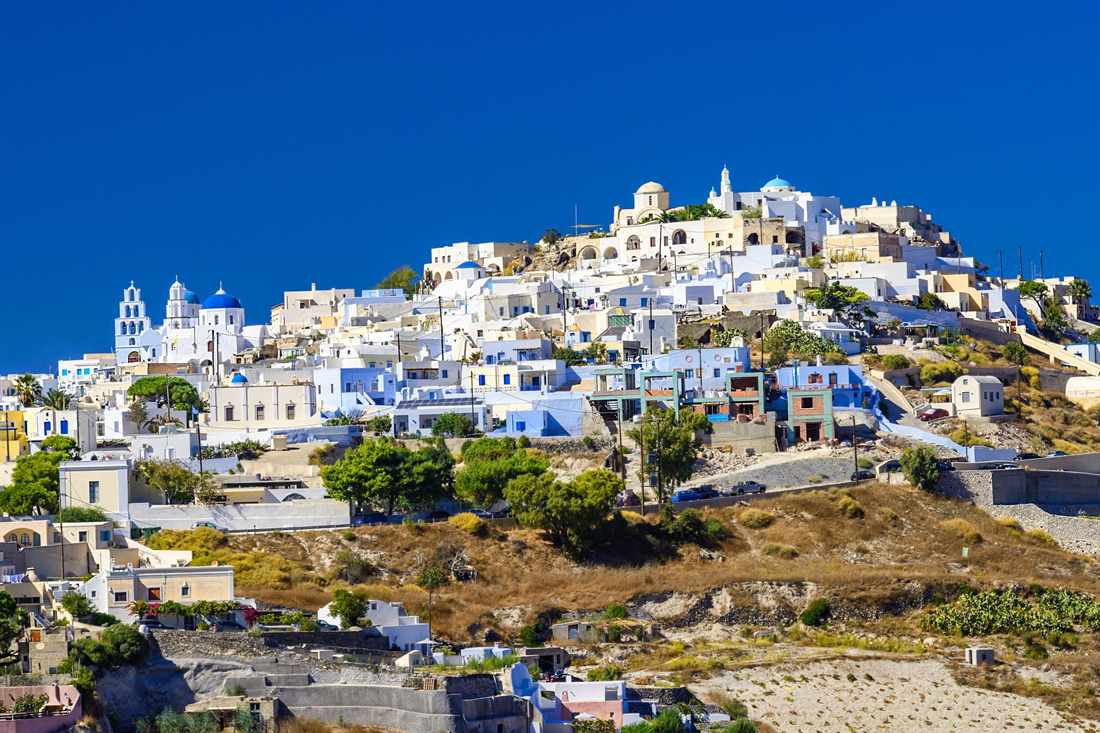
Pyrgos is Santorini’s highest settlement, topped by the ruins of a Venetian castle. Megalochori is a quiet village in the southwest with old mansions and a bell tower. A 4 day Santorini Greek tour can add both, away from the crowds of Fira and Oia.
Pyrgos sits on a hill in the shape of an amphitheatre. It lies just below Mount Profitis Ilias, the island’s highest point. Anyone climbing up here during a 4 day Santorini Greek tour gets views of Santorini in almost all directions. Narrow, winding paths lead up the hillside from the main square.
On top of the hill, the kasteli, a Venetian castle, now stands in ruins. It is the chief attraction of the village. A memorial plaque near its entrance remembers those who died in the Second World War. The village around it is medieval, with fortified walls and hidden passages.
Around Pyrgos and Mount Profitis Ilias there are at least forty-eight religious sites. The blue-domed church of Aghios Nikolaos is one of the key churches in town. Pyrgos is also among the Santorini villages that tourism has spoiled least. The pace here is slower than in Fira for a 4 day Santorini Greek tour traveller.
At Easter, residents light thousands of tin lamps, called denekedakia, as the Epitaph procession begins. Women sprinkle the Epitaph with rose water from their gardens. If the weather allows, the lamps stay lit until Holy Saturday morning. Residents gather from early in the morning to place the tins.
After the afternoon Descent from the Cross, church bells toll mournfully in the streets. If a 4 day Santorini Greek tour falls at Easter, an evening here shows the whole hillside aglow. On Easter Sunday, the square has fireworks and lamb on the spit.
Megalochori lies in the southwestern part of Santorini, set back from the caldera. It is one of the island’s oldest villages, and its existence is recorded back to the 17th century. Fira, the place for nightlife, is around a 10 to 15 minute drive away. A 4 day Santorini Greek tour can pair the two easily.
A traditional bell tower stands in the village square, a landmark that visitors photograph. Trees give the square shade, and locals gather there to play cards. The village also has bougainvillea-covered streets. Megalochori feels very different from Oia or Fira, slower and less crowded. It is a calm stop on a 4 day Santorini Greek tour.
Winding paths run between neoclassical mansions, and the village has a history of merchants and wealthy land barons. The mansions have high walls, inner courtyards and solid wooden doors, built for privacy and for safety against pirates. The village rewards a slow walk. A 4 day Santorini Greek tour has 3 nights on the island.
What do the churches and monasteries of Santorini show?
A 4 day Santorini Greek tour spends 3 hotel nights on an island with old religious sites. Three of them are the Profitis Ilias monastery and the Byzantine church of Panagia Episkopi. The third is the ruined church of Agia Eirini in the village of Perissa.
Profitis Ilias is the highest point on the whole island of a 4 day Santorini Greek tour. It rises about 567 metres above sea level. The monastery is built at that height, in a stone, fortress-style building. Two monks, who were brothers from Pyrgos, founded it in the early 18th century.
A 4 day Santorini Greek tour stays on one island. The monastery lies in the south-east part of the island, near the village of Pyrgos. A paved, winding and narrow road with steep drop-offs climbs to it from the main road in Pyrgos. The monastery has unobstructed 360-degree views of the Aegean Sea.
The mountain of Profitis Ilias is the geologically oldest part of the island. The monastery is an important monastic centre of the Cyclades.
Panagia Episkopi is a middle-Byzantine Greek Orthodox former cathedral, now a church. It lies on the island of a 4 day Santorini Greek tour, south of the village of Mesa Gonia. It stands in the northern foothills of Profitis Ilias, near the rocky mountain massif.
As tradition has it, the church was built in the 11th century with imperial sponsorship. On the site of the church there used to be an Early Christian basilica with three aisles. Its plan is cruciform, with a dome.
The mid-Byzantine marble iconostasis is preserved in its entirety. The Orthodox bishop, and later the Latin bishop, had his seat at the church. The dating of the wall paintings to the end of the 11th or 12th century is a matter of debate.
Part of the frescoes were successfully freed from the plaster and restored. A fire destroyed the major part of the books, church documents and priestly robes. The icons of the church, however, survived without damage.
The island’s name, Santorini, shortens Saint Irene. It comes from an old church in Perissa village. That church, Agia Eirini, is now a ruin on a 4 day Santorini Greek tour island. It was a two-aisled, middle-Byzantine church of the 8th or 9th century.
Under that church lay the ruins of a 5th-century basilica with three aisles. It was dedicated to Saint Irene (Agia Eirini) as well.
Churches on a 4 day Santorini Greek tour island follow more than one style. Oia has a complex of white-washed, blue-domed churches. The churches of Imerovigli are all made in the Cycladic architectural style.
What do you eat on Santorini during a 4 day Santorini Greek tour?
On a 4 day Santorini Greek tour you eat fava, cherry tomatoes, white aubergine, wild capers and goat cheese. Fava is a yellow split-pea purée. The volcanic soil grows these crops, and the European Union protects Santorini fava with a PDO stamp.
Fava is the dish to find in every traditional tavern on a 4 day Santorini Greek tour. Taverns serve it as a velvety starter, and cooks garnish it with onions, herbs or local capers. It is made from Lathyrus clymenum, a legume that farmers grow only on the island.
Grocery stores on the island sell fava too. Local recipes pair it with pork or with tomato purée. Cooks also turn it into a soup, add it to rice or fold it into an omelette. Farmers work rough terrain, and they plough tracts of land that tractors cannot reach. The volcanic subsoil gives the fava a sweet taste.
The crops on the island get no artificial irrigation, and rain is rare. Plants drink the humidity and sea mist that the volcanic soil absorbs. This soil produces crops that grow only on Santorini or give well-known products an exceptional taste.
Locals call cherry tomatoes tomataki, and these small fruits hold a high concentration of lycopene and vitamin C. They go into tomatokeftedes, fried tomato balls made with onion and herbs. Every tavern serves them as an appetizer, so start a meal on a 4 day Santorini Greek tour with them. Each family-run taverna makes them its own way.
White aubergine has sweet, juicy flesh, and it absorbs no oil when fried. Every taverna on Santorini serves it fried or as a salad on a 4 day Santorini Greek tour. Cooks also serve it raw. Ask for melitzanosalata, a paste that you eat with fresh bread.
Wild capers grow in peculiar places, such as the caldera cliffs and the walls of the houses. They are small flower buds. Cooks add them as a finishing touch to the Greek salad.
The island’s representative cheese is the Chloro, which means fresh. This creamy goat cheese is made in very limited quantities. Hard to find, it is a sought-after product. Cooks use it in the Santorinian salad. Look for it in authentic tavernas, restaurants and selected shops on a 4 day Santorini Greek tour.
Melitinia are Santorini’s Easter treat, filled with soft cheese and shaped from hand-pinched dough. Cooks sprinkle them with cinnamon, and the island eats them all year round. Koufeto, an almond and honey delicacy, is served at weddings as a symbol of prosperity. Restaurants serve melitinia as a favourite dessert, so try a plate on a 4 day Santorini Greek tour.
What is the caldera path from Fira to Oia?
The caldera path is a signposted footpath along the crater rim, running north from Fira to Oia. Wikivoyage gives it as an 11 km trail that takes about 3 hours at a moderate walking pace. That fits one morning of a 4 day Santorini Greek tour.
Hikers on a 4 day Santorini Greek tour start in Fira, the capital of Santorini. The trail leaves northward from Agiou Mina Street, and “To Oia” signs appear before you leave town. The Earth Trekkers site says it is a better experience to walk from Fira to Oia.
On a 4 day Santorini Greek tour, the walk passes through Fira, Firostefani, Imerovigli and Oia, in that order. Keep the water on your left and you are heading the right way.
The walking path is a mix of paved pedestrian streets and dirt hiking trails. The first half is mostly paved or cobblestone. In the second half, loose volcanic rock and dirt trails take over, with steep descents and climbs. The middle stretch is a steady uphill walk on a rocky trail.
The highest point of a 4 day Santorini Greek tour walk is Imerovigli, at 350 metres. Oia sits at 130 metres. A large part of the path has no shade, and the second half has none at all. Start early in the morning to avoid the midday heat.
Skaros Rock is an outcrop near Imerovigli. From there, you look back to Imerovigli and along the cliffs of Santorini. Past Imerovigli, the path forks before Profitis Ilias Church. The left fork climbs to the church for caldera views. The right fork is easier but misses them.
The 4 day Santorini Greek tour walk briefly joins the road, then the trail picks up again. The last stretch drops into Oia, past red volcanic rock and prickly pear cacti.
- Water: pick up water and snacks before you go, and stock up again in Imerovigli. Carry at least 2 litres per person.
- Food: do not count on buying food or water between Imerovigli and Oia.
- Climb: the climb from Fira up to Imerovigli is short but steep.
- Signs: there are occasional signs and distance markers, but they are infrequent.
- Sun: bring sunscreen and sunglasses.
- Feet: wear a good pair of walking shoes.
- Soles: choose walking boots or sturdy runners with grip, as the second half has loose volcanic rock.
Wikivoyage warns that the walk can be difficult. It names the up and downhill climbs and the rocky surface at times. It also names unprotected cliffs that drop sharply into the caldera. A side trip to Skaros Rock adds up to 30 to 60 minutes. Plan that time into a 4 day Santorini Greek tour morning.
A 4 day Santorini Greek tour walker can return from Oia by bus or by taxi. Services from Oia arrive at Fira bus station, the transit hub of the island. The ride takes around 30 minutes.
Where do you stay on a 4 day Santorini Greek tour, and what are cave houses?
You stay 3 nights in a hotel during a 4 day Santorini Greek tour, as the tour list says. Cave houses, called yposkafa, are homes dug into the volcanic rock of the caldera. Today they also serve as hotel rooms.
The word yposkafa translates as “excavated into the rock”. Builders dug into the soft pumice surface, deep enough to anchor each home in the rock below. If the hotel for a 4 day Santorini Greek tour has cave rooms, they are insulated. Wikipedia says the air trapped in the pumice gives them coolness in summer and warmth in winter.
Without wood, residents made vaulted roofs from volcanic ash and lime. Cave houses had a long, narrow space with a vaulted ceiling. Only an arched entrance shows outside. Daylight and fresh air came in only through the door and two small windows.
Poorer families lived in the caves, and Wikipedia says the crews of the ships used the cave houses of Oia. Captains and ship owners built much bigger freestanding homes on top of the volcanic rim. On the highest part of Oia, the two-story captains’ houses recall its former affluence.
Greeka lists houses, hotels, chapels, restaurants and wine cellars known as canaves in the steep volcanic rock. It adds that not every hotel complex consists entirely of cave houses. Book a cave room or suite specifically, and book early. On a 4 day Santorini Greek tour, ask your operator which room type is booked.
The list for the 4 day Santorini Greek tour names no hotel grade and no village.
- Fira, the capital, has the main bus station, the widest choice of restaurants and shops, and nightlife. It suits travellers without a rental car.
- Firostefani, a small caldera village just north of Fira, has good restaurants and a quieter setting, 10 to 15 minutes from Fira on foot.
- Imerovigli sits high on the caldera. It is quieter and more romantic than Fira or Oia.
- Oia has blue domes, cave hotels and sunset views, but its narrow paths get congested in the tourist season. It is also less convenient for exploring the island. It is worth visiting wherever you stay, so a 4 day Santorini Greek tour can use it as a day out.
- Kamari has a lively promenade, and it is particularly good for families.
- Perissa and Perivolos are the choice for long beach days.
The beach villages are flatter than the caldera villages and have larger hotel pools. You can still visit the caldera side by bus. Weigh views, sand and quiet before you choose a hotel for a 4 day Santorini Greek tour.
Which season suits a 4 day Santorini Greek tour, and what do you pack?
Choose June or September for a 4 day Santorini Greek tour. The National Observatory of Athens puts the average high at 27.9°C in June and at 27.2°C in September. July and August reach 30.1°C and 30.2°C and stay nearly dry. Pack shoes with grip, sun protection, water and an evening layer.
Summer on a 4 day Santorini Greek tour is hot and dry. Wikipedia calls the climate hot semi-arid, with dry summers. July averages 0.03 mm of rain and a low of 23.3°C, and August averages 2.5 mm. The hottest weather and the biggest crowds come in July and August. June and September are warm, with excellent swimming and boat tours.
Spring and autumn are milder on a 4 day Santorini Greek tour. April has an average high of 19.6°C and a low of 13.6°C. October has 22.8°C and 17.5°C. Winter brings the rain: December averages 54.6 mm and January 52.7 mm. November through March is quiet, so come for walking, views and photography, not beaches or nightlife.
The meltemi wind blows from about late spring until mid-September, and Wikipedia says it is strongest in the afternoon. It runs at 4 to 7 on the Beaufort scale, and in rare cases 8 to 10.
The fast boat of about 4.5 hours is available only in high season. Ask which boat your 4 day Santorini Greek tour uses.
Cruise passengers add to the crowds on a 4 day Santorini Greek tour. In Oia, late afternoon is the busiest time, when cruise passengers and sunset crowds overlap. The island welcomed 11,000 cruise tourists in a single day. The mayor of Thira wants no more than 8,000 cruise passengers a day.
Sunset times change the plan for a 4 day Santorini Greek tour. The sunset window is 20:31 to 20:41 in June and 19:05 to 19:48 in September. In December it is 17:04 to 17:13.
In winter, marine squalls and heavy cloud can hide the sunset for consecutive days. In late March and late October, daylight saving moves the times by an hour.
Stairs and stones decide what goes in your bag on a 4 day Santorini Greek tour. Pack these:
- shoes with grip, because the caldera villages are steep and full of stairs
- aqua shoes, because Santorini has almost no sandy beach, only gravel or big stones
- sunscreen and enough water for the Fira to Oia hike, which has very little shade, so start early in summer; after Imerovigli, the options to buy water are limited
- a vest for summer evenings, because the meltemi can make the air chilly
- a windbreaker for the December sunset
- a light if you plan to walk back from Skaros after dark
What else do travellers ask about a 4 day Santorini Greek tour?
Do the ferries run in strong wind?
The ferry is part of a 4 day Santorini Greek tour, and authorities can ban sailings in strong wind. If wind stops the boats, check with the port authorities or the ferry operator for updates.
Check the season before booking a 4 day Santorini Greek tour. The windier part of the year lasts 4.9 months, from November 6 to April 2. February is the windiest month, with an average hourly wind speed of 16.0 miles per hour.
What is the step count to a caldera hotel room?
On a 4 day Santorini Greek tour, caldera hotels have steep steps. The number of steps can vary enormously between rooms at the same hotel. Ask for the exact number of steps from the road and reception to your specific room.
Is the island suitable for children and older travellers?
A stroller works in parts of Fira and Oia for families on a 4 day Santorini Greek tour. Yet there are plenty of stairs, and someone needs to be ready to babywear.
For older travellers, the Kamari seafront is flat, paved and about 1 km long. Tavernas there have outdoor seating without steps. Exploring Oia village means cobblestone, steps and crowds.
Are there ATMs in the villages?
ATMs are widely available throughout Santorini, particularly in towns such as Fira, Oia and Kamari.
Smaller villages are different. Tiny family-run tavernas in villages like Pyrgos or Emporio never installed a card terminal. Take cash from a town ATM before you visit those villages on a 4 day Santorini Greek tour.
How warm is the sea for swimming?
The warmer water lasts 3.4 months, from June 25 to October 6, with an average temperature above 23°C. Book a 4 day Santorini Greek tour inside those dates if swimming matters to you.
Cooler water lasts 4.6 months, from December 14, with an average temperature below 17°C. February has the coolest water, at an average of 16°C.
Do restaurants and beach bars close in winter?
Beach bars and beachside restaurants close in winter. Seasonal restaurants open in spring and close for winter, while local tavernas and bakeries stay open all year.
In November, Fira has the widest choice of restaurants, while Oia and Imerovigli offer less. Check opening days before you plan dinners on a 4 day Santorini Greek tour in the off-season.
When does the sun set in winter and summer?
The earliest sunset on the island is at 5:02 PM on December 5. The shortest day is December 21, with 9 hours and 41 minutes of daylight, so winter evenings fall dark early.
The latest sunset is 3 hours and 38 minutes later, at 8:40 PM on June 29. The longest day is June 21, with 14 hours and 39 minutes of daylight. Plan your evenings on a 4 day Santorini Greek tour around these times.