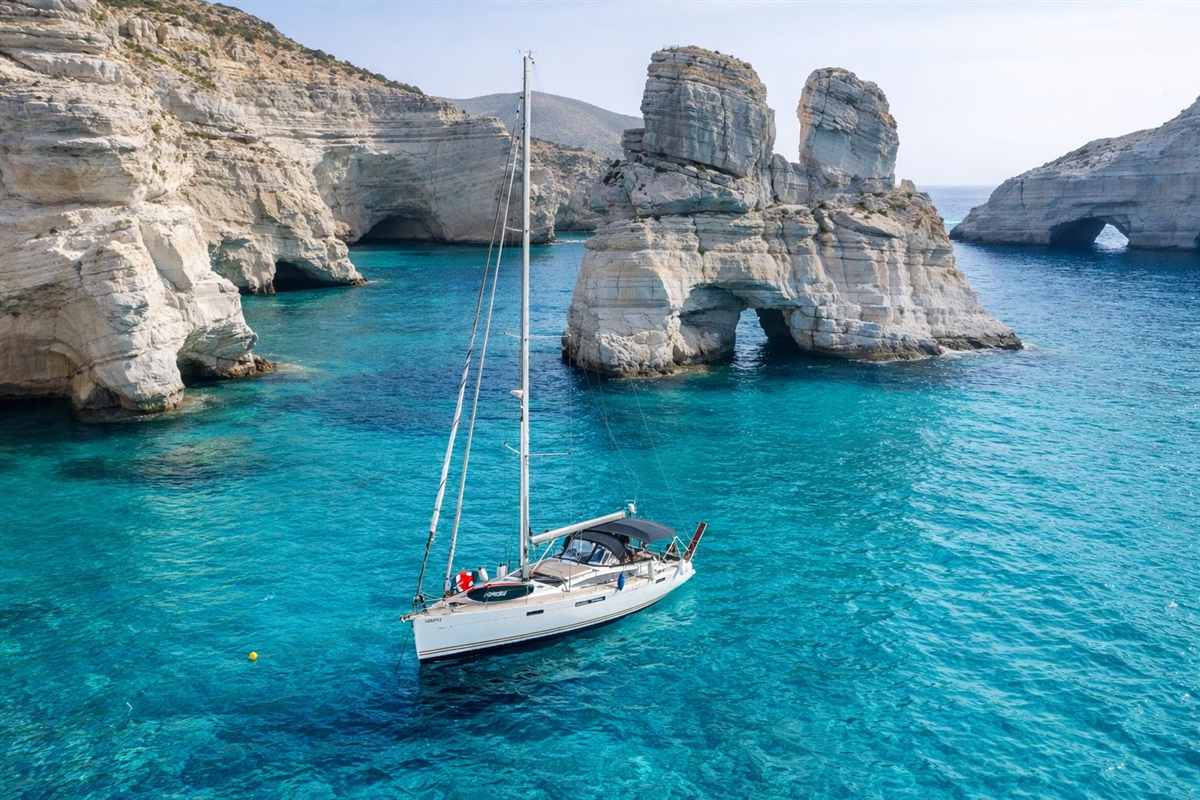
Milos sailing means a full day under sail from Adamas around the volcanic island, with a stop at Polyaigos. Browse more tours in Greece for other island days.
This page covers the route, the boats and crew, lunch and drinks on board, the swim stops, the volcanic coast, private charters, the season and what to bring on a Milos sailing day.
What does a Milos sailing day trip include?
A Milos sailing day trip includes a crew, lunch, drinks, snacks and snorkelling gear on a small boat. Polco, an operator based on the island, also sends every guest a set of photos from the day.
Start with the people on board. The Polco crew speak English, Spanish, French and Italian. Its sailboat cruise carries up to 12 passengers, so the day stays relaxed. The crew serve the food themselves, and they take the photos with a GoPro camera.
Food comes in stages on a Milos sailing day. Polco lists lunch made to suit vegetarian, vegan and other food needs, plus drinks and snacks through the day. Guests tell the operator about any limits when they book. On the round-the-island route, the crew serve a light breakfast after the first swim and dessert after the last one.
Gear is on the boat too, so Milos sailing needs little packing. Polco says its yachts carry snorkelling gear, and guests are welcome to bring their own mask and flippers. The boats also have a Bluetooth sound system. The west Milos sailboat cruise adds a deck shower, mattresses and shaded areas with hammocks. Guests bring only personal items.
Other operators list different extras. One Oneiro reviewer wrote that the boat supplied fresh towels and snorkelling equipment. Another said the crew offered options for guests with celiac disease or food intolerances. Excellent Yachting lists a swim, a snorkel and a freshly prepared meal on its private sailing yacht tour.
Because lists differ, read each listing before you book Milos sailing. Check the group size, the meal and the gear, and ask about anything the page leaves out.
Where does the Milos sailing trip leave from in Adamas, and what time does it run?
Polco’s Milos sailing trips leave from the port of Adamas. The round-the-island sailboat cruise departs at 09:00 and the west Milos sailboat cruise at 10:00. Guests meet 30 minutes before departure.
Oneiro calls Adamas the port of Milos and says the name comes from the diamond. For the 09:00 cruise, Polco names the meeting point as Adamas port. For the 10:00 cruise, it names the Polco location in Adamas. Check which one your booking lists, then arrive with the full 30 minutes in hand.
The finish is listed for one boat only. Polco’s catamaran cruise leaves Adamas at 09:00 and returns to the port around 18:00. Its 44-foot catamaran takes 22 people. Sailboat and catamaran pages differ, so ask for the return time of your own Milos sailing booking.
The start time is firm. Polco states that guests who arrive after departure are not admitted on board. The booking then counts as a no-show, and no refund is given.
Season matters for Milos sailing schedules. The round-the-island sailboat cruise runs daily from late spring to September. The west Milos sailboat cruise runs daily from April to October.
Not every Milos sailing boat starts in the same place. Excellent Yachting lists Adamas port for its private 43-foot sailing yacht tour. It lists Provatas Beach for a private tour to Kleftiko and Tsigrado. Oneiro names Adamas, Sykia and Kleftiko as one itinerary. One reviewer started from Paliochori after minibuses carried the group from Adamas at no extra cost.
Why do Milos sailing boats head for Polyaigos?
Milos sailing boats head for Polyaigos because it is an uninhabited island with bright turquoise bays. It lies about 6.2 kilometres east of Milos. Its blue water is the main swim stop of the full-day sailboat tours.
Nobody lives on Polyaigos, and Drougas Sailing calls it the largest uninhabited island in the Aegean. Goats are its only inhabitants, and the Greek name refers to them. They keep the land bare, so a Milos sailing deck looks out on rock and sea instead of villages. Kimolos lies 2 kilometres to the north-west.
The island measures about 6 kilometres along its longest axis, and its coastline runs for 22 to 27 kilometres. Two mountains rise from it: Stroggylo at 330 metres and Psilo Vouno at 370 metres. Wikipedia adds that the Greek Orthodox church owns much of the land. The church sublets parts to herdsmen from Milos and Kimolos.
Drougas Sailing says its Milos sailing cruise reaches remote bays, sea caves and beaches that cannot be reached from land. Polco Sailing, Drougas Sailing and Horizon Yachts all put Polyaigos on their full-day sailboat routes. The order differs.
Polco makes Galazia Nera its first swim and serves a light breakfast on board afterwards. Horizon keeps Polyaigos for its last swim before the return to Adamas.
A Milos sailing cruise can pair Polyaigos with Kimolos. Drougas Sailing adds Prassa Beach on Kimolos, called White Chalk because its white sand comes from chalk rocks. It fits both islands into one cruise of about 7 hours.
What can you swim at on the Polyaigos coast?
On a Milos sailing day you swim and snorkel at Galazia Nera (the Blue Lagoon) and at Myrsini Bay. Operators name these two bays as the swim stops. Both lie on the Polyaigos coast.
Galazia Nera means “blue waters” in Greek, and Milos sailing tours stop there for a swim. Drougas Sailing calls it a top yachting destination for swimming and snorkeling in crystal-clear seas. Horizon Yachts names it the Blue Lagoon and calls it the ultimate destination for swimming, snorkeling and relaxation.
Drougas Sailing describes Myrsini Bay as a sheltered bay surrounded by natural scenery. Horizon Yachts lists Galazia Nera or Myrsini Bay for its last swim, while Drougas Sailing swims at both. A small fishing-boat tour from Pollonia makes Mirsini its first swim and mentions an underwater route to discover.
The Polyaigos coast holds more than two bays for Milos sailing guests. Wikipedia says the island’s beaches lie mainly on the southern part. Its sea-surface caves shelter a dwindling population of Mediterranean monk seals. The operator pages do not promise a seal sighting.
One travel blogger describes orange and white rocks behind the water and calls the swim very inviting, with excellent visibility. The blogger recommends an underwater camera for the clear water.
Gear is on board. Polco Sailing says its yachts are fully equipped with snorkeling gear. Guests are welcome to bring their own mask and fins.
On Drougas Sailing boats, swimmers get noodles for extra comfort in the water and an underwater GoPro camera to borrow. That kit helps Milos sailing swimmers feel at ease in the water.
What route does a full-day Milos sailing trip follow around the island?
A full-day Milos sailing trip leaves Adamas at 09:00 and loops around the island. It has photo passes, four swim stops and lunch at Kleftiko. Polco runs this Milos and Polyaigos route as a sailboat cruise for up to 12 guests.
The Milos sailing day starts with a slow tour of Adamas Bay, heading northeast. The boat passes Klima, the fishing village where the Venus de Milo was found. Next come Arkoudes, the bear-shaped rocks at the bay entrance, and Glaronisia, the Seagull Islands, made of hexagonal volcanic rock.
The first swim is at Galazia Nera, the Blue Waters of Polyaigos, followed by a light breakfast on board. The boat then follows the south coast of Milos past Theiorychia, where abandoned sulfur mines stand. Gerakas Beach, which only boats reach, gets about 40 minutes.
After Gerakas the boat sails past Tsigrado and Fyriplaka and through the bay of Gerontas. Kleftiko, the old pirate hideout, is the centre of the Milos sailing route. The stop lasts about one hour for swimming, snorkelling and the sea caves. Lunch is served on board afterwards.
The return leg of this Milos sailing loop follows the west coast to Sykia, the island’s largest sea cave. The crew pauses at its collapsed entrance and at the emerald bay to the south, an old volcanic crater. The last swim is at Kalogries for about 30 minutes, with dessert on board.
A second full-day route covers only the west side. Polco’s West Milos cruise leaves at 10:00 and passes Cape Vani, a 30-metre rock. It swims at Kalogries for 20 minutes, Sykia for 1 hour and Kleftiko for around two hours.
How do wind and sea conditions change the Milos sailing route?
Wind decides which side of Milos the boat sails first. In strong north wind, Polco’s Milos sailing cruises start from the south side at Palaiochori bay. In strong south wind, they sail the north side from Adamas.
Polco states that every itinerary is subject to the weather and to the captain’s decision. When a north wind makes the north side impossible to sail, the day begins at Palaiochori on the south coast. A transfer from Adamas port to that bay is included.
A strong south wind flips the plan. The Milos and Polyaigos cruise then sails from Adamas toward the north side and Polyaigos. The West Milos cruise does the same and visits the inaccessible beaches of Kimolos and Polyaigos. Milos sailing always has a calmer side to choose.
Other operators change the start point too. Oneiro lists one route from Adamas via Sykia to Kleftiko, and another from Palaiochori via Kleftiko to Sykia. One travel writer adds that sellers advise which day suits the wind. The wind changes where you start and which way you head.
Rough water changes the ride more than the route. One Excellent Yachting reviewer wrote of choppy seas that the crew handled well, and nobody got seasick. Another traveller sat at the front on a windy trip home and was soaked by waves. Guests under the canopy stayed dry.
Extreme wind cancels the sailing. Polco then offers another day first, and a full refund if none fits. It advises against booking the cruise for your last holiday day. That lets the crew move you to a better day. Book your Milos sailing early in your stay.
What sailboats are used for Milos sailing, and how large is the group on board?
Milos sailing runs on monohull sailboats and catamarans between 40 and 55 feet long. Small-group cruises carry up to 12 passengers, while the larger yachts take 17 to 25 guests. Read the passenger cap of each boat before you book.
Polco Sailing keeps its small-group cruises to a maximum of 12 passengers. Its gallery shows a 55-foot sailing boat called Niki, anchored in front of the Kleftiko caves. The private cruise page lists 45-foot sailing yachts for up to 12 people. Milos sailing with Polco therefore stays a small-group day.
Oneiro sails a Beneteau Oceanis 400, a 40-foot sailboat, and lists a maximum of 17 people on its semi-private trip. The boat carries lifeboats and life vests, and Lloyd’s Register inspects it every year. Oneiro says the boat is safe in all weather conditions, which suits Milos sailing on windy days.
Excellent Yachting lists bigger sailing yachts. Mama Maria is a 55-foot yacht for 25 people, and Agios Nikolaos is a 50-foot yacht for 22 people. The same company offers a private sailing tour on a 43-foot yacht. Milos sailing groups differ by company, so compare the numbers.
Polco also runs a catamaran, a Lagoon 440 that measures 44 feet. It takes up to 25 passengers on day trips, but Polco limits the number to 20 for extra comfort. On this Milos sailing catamaran, shaded seats sit at the back, at the front and on the fly-bridge.
What does the crew do, and can guests help sail?
The skipper sails the boat and sets the route. The crew serves lunch, shares the history of the island and takes photos. For Milos sailing, the operator pages do not ask guests to work the sails. Guests swim, snorkel and relax.
The captain makes the plan. Polco says its routes change with the weather, at the captain’s discretion. When a strong north wind blocks the north coast, the cruise starts on the south side, at Palaiochori. On a private Milos sailing day, you plan the stops together with the skipper.
Safety also sits with the crew. Every Polco skipper has taken a first-aid course, and each boat carries a first-aid kit that meets Greek safety rules. Greek authorities want crew lists before a boat sails. So Polco asks each passenger for a full name, nationality, ID number and date of birth.
The crew looks after the guests on every Milos sailing cruise. At Kleftiko, Polco says lunch is freshly prepared and served by its crew. Between swims, the crew tells you facts about the history of the island. A GoPro films the day, and the photos and videos reach you at the end of the cruise.
The crew also handles the shade. Tents roll out from the boom and cover up to half of the boat. Polco deploys part or all of them, depending on whether the group wants sun or shade.
Can guests help sail? The pages checked for this post do not list sail handling as a guest task. One review on the Polco site says the sails went up during the day. Oneiro says its boat passes Klima under open sails on the way back.
If you want to try a task, ask the skipper before you leave the port. This is a quiet side of Milos sailing, and the crew does the work.
What is lunch like on a Milos sailing boat?
Lunch on a full-day Milos sailing trip is a fresh meal served on board, with no restaurant stop needed. One operator calls its cruises fully catered, with homemade food made from local products.
Menus differ from boat to boat. A travel writer’s day on a 57-foot sailing yacht from Adamas began with cake before breakfast. A sandwich came next for breakfast, then bread and salami before lunch. Lunch itself was pasta with tuna and tomato sauce, and ice cream followed.
A family-run crew on another Milos sailing boat served a different day. Guests describe breakfast, then fruit and nuts after a swim at Kleftiko, then lunch at Sykia. The last stop brought grilled octopus with ouzo. A reviewer of the same trip lists a small breakfast, lunch and mezze.
The pattern is clear: food arrives in stages through the day, not in one big sitting. That suits a long day of Milos sailing, because you swim between meals and get hungry again.
Private cruises eat on board too. One private sailing yacht of 43 feet leaves Adamas port for Kleftiko and lists a freshly prepared onboard meal. A private Milos sailing day therefore keeps lunch on deck, not on shore.
Special diets need a word with the crew. The travel writer’s operator can provide a vegetarian option if it knows a day before. A guest on another operator’s boat says the crew accommodated vegetarians. A third reviewer says the crew had alternatives for celiac or intolerant guests. Tell the crew about your diet when you book your Milos sailing day.
Which drinks and snacks come on board?
Drinks on a full-day Milos sailing boat run all day long. One operator keeps an open bar with soft drinks, beer, wine and Greek traditional spirits,. The crew serves snacks between meals.
The travel writer’s day had as much wine, ouzo, soft drinks and water as guests cared to drink. A guest on a different boat writes that they drank all they wanted. On the family-run boat, reviewers call the wine and ouzo endless. One says the vegetables come from the captain’s family garden.
Snacks fill the gaps between the meals. A guest on the family-run boat says the crew served multiple snacks and drinks throughout the day. Snacks named by guests are cake, bread and salami, fruit and nuts, and ice cream. Each crew plans its own day.
The family-run boat ends its day with a shared table. One guest describes everyone gathering to eat grilled octopus made by a crew member. Passengers from other boats looked a bit jealous.
Water matters as much as wine on a hot day at sea. The travel writer’s boat served water as freely as the other drinks. Keep drinking it between swims, and take a glass of water with each glass of wine. Good Milos sailing days stay fun when everyone stays hydrated.
Check the list when you book your Milos sailing day. Open bars and meal plans differ between operators, so read each list closely. Ask what is included, and ask about your diet in the same message. Then the crew plans the day around you.
Where do Milos sailing boats stop to swim and snorkel?
Milos sailing boats anchor at Kleftiko, Sykia, Kalogries, Gerakas and Polyaigos. Travellers describe about three swim stops in a full day. Wind and sea decide which bays the skipper picks on the day.
Kleftiko is the headline swim stop on a Milos sailing day. One visitor borrowed a mask from the boat and swam through the caves. Fish moved below, and the sandy bed showed ripples. The name comes from kleftis, the Greek word for thief, because pirates hid their ships here.
Sykia is a sea cave with a collapsed roof, which leaves a round hole open to the sky. A small beach of pebbles lies inside, and the water is clear. A fig tree beside the opening gave the cave its name. A large yacht cannot enter, but small boats and swimmers can.
Kalogries lies in the north-west of the island. Its calm water and the shape of the bay form a natural pool. On Milos sailing trips, a stop here suits relaxed swimmers. Gerakas, on the south coast, is reachable only by boat. The crew handed out fins and floats to swimmers who wanted them.
Polyaigos is the last big swim of a Milos sailing route. A visitor praised the visibility there and used an underwater camera. Polco keeps snorkelling gear on board, so you can look at the seabed without bringing your own.
What sea life and water colours can you see from the deck?
From a Milos sailing deck, the sea runs from turquoise to deep blue and green. White, grey, orange and rainbow rocks frame it. Operators name monk seals, sea turtles and dolphins in these waters, but a sighting depends on luck.
Horizon Yachts calls the coast a sanctuary for monk seals, sea turtles and dolphins. It says lucky swimmers at Kleftiko Bay spot them. Wikipedia adds that the sea-level caves of Polyaigos shelter a shrinking number of Mediterranean monk seals. Treat any sighting on a Milos sailing day as a bonus.
Fish are easier to find. Swimmers at Kleftiko watched them over the sandy bed, and a snorkel mask brings them closer. Polco crews carry a GoPro with an underwater dome for photos. One traveller reports that a skipper photographed bright mineral deposits under the water inside the Sykia cave.
Colour changes with each rock wall. At Cape Vani, rainbow-coloured cliffs rise from a clear green sea, according to one visitor. Polyaigos shows orange and white rocks above very blue water. Kleftiko has grey and white rock with turquoise water.
Palaiochori, on the south coast, has colourful pebbles, colourful vertical rocks and deep blue water. Polco calls Milos the island of colours for this reason. The beaches run from white to black, red, grey and golden. Each stop shows a new shade.
Gerakas has a surprise. The water is warm in the small cave on the left of the beach. The volcano of Agia Kyriaki stands above it. Ask the crew whether a Milos sailing stop there is planned, because the weather decides the route on the day.


How did Milos form, and what does its volcanic coast look like from the sea?
Milos is a volcanic island. Volcanic activity began there 2 to 3 million years ago and last erupted 90,000 years ago. On a Milos sailing day, the coast shows it in white rock, black obsidian, striped lava columns and bright cliffs.
The island sits at the far south-west of the Cyclades chain. Its rocks include tuff, trachyte and obsidian, a glass-like volcanic rock. Wikipedia calls the volcano dormant, so it is not extinct. Milos sailing shows this volcano from the outside, which is a clear angle to read the coast.
The bay is the first lesson. The natural harbour of Milos is the hollow of the main crater. It cuts into the island from the northwest and splits Milos into two fairly equal parts. The hollow is volcanic ground, and every Milos sailing deck looks out over it.
Heat still lives under the island. Hot sulfurous springs rise on the eastern shore of the harbour. On the south coast, one cave still holds great volcanic heat, as Wikipedia notes. The ground that built Milos has not gone cold. Milos sailing keeps you close to that restless shore.
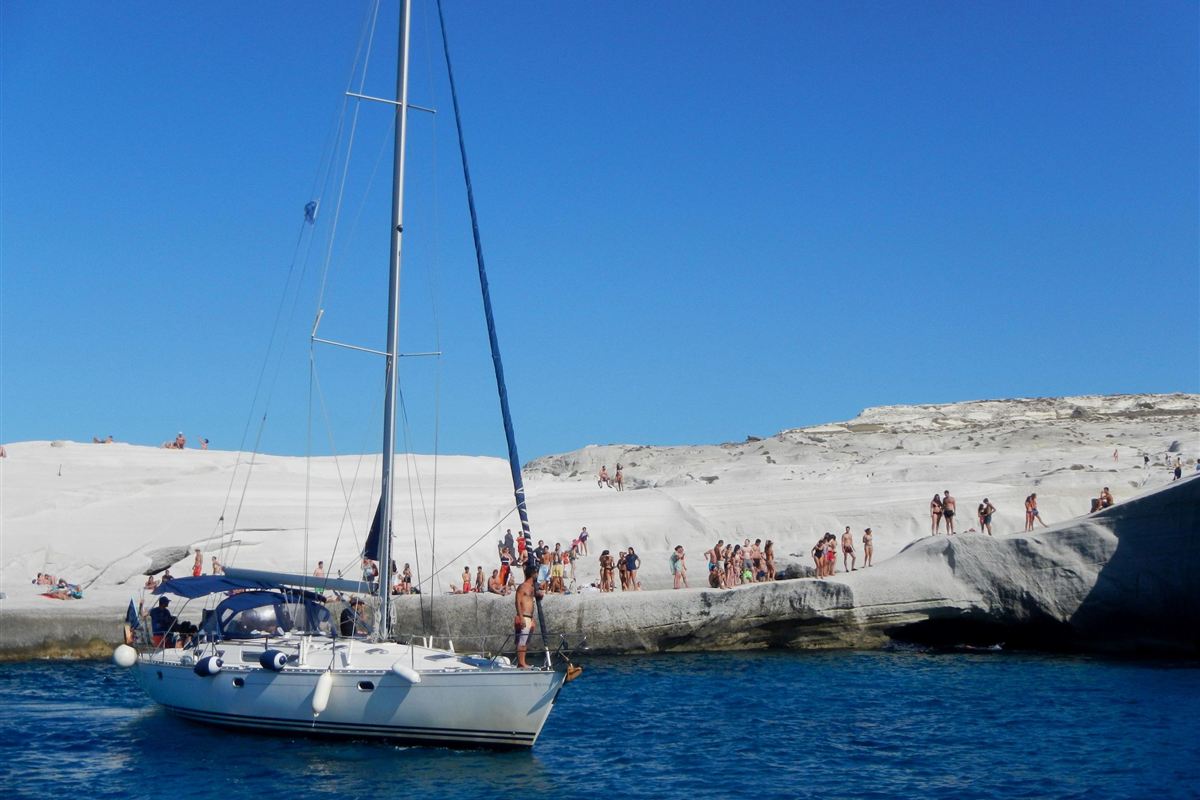
Sarakiniko is the white side of the coast. Its volcanic white rock has been shaped by wind and waves. From the water, the formations look like marble or like the surface of the moon. Among the sights of Milos sailing, this smooth white shore looks least like a normal beach.
Glaronisia is a small islet north of Milos. It shows columns of dacite lava, which formed in the late Pliocene. Great pressure shaped the rock into long, thin hexagonal columns. From a boat, the islet looks striped. On a Milos sailing trip, these columns are clear proof that lava once poured here.
Sykia is a sea cave with a collapsed roof. Black obsidian cliffs stand above white rock, and a fig tree grows over the opening. A small beach of pebbles lies inside. You reach it only by boat or by swimming, so Milos sailing is the natural way to see it.
Colour changes from cove to cove. Vani has rainbow-coloured rocks that rise sharply from the water, because the cliffs hold a rich mix of minerals. Old mining remains are still visible there. At Thiorichia beach, an old sulfur mine stands by the shore. Milos sailing brings you close enough to see each shade.
The island is rugged and hilly, and Mount Profitis Elias rises 748 metres in the west. The coastline runs about 125 kilometres and has over 70 beaches. Sands run from white to black, red, gray and gold. Polyaigos, an uninhabited island, has orange and white rocks. Milos sailing is a calm way to follow this long coast.
Obsidian from Milos was a trade good as early as 15,000 years ago. Kimolos lies 1.6 kilometres north-east of Milos and was known in antiquity for its figs and fuller’s earth. The islands share one volcanic origin, and Milos sailing lets you see them side by side.
How do shared day trips, private charters and yacht rentals differ in Milos sailing?
A shared day trip puts you on a boat with other guests and a fixed plan. A private charter gives your group the whole boat and your own plan. A yacht rental hands you a boat for the day. Milos sailing operators sell all three.
On a shared day trip, the operator sets the boat, route and timetable. Polco lists a full-day cruise on a 41-foot catamaran for a small group of up to 12 passengers. One Oneiro reviewer wrote that guests from all over the globe felt like a big family for one day. A shared trip is the simplest form of Milos sailing.
Semi-private sits between the two. Excellent Yachting lists a motor yacht cruise for up to 10 guests, with a morning or a sunset slot. Oneiro sells its Adamas, Sykia and Kleftiko cruise as both semi private and private. The boat is smaller, so the group is smaller. Excellent Yachting sells these as Milos sailing cruises.
A private charter means only your own group is on board. Polco describes its private sailing boat cruise plainly: charter the boat privately, make your own plan and avoid crowds. Excellent Yachting lists a private tour on a 43-foot sailing yacht. It runs from Adamas port to Kleftiko, with a freshly prepared meal on board.
Private tours can be half-day or full-day. Excellent Yachting lists a half-day or full-day private tour to Kleftiko or Polyaigos that leaves from Provatas Beach. Horizon Yachts also offers half-day and full-day tours, shared or private. Not every private boat leaves from Adamas, so check the departure port before you book Milos sailing.
A yacht rental is a different product in Milos sailing. Horizon Yachts lists “rent a boat” and “rent a RIB” next to its sailing tours. It says a rental suits a day of independent exploration. Excellent Yachting lists boat rentals and yacht charters among its services, with 24 hour technical support. Ask each operator what a rental includes.
Fast boats are part of this choice. Excellent Yachting lists speedboats of 8.5 to 12 metres, each with a private skipper. Horizon Yachts says a tour to Kleftiko runs on a sailing boat, a RIB or a speedboat. For true Milos sailing under canvas, pick a sailing yacht or a catamaran instead.
Read what each listing says about the boat. Oneiro states that its privately owned fleet has 2 boats: a Beneteau 400 sailing boat and a Regal speedboat. Oneiro lists a Palaiochori to Kleftiko cruise, with semi private and private options. Polco also runs multi-day charters for guests who want more than one day of Milos sailing.
Match the type to your group. Pick a shared trip to meet people and follow a set route. Pick semi-private for a small group on a motor yacht. Pick a private charter to choose your own stops and pace. Pick a rental for full control of a boat. Each type gives your Milos sailing day a different feel.
What do you bring and wear for Milos sailing?
Pack a towel, sun protection and swimwear for Milos sailing, then add a hat, sunglasses and a windproof top. Polco Sailing is an operator based on Milos. It says it takes care of everything else on board, from snorkelling gear to a fully catered lunch.
Operators agree on the basics. A Manawa listing for a full-day sailing tour asks guests to remember a swimsuit, towel, sunscreen, sunglasses and hat. Two Airbnb Experience listings for Milos sailing ask for towels, sun cream and swimwear, or sunscreen, hats and towels. Polco adds one more item to the list: a good mood.
Wear a hat that stays on your head. Wind moves fast across an open deck. One reviewer of Excellent Yachting wrote that the crew even went back for his wife’s hat when it blew off. The sea was choppy that day, and the writer says the crew handled it well. Choose a hat with a chin strap for Milos sailing.
The sea is cooler than the beach, so bring a layer. A writer on Sue Where Why What boarded a Milos boat tour in beach clothes. Then the crew came out in thermals and waterproof jackets. She sat at the front for the ride home, and the waves soaked her and her towel.
A light windproof top for Milos sailing keeps the return trip comfortable. Add a spare dry towel to your bag, and you stay warm after a full day of swimming and wind. Both items weigh very little, so they take no real space on a small boat.
Shade and seating change from boat to boat. Manawa describes a catamaran with deck seating, showers and large shaded areas with hammocks. A reviewer of Milos Oneiro praised the cushions and lightweight cover-up blankets on the sailboat.
Ask your operator what is on board before you pack for Milos sailing, because the extras differ. The same writer urges guests to note every extra, such as masks, snorkels and the bar.
Leave bulky gear at the hotel. Manawa lists snorkelling equipment and stand-up paddling equipment among the included items. Polco says snorkelling gear is available, and it films the day with a GoPro in an underwater dome.
Polco sends the photos and videos at the end of the cruise. Your phone can stay dry in your bag during the swim stops of a Milos sailing day. Manawa also lists lunch, snacks and drinks. Polco lists an open bar. You need not carry food or drinks aboard.
Think about your feet. Milos Oneiro says you reach Tsigrado beach by ropes and a wooden ladder. Sandals or water shoes that stay on in the sea suit that kind of stop on Milos sailing days. The writer on Sue Where Why What also found gravel at one beach, and it stuck in her bikini.
Keep your bag small and pack it for the ride home. Pack a towel, a hat, sun cream, a warm layer and good shoes. Then Milos sailing stays easy until the last swim.
Which season and months suit Milos sailing, and how warm is the sea?
Milos sailing suits late spring to mid-October, and the sea is warmest in August at about 25°C. From late spring to October the water stays above about 21°C, which makes swimming comfortable.
June and September are the balanced months for Milos sailing. The air sits between 27 and 29°C, the sea between 22 and 24°C, and the mornings are calm. September water is warmer than June water, because the sea lags the air by about a month. Milos in September is June with warmer water and fewer people.
Polco Sailing lists 18 to 22°C for late spring and June. It gives 23 to 26°C for July to September. For October and November it gives 19 to 22°C. At 19°C the water feels refreshing, and a rash vest helps if you snorkel. Polco Sailing adds that June to September has the longest days.
Summer air runs between 25 and 35°C, so Milos sailing means a full day of sun. Rain is essentially zero from June to September. June averages 28 to 29°C with a sea breeze. From 24°C the sea is warm enough to stay in as long as you like. June to September is the easy all-day swimming window.
July and August bring the warmest water and also the meltemi. This dry north wind blows from June to September and is strongest in July and August. Polco Sailing says it can reach 30 to 40 knots. Morning is the calm part of the day, because the wind builds from late morning and peaks in mid-afternoon.
The meltemi comes in episodes of two to five days, with calmer days between them. A strong episode can last a week in August. Wind does not end a trip by itself. One guest on the Milos Oneiro site still rated a windy day as “a great trip”. Milos sailing in a stiff breeze means a livelier ride.
A guest on the Excellent Yachting site mentions choppy seas. The same guest says the crew steered through them and nobody got sea sick. If you dislike motion, choose June or September, when the wind is lighter. Check the forecast the day before your trip. Milos sailing in those two months gives warm water without the strongest winds of midsummer.
Late spring and October are the shoulder months. Polco Sailing links both with fewer crowds, mild temperatures and good sailing conditions. The sea in late spring is still 18 to 19°C, while early October is about 22°C. Boat operators start opening in late spring and start closing around mid-October. Ask before you book Milos sailing in those weeks.
From December to April the sea is 15 to 18°C. Below about 18°C the sea is bracing, so swimming without a wetsuit is cold. February and March are the coldest, near 15°C. Milos has mild, rainy winters and warm to hot, dry summers. A Milos sailing day built around swimming and snorkelling belongs to the warm months.
Is Milos sailing fine for children, non-swimmers and older guests?
Yes. Milos sailing works for children, non-swimmers and guests with mild mobility issues. One Milos operator carries life jackets of all sizes and floating devices on every boat. Its catamarans give a steadier deck, more shade and fewer steps.
For families, Milos sailing starts with safety gear. Polco says its boats are fully equipped with life jackets of all sizes, and floating devices are provided too. The same operator says its skippers have taken a first-aid course, and each boat carries a first-aid kit. Ask the crew to show the children’s jackets before you leave the harbour.
Shade matters on a full day of Milos sailing. Polco says every yacht has bimini tops, which are tents over the rear seating area. More tents roll out from the boom and cover up to half the boat. Small groups let the crew set the shade to suit your family. Children can rest out of the sun.
A non-swimmer still has a good day on a Milos sailing trip. Polco says you can wear a life jacket or use a floating device and swim safely. Small beaches at the stops let you walk into the water. You never have to swim. Hammocks and shaded areas let you stay on board and relax.
Other crews on Milos sailing trips work the same way. A guest of Excellent Yachting wrote that the crew provide swimming aids and help you if you are tired. A travel blogger says the yacht supplied fins and floats for anyone not confident in the water. Say at booking that a member of your group cannot swim.
Shore access is the one place where Milos sailing needs a little care. Oneiro says Tsigrado beach needs ropes and a wooden ladder to reach on foot. Polco lists Tsigrado among the sites its round cruise passes for photos. Ask the skipper which stop needs a ladder and which has an easy walk-in beach.
Older guests, and anyone who finds steps hard, will find a catamaran easier for Milos sailing. Polco says catamarans do not tilt while sailing. They have larger shaded areas and fewer steps. On its Lagoon 440 catamarans, only two steps lead to the shaded rear seating area. Polco asks guests with mobility concerns to contact the team first.
One detail needs planning. Polco says the restrooms on both its catamarans and sailing boats are reached by going down steps. Catamarans are easier because their layout is wider and the steps are less steep. Ask about this before you choose a boat for a grandparent or a small child.
Rough water worries first-time guests on Milos sailing days. Polco says that in strong north winds, called the meltemi, it sails the protected south side of Milos. It shares the route a couple of days before the trip. One Excellent Yachting guest met choppy seas, yet wrote that nobody got seasick.
Paperwork needs every name. Polco says Greek authorities require a crew list before a boat sails. That list holds each passenger’s full name, nationality, ID or passport number and date of birth. Have these details ready for children as well, so Milos sailing starts without delay. Bring a hat, sunscreen and a towel.
What else do travellers ask about Milos sailing?
Where is the easiest place to stay before a Milos sailing day?
Stay in Adamas, the port town of the island. One travel blogger picks it because the busy port has a wide choice of hotels and restaurants close by. Her own hotel stood very close to the port. A local sailing operator says the name Adamas comes from the diamond.
Adamas is also the largest tourist centre on the island. It has restaurants, entertainment spots and two beaches with clear blue water. That makes it an easy base for a Milos sailing day.
How early do you book a Milos sailing trip?
Book as soon as you arrive on the island, says one travel blogger. Early booking gives you the widest choice of boats and dates.
The sellers also name the day that suits the wind. The wind changes where the boat starts and which way it heads. It also decides whether the boat circles half or all of the island. Boats for Milos sailing fill up faster at weekends, so a weekday gives you more choice.
The same blogger says the boats return to the harbour after 7 pm. That is when the sellers talk to visitors. She advises you to look around and speak to the vendors before you choose.
What are the cancellation and payment rules for Milos sailing?
The rules differ by operator. One local company charges no fee more than 72 hours (3 days) before the confirmed date. A cancellation 48 hours ahead costs half of the booking, and one 24 hours ahead costs all of it.
Payment differs too. A guest review says the captain of that company takes cash or card on the boat. Another traveller says a second company took a card number to hold the places. Read your own rules when you book your Milos sailing day.
What can you add on land around a Milos sailing day?
Sarakiniko, Plaka and Klima are easy additions. A blogger took the bus to Sarakiniko, arrived just after 11 and left at 1 pm. She found little sand and no shade there. She calls it Luna Beach, because it felt like walking on the moon.
In Plaka, she climbed to the Kastro church early to avoid the heat and the crowds. The views cover the whole island. From Plaka, Klima is a 30-minute walk downhill, with a restaurant in the centre. The way back is uphill.
How big is Milos, and is it crowded?
Milos is a small island. It measures about 23 kilometres from east to west and 13 kilometres from north to south. Its area is about 151 square kilometres, according to Wikipedia.
One blogger calls it one of the smaller, quieter Cyclades, with far fewer tourists than Santorini, Paros, Naxos or Mykonos. She counts a 125-kilometre coastline and over 70 beaches. She adds that a boat reaches beaches no other transport can. That is why Milos sailing suits the island.