A Melissani and Drogarati caves tour links a hall of stalactites and a sunlit underground lake on Kefalonia in one half day from Argostoli. Browse the tours in Greece list to fill the other days of a trip around the Ionian islands.
This page covers what the tour includes, the pickup and timing, Drogarati Cave and its sound, Melissani Lake and the rowing boat, the myths and the water, the Myrtos viewpoint, Argostoli and Sami, the tour options, the crowds and what to wear.
What does a Melissani and Drogarati caves tour include?
A Melissani and Drogarati caves tour from Argostoli is a half-day coach trip. It covers Drogarati Cave, a short rowing boat ride inside Melissani Lake and a photo stop above Myrtos Beach. Pickup and drop-off come with it.
The tour is run by Avalon Travel Services. Its listing names three items as included. The first is port or hotel pickup and drop-off. The second is transport by air-conditioned coach. The third is a short rowing boat ride inside Melissani Lake. The coach carries the group from one stop to the next all day.
The stops follow a fixed order. A Melissani and Drogarati caves tour goes to Drogarati Cave first, where the group walks through the chambers. The coach then drives on to Melissani Lake. After the two caves, the route passes a viewpoint above Myrtos Beach for photos. The coach then returns to Argostoli.
The rowing boat at Melissani is the only boat trip on the day. The listing calls it a brief crossing and says no other boat ride is part of the excursion. So the day is mostly about walking inside caves, riding the coach and looking out over the coast.
The talks along the way cover three themes. On a Melissani and Drogarati caves tour, you learn about the geology, the mythology and the natural heritage of Kefalonia. The operator also keeps the right to change the route on the day. You can cancel up to 24 hours before the start for a full refund.
Where does the pickup start, and how long is the day?
A Melissani and Drogarati caves tour offers 14 pickup points around Argostoli, including hotels and the cruise ship terminal. The tour lasts 4 hours. Pickups outside Argostoli add transfer time to that length.
The pickup list mixes hotels, shops and public spots. Hotels include White Rocks Hotel Kefalonia, Kefalonia Grand Hotel, Irinna Hotel and Princess Hotel. Electra Kefalonia Hotel & Spa, Mediterranee Hotel and Thalassa Boutique Hotel Kefalonia are on the list too. The Thalassa is listed as a hotel for adults only.
Other points are the Visitor Center, the Avalon Travel Kefalonia office and the Cruise Ship Terminal Argostoli. That last point makes a Melissani and Drogarati caves tour easy to join from a ship. Guests who arrive by sea can step off and meet the coach at the terminal.
Shops on the list serve as meeting points too. They include Minimarket Tiritompas, Dolphin Supermarket, Veronica’s Jewellery Lassi and Crazy George’s. Each pickup point is also a drop-off point, so the 14 places work both ways. Check availability on the listing to see the starting times for your chosen point.
The tour runs for 4 hours in total. Of that time, driving takes about 1 hour and 45 minutes. The rest of a Melissani and Drogarati caves tour goes on the caves, the boat and the Myrtos photo stop.
Your pickup point changes the length of your day. With a pickup outside Argostoli, the transfer to and from the start is not counted in the 4 hours. That extra travel time is added on top. Plan your evening around the full time of your Melissani and Drogarati caves tour.
What is Drogarati Cave, the chamber of stalactites?
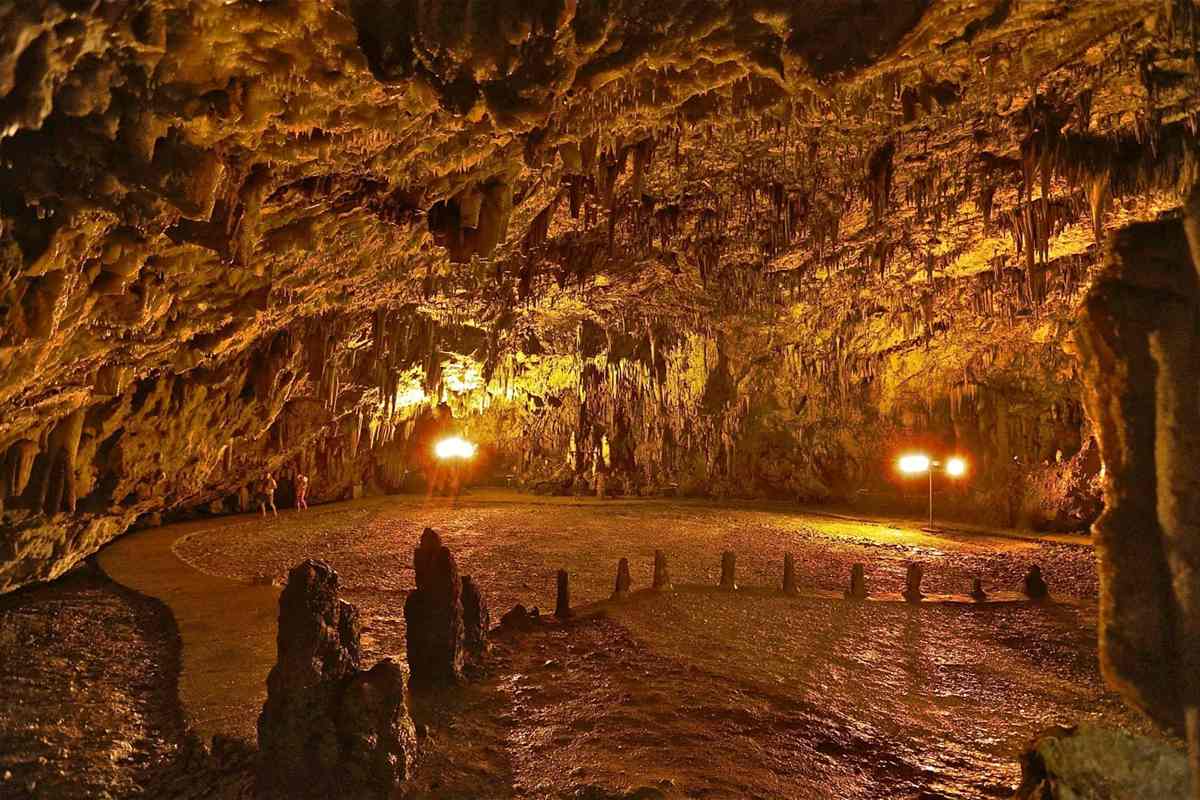
Drogarati is a cave about 3 km outside Sami, and the Melissani and Drogarati caves tour visits it. Its main chamber measures 65 by 45 metres, with a roof 20 metres high. It holds countless stalactites and stalagmites.
Wikivoyage places the cave at Haliotata, 120 metres above sea level. It lies in the same area as Melissani Lake. On a Melissani and Drogarati caves tour, an air-conditioned coach brings guests to Drogarati. They walk through its interior and hear how the cave formed.
Rainwater filters through the bedrock and drips slowly down. Lime in the water leaves deposits. Stalactites grow down from the roof, and stalagmites grow up from the floor. Minerals in the bedrock give them their colours. They grow about 1 cm in 100 years. Each spike seen on a Melissani and Drogarati caves tour shows a long stretch of time.
Speleologists say Drogarati is over 100 million years old. The steps lead down to a depth of 60 metres. Inside, the air stays at a cool 18°C, a relief in the hot summer months. That cool air greets guests on a Melissani and Drogarati caves tour when they reach the bottom.
Visitors are asked not to touch the stalactites. Skin oils stay on the rock and stop future calcification. They can also change the colours. Wikivoyage reports that the cave lost a large share of its formations. The claim blames German forces, who allegedly used them for target practice in the Second World War.
Speleologists found an extension of the cave that visitors cannot reach. It is believed to connect with other caves in the area. So the chamber you see on a Melissani and Drogarati caves tour forms only part of a larger system underground.
Why is Drogarati Cave known for its sound, and how was it found?
Drogarati has strong acoustics, so its main chamber once hosted concerts. On a Melissani and Drogarati caves tour you also hear how it was found. An earthquake about 300 years ago broke part of the cave and created an entrance.
As you enter, a natural platform sits above the main chamber. It is called the Royal Balcony. From there you look down into the large hall below, known as the Chamber of Exaltation. A Melissani and Drogarati caves tour gives you this view before you walk down among the formations.
The Chamber of Exaltation was used for concerts from time to time, because the acoustics are so strong. One local travel site invites visitors to sing anything and feel like an opera singer. Tour listings also name the acoustics as a highlight. Guests on a Melissani and Drogarati caves tour can test the sound for themselves.
The last event came when the cruise ship MS Deutschland docked at Argostoli port. The Bavarian Philharmonic Orchestra was on board. The musicians held a concert inside the cave, and the same site calls it unforgettable. Guests on a Melissani and Drogarati caves tour now stand in the same hall where that orchestra played.
The cave was discovered only about 300 years ago. An earthquake destroyed part of it and opened an entrance. Later, the speleologist Yiannis Petrochilos and his wife Anna explored it. They went in with ropes and ladders. The same speleologist also explored Melissani cave.
Drogarati has been open to the public since nineteen sixty-three. The ropes are gone, and descending steps now lead visitors down. Wikivoyage calls it one of the finest caves in Greece. That standing explains why a Melissani and Drogarati caves tour gives it a full stop on the route.
What is Melissani Lake, the cave with an open roof?
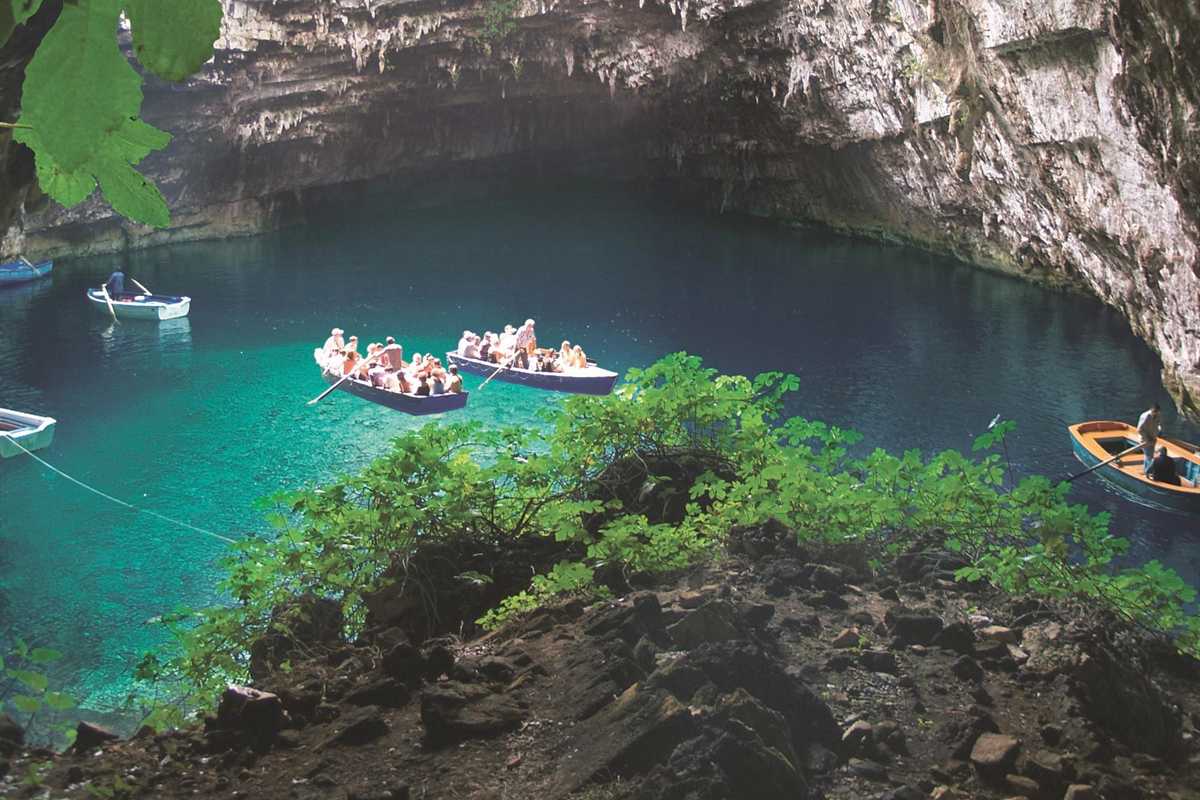
Melissani Lake is a cave and cenote northwest of Sami on Kefalonia. On a Melissani and Drogarati caves tour, you see sunlight stream through its open roof. The light lands on an underground lake about 40 metres deep.
The cave lies at Karavomylos, 2 kilometres from Sami town. It sits about 5 kilometres southeast of Agia Efimia. It formed when limestone bedrock collapsed and exposed groundwater. That collapse made a sinkhole, now open to the sky. Wikipedia calls it a typical feature of a karst landscape on a coastal limestone aquifer.
The cave is 160 metres long and 40 metres wide. A Melissani and Drogarati caves tour shows you two parts. The first chamber lies under the collapsed roof, where direct sunlight turns the water a vivid turquoise. The second section is enclosed and darker, with old stalactites reaching down toward the water.
Those stalactites are 16,000 to 20,000 years old. A small island sits in the centre of the lake. The lake bottom is covered with stones, and plants grow at the opening of the cave. The stone near the opening ranges from stucco to a honey-like brown.
Forests surround the site, and a mountain slope rises to the west. One visitor site says the light is at its strongest around midday. Wikipedia notes a popular saying that the water is so clear the boats seem to float on air. That clear water is the reason a Melissani and Drogarati caves tour stops here.
How does the rowing boat ride inside Melissani Lake work?
On a Melissani and Drogarati caves tour, you board a small traditional rowing boat on the lake. A vertical shaft gives access to the water table. The boat is shared with other visitors, and the ride lasts about 10 to 15 minutes.
A local boatman rows the boat across the water. As he rows, he tells the mythology and history of the cave. On the half-day Melissani and Drogarati caves tour from Argostoli, this crossing is the only boat ride of the day. The rest of the route runs by coach.
The ride makes a round trip on the water. The boat passes from the sunlit chamber under the open roof into the darker, enclosed section. One tour page describes the rhythmic echo of the oars inside the cave. The rock walls carry the sound across the still lake.
Space in the wooden boats is limited, so large bags are discouraged. Children are welcome, but they must stay seated during the ride. Food and drinks are not allowed inside the cave. Plan around these rules before a Melissani and Drogarati caves tour, and leave bulky items on the coach.
Photography is allowed in the cave. One visitor site suggests a polarising filter to cut the glare on the water. The ride is short, so keep the camera ready from the start. A Melissani and Drogarati caves tour gives you only a brief spell on the lake.
What myths are told about Melissani, from the nymphs to Pan?
On a Melissani and Drogarati caves tour, you visit a place tied to old myths. In Greek mythology, Melissani was the Cave of the Nymphs. Finds from the cave are linked to the god Pan and the nymph Melissanthi.
The cave carries the name of a nymph. Archaeologists found objects dedicated to Pan and to the nymph Melissanthi inside it. The lake you cross on a Melissani and Drogarati caves tour was once a holy place. People came here to honour gods, not only to look at the water.
The finds date from the 4th and 3rd centuries BC. They relate to the cult of the god Pan. Archaeologists also found a number of female figures. These figures are known as the nymphs of Melissani. Together they show that the cave was a place of worship in ancient times.
A small island sits in the centre of the lake. In ancient times it served as a ritual site. Look for it from the water during your Melissani and Drogarati caves tour. The lake bottom around it is covered with stones, so the island stands out clearly.
The cave was rediscovered in modern times. Excavations at Melissani took place under the archaeologist Spyridon Marinatos. Today his finds are in the Archaeological Museum of Argostoli. A visit there adds the objects themselves to the story of the cave and its nymphs.
Where does the water of Melissani come from?
The water you see on a Melissani and Drogarati caves tour starts as sea water near Argostoli. It sinks underground, travels under the island and passes through Melissani. It comes out again around fourteen days later near Sami.
The journey begins at the Katavothres swallow holes. They lie in the Vlikha area, facing Lixouri, on the coast road west of Argostoli. In the Venetian period, people called this road the Piccolo Gyro. Here sea water disappears into sinkholes in the ground.
The power of this sea water once turned a water mill. A Katavothres waterwheel still stands on the Fanari Road, a coastal route north of Argostoli. A Melissani and Drogarati caves tour does not stop there. Visit it on a free day to see where the water enters the island.
From there the water flows under the island to the east. It passes through the underground lake at Melissani on the way. A Melissani and Drogarati caves tour shows you this hidden water at the one point where daylight reaches it. The water then re-emerges in the Karavomylos area of Sami.
The lake does not hold pure sea water. Its water is brackish, a mix of fresh water from inland and sea water from deep inside the island. Cave divers have explored huge channels in the rock below. The bay of Sami also holds other cenotes, with impressive shafts.
The water ends its trip in the bay of Sami. The groundwater of Melissani flows out at Fridi beach. Along the shore it forms brackish springs, both on the coast and under the sea. Keep this route in mind as you float across the lake on a Melissani and Drogarati caves tour.


What is the Myrtos Beach viewpoint on the way back?
The Myrtos Beach viewpoint is the photo stop on the drive back. After the caves, a Melissani and Drogarati caves tour pauses above the bay. Guests look down at white cliffs and the deep blue Ionian Sea.
The stop comes after both caves. The coach follows a scenic drive and halts at a spot that overlooks the beach. From there, the coach returns to Argostoli, where the day began. The viewpoint is the last stop before the ride home.
The view is all about contrast. White cliffs drop down to the shore, and the sea below shines deep blue. A Melissani and Drogarati caves tour gives you time for photos here. It is a viewpoint stop, not a swim stop, so you stay up on the road.
The beach itself is made of bright white pebbles. One tour page describes water that shifts through shades of turquoise and deep blue. Towering cliffs and green hills frame the bay on both sides. That frame gives the view its shape from above.
Want to swim at Myrtos on another day? Argostoli has a frequent summer bus service that lists Myrtos among its stops. The photo stop on a Melissani and Drogarati caves tour can lead to a beach day. Plan it for later in your holiday.
What are Argostoli and Sami, the two towns on the route?
Argostoli is the capital of Kefalonia, on a sheltered bay in the west. Sami is a port town on the central east coast. A Melissani and Drogarati caves tour starts in Argostoli and crosses the island toward Sami.
Argostoli has been the capital and centre of Kefalonia since seventeen fifty-seven. People moved there for the trade that its sheltered bay made possible. The town grew into one of the busiest ports in Greece. Every Melissani and Drogarati caves tour on this route sets off from this town.
At the east end of the Argostoli bay lies the Koutavos Lagoon. It is now a nature reserve and a feeding ground for loggerhead turtles. Long ago it was a swamp full of mosquitoes. Today it is a quiet sight close to the town centre.
Argostoli is also a ferry town. A small ferry crosses the bay to Lixouri, the second city of the island. It runs once an hour in winter and twice an hour in summer. That gives you an easy half-day trip on a free afternoon.
The earthquake of nineteen fifty-three levelled the towns of Kefalonia, apart from Fiskardo. Both towns on a Melissani and Drogarati caves tour were rebuilt after it. The buildings you see there are largely plain concrete. That is why their streets look newer than the long history of the island suggests.
Sami faces the island of Ithaka across the water. The ferry from Patra on the mainland arrives in its port. The Melissani Cave lies west of the town. In ancient times Sami was Same, one of four city-states on the island, and Argostoli was Cranii.
Film fans know Sami from Captain Corelli’s Mandolin. Its harbour front was turned into a set for that film. A Melissani and Drogarati caves tour visits this eastern side of the island. Then the coach turns back west toward Argostoli.
How does the coach tour compare with a shore excursion or a visit on your own?
A Melissani and Drogarati caves tour by coach leaves from Argostoli as a half-day trip. The shore excursion lasts 4.5 hours and starts at the cruise ship pier. On your own, you need a car or bike.
The shore excursion suits cruise guests. It offers pickup and drop-off at the cruise ship pier terminal. Its listing names entrance fees at the caves as included. A live host speaks English, Arabic or Italian, but only on the shared group option. Private options run without that escort.
This Melissani and Drogarati caves tour for cruise guests also lists seven drop-off places. They include Lassi, Svoronata, Lourdata, Vlachata, Leivathos and Argostoli. So guests can end the day at a resort instead of the ship. The listing says the trip does not suit people with mobility impairments.
A visit on your own takes more planning. Wikivoyage says you need a car or bike to get around the island. It calls the KTEL bus routes too infrequent to be of much use to tourists. Wikipedia also lists only an infrequent bus from Argostoli to Sami.
Drivers find Drogarati with a road sign. Coming from Argostoli, the sign stands on the left just before Sami. A short side road leads to the car park. Tickets are sold at the entrance. A self-drive day replaces a Melissani and Drogarati caves tour, but you plan every stop yourself.
When are the caves busiest, and what do you wear?
The caves are busiest in July and August, above all on days when multiple cruise ships reach Argostoli. On a Melissani and Drogarati caves tour, wear comfortable walking shoes, because both caves have steps and uneven surfaces.
Queues grow long at the entrances on those peak days. The coach operator says this happens even with careful planning. The site authorities manage the flow of visitors, not the tour leader. Expect waiting time on a Melissani and Drogarati caves tour in high summer. Plan the rest of your day with room to spare.
Wikivoyage says Melissani opens every day from 09:00 to late afternoon. A visit on your own outside the cruise rush gives more freedom with timing. Before you book a Melissani and Drogarati caves tour, ask about starting times. The listings show them only when you check availability.
Shoes matter above all. The shore excursion counts about 130 steps down to Drogarati Cave. At Melissani, the descent takes 50 steps, so that site does not suit wheelchair users. Choose closed walking shoes with grip for any Melissani and Drogarati caves tour, and leave sandals for the beach.
Pack a light layer as well. Drogarati keeps a constant temperature of 18 °C, according to Wikivoyage. That feels cool after a hot coach ride. Keep bags small, because space in the wooden boats at Melissani is limited. Food and drinks are not allowed inside the cave.
Bring a camera, since photography is permitted. A polarizing filter cuts the glare on the water at Melissani. Leave pets at your hotel, because only service animals with proper papers are allowed inside. Pack light and simple for a Melissani and Drogarati caves tour.
What else do travellers ask about a Melissani and Drogarati caves tour?
How large is Kefalonia, the island of the tour?
Kefalonia is the largest of the Ionian Islands, in western Greece. It covers 773 square kilometres. It is also the sixth-largest island in Greece, after Crete, Euboea, Lesbos, Rhodes and Chios. A Melissani and Drogarati caves tour shows only one part of this large island.
The island has four peninsulas and a range of high mountains. A recent census recorded 36,064 people.
Which language do people speak on the island?
English is understood almost everywhere on Kefalonia. Wikivoyage says only senior citizens stick to their native language. Italian is widely recognised too, because the island has strong historical links with Italy.
A greeting in Greek brings a warm reply anywhere on the island. That small effort adds a friendly touch to a Melissani and Drogarati caves tour. A sizeable share of the summer population lives abroad in the winter months.
How do travellers fly in before the tour?
The main airport lies near Argostoli. Wikivoyage calls it a typical small island airport. The main travel days are Tuesday and Sunday, and both days get very crowded.
A small cafe bar and a gift shop sit before and after security. Plan a Melissani and Drogarati caves tour away from your arrival day for a calmer start.
What is the Castle of Saint George, and what other sites stand nearby?
The Castle of Saint George once held the capital of Kefalonia. The capital moved there because the site in the interior was well protected. From the 8th century, the island was the centre of a Byzantine province, the theme of Cephallenia.
The castle stands at Perata and offers panoramic views. A Roman villa just outside Skala keeps its mosaic floors more or less intact. Both suit a free day after a Melissani and Drogarati caves tour.
Where does the name Kefalonia come from?
The name is said to come from Cephalus, a hero of Greek legend and the son of Hermes. Writers have suggested the island was the Homeric Ithaca, home of Odysseus. One theory says Paliki, now a peninsula, was a separate island in the late Bronze Age.
In ancient times, four city-states ruled the island: Pale, Cranii, Same and Pronnoi. All four minted their own coins. These stories give a Melissani and Drogarati caves tour a wider backdrop.