
A Vergina and Pella day trip takes you west from Thessaloniki to the two old capitals of Macedon, where the royal tombs and the pebble mosaics lie a short drive apart. Pair it with other tours in Greece if you have more days in the north.
This page covers what the day trip includes, the hour-by-hour run, the distance and ways to travel, the Royal Tombs museum, the tomb of Philip II, Aigai, the museum rules, ancient Pella and its museum, the link to Alexander the Great, the mosaics, the season and what to bring on a Vergina and Pella day trip.
What does a Vergina and Pella day trip include?
A Vergina and Pella day trip visits Pella, then the Royal Tombs Museum and New Museum of Aigai. Round-trip coach travel and an English-speaking archaeologist come with the tour. Lunch is a stop, but you pay for it separately.
A Vergina and Pella day trip has four stops in two places. Pella has the archaeological site and its museum. Vergina, a UNESCO World Heritage site, has the Royal Tombs Museum and the New Museum of Aigai. The operator frames the day as a trip into the Macedonian kingdom of Alexander the Great and Philip II.
The operator’s own page for the tour lists four inclusions.
- Round-trip transportation to Pella and Vergina
- An English-speaking trip attendant who is an archaeologist
- Basic travel insurance during transportation
- Assistance with the ticket issuance process
A second listing adds skip-the-line assistance at the sites and names a modern air-conditioned bus. It also lists a tour leader at the Pella site and museum and at the Museum of Vergina.
A travel blogger says the Vergina and Pella day trip generally has no guided visit inside the museum. Even so, the tour leader came in with the group that day. Ask the operator before you book if guiding inside the museums matters to you.
Tickets are where the sources differ. The operator’s page lists the entrance fees for the Vergina museum and the Pella site and museum as not included. One booking listing names the same fees as included, yet also asks you to bring cash for the tickets. Confirm the terms on the listing you book.
Lunch is at a traditional Greek restaurant in the area, and the operator lists it as not included. A standard group is up to 49 people. The Vergina and Pella day trip is a full day by bus.
How does a Vergina and Pella day trip from Thessaloniki run, hour by hour?
A Vergina and Pella day trip from Thessaloniki leaves at 08:00 and lasts about 8 hours 30 minutes. It drives to Pella first, then on to Vergina, with a lunch stop and a return drive.
The operator’s itinerary gives the length of each stage.
- 08:00: meet at Aristotelous Square and Egnatia Street, at the white statue of Venizelos. Arrive at least 10 minutes before departure.
- 45 minutes: drive to Pella.
- 1.5 hours: Pella archaeological site and museum.
- 1 hour: drive to Vergina.
- 2 hours: Museum of the Royal Tombs and New Museum of Aigai.
- 1 hour: lunch break.
- 1 hour: return to Thessaloniki.
A second listing splits the time differently. It allows one hour at the Pella museum, one at the Pella site, and 1.5 hours at the Royal Tombs. Another description places lunch before the New Museum of Aigai, not after the museums. The tour ends where it began, at the Eleftherios Venizelos statue.
One traveller expected the Vergina and Pella day trip to feel rushed, then found the timing right. That traveller still wanted more time at Pella.
Reviewers call the pace good and praise the punctual start. The operator also asks you to be punctual at every meeting time. One listing says the tour must be booked by 07:30 on the visit date.
How far are Vergina and Pella from Thessaloniki, and how do you travel there?
Pella is 50 km from Thessaloniki, about 45 minutes by road, and Vergina is another hour beyond it. A bus on a Vergina and Pella day trip links both sites in one loop.
On the operator’s Vergina and Pella day trip, the itinerary lists three drives. The first takes 45 minutes to Pella. The second takes one hour from Pella to Vergina, and the third takes one hour back to Thessaloniki. Together they add up to 2 hours 45 minutes on the road.
Driving yourself works well. One travel site puts the Vergina museum about 80 km west of Thessaloniki, a drive of 1 hour 10 minutes. Another page gives 70 km and about one hour on the motorway.
Pella sits on the Thessaloniki to Edessa road, about 40 km out by the first site’s count. Sources differ on the kilometres, so use the drive times for planning.
You can drive the loop in either order. One site suggests reaching Vergina by 10:00 and stopping at the Pella museum on the drive back east. That order suits a self-drive Vergina and Pella day trip, because Pella lies on the road home.
Without a car, a public route exists, but it reaches Vergina only. A travel site describes a KTEL bus to Veria, then a local bus or taxi to the Royal Tombs. It gives 1.5 to 2 hours for the journey and warns that return service is limited, especially off-season.


Which versions run, from coach tours to private drivers?
Two organised versions run from Thessaloniki. One is a group bus tour with an archaeologist. The other is a private car or minivan with a driver. Both cover a Vergina and Pella day trip in one day.
The bus tour for the Vergina and Pella day trip runs on a modern air-conditioned bus. The tour includes an English-speaking trip attendant who is an archaeologist. The booking page lists a standard group of up to 49 people. One traveller’s group of about 15 rode in a van instead, so the vehicle changes with the day.
The private Vergina and Pella day trip suits small groups. One Thessaloniki taxi firm offers a car for 1 to 4 passengers or a minivan for 5 to 8. Its tour adds Edessa, a town popular for its waterfalls, and takes 10 hours in total. That is 6 hours of travel plus 4 hours of waiting time.
The driver collects you at your hotel, and pick-up times are flexible. A tour leader can be added on request.
Half-day tours that cover Vergina alone also exist. One travel site says they include transport, a tour leader, and sometimes a stop at Veria. These suit travellers who want the tombs without the Pella leg.
A chauffeur firm describes a four-hour half-day excursion to Pella only. It offers a car for up to 4 passengers or a minivan for up to 8. Check that a private offer lists both sites before you book a Vergina and Pella day trip.
The choice comes down to timetable and freedom. The bus tour keeps a fixed meeting point and start time. A driver adapts to your hotel and your pace. Either way, the Vergina and Pella day trip fits comfortably inside one day.
What is inside the Royal Tombs museum at Vergina?
The Royal Tombs museum at Vergina is an underground hall under a man-made burial mound. It holds the royal tombs of Aigai where they were found. A Vergina and Pella day trip reaches the gold wreath, the royal armour and the tomb paintings here.
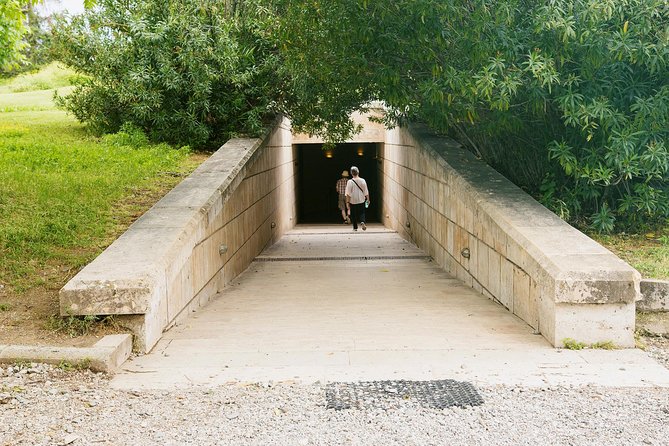
On a Vergina and Pella day trip you enter through a dark passage and leave the daylight behind. Inside, an open circular space lights the finds. The museum was built over the tombs, so they remain where they were found. UNESCO calls the tomb interiors entirely authentic, but the mound above is a modern copy.
The gold larnax is the centrepiece. This chest for cremated bones weighs 11 kilograms, and its lid carries the sixteen-rayed Sun of Vergina. A gold wreath of 313 oak leaves and 68 acorns is on show as well. One operator lists the larnax and the royal armour as highlights of its Vergina and Pella day trip.
The cases around the larnax hold gold-adorned armour, weapons, silver feast vessels and a carved burial bed with ivory. The front room of the same tomb holds a second larnax. It has a woman’s bones and a gold diadem, which points to a queen. A second bed, partly burned, holds a gold wreath of myrtle leaves and flowers.
A Vergina and Pella day trip also passes a 5.6-metre painted hunt above the entrance to Tomb II. Another tomb has a wall painting of Hades carrying off Persephone. A third holds a silver urn with the bones of a young prince. Four tombs and a small temple, the heroon, stand inside the hall.

Whose tomb was found at Vergina, and why does it matter?
Manolis Andronikos named Tomb II at Vergina as the tomb of Philip II, the father of Alexander the Great. Scholars disagree on the owner, yet a Vergina and Pella day trip reaches two royal tombs found untouched.
The tombs on a Vergina and Pella day trip were found in the late twentieth century. Andronikos believed a hill called the Great Tumulus hid royal tombs. In a six-week dig he found four buried tombs, two never disturbed. He named Tomb II as Philip’s and Tomb III as Alexander IV’s. Alexander IV was the son of Alexander the Great.
His case rests on the bones and the armour. One bronze greave fits a leg with a misaligned tibia, and records say Philip II broke his tibia. The skull shows damage to the right eye, matching a recorded arrow wound. Later studies of the cremated remains pointed to Philip II and his Thracian wife Meda in Tomb II.
Not everyone agrees. Two scientists argued that Philip lay in Tomb I, citing a stiff knee and a hole matching his wound. They gave Tomb II to King Arrhidaeus and his wife Eurydice. The Greek Ministry of Culture called this baseless. It said the stiff knee belonged to another body put into Tomb I after looters had been there.
The tombs on this Vergina and Pella day trip matter for what they kept. Gallic mercenaries plundered tombs at Aigai in the third century BC. Tomb I was robbed, but Tombs II and III were intact. UNESCO notes their discovery showed the intact front of an ancient Greek building for the first time.
What else is there to see at Aigai beyond the tombs?
Aigai holds more than the tombs that a Vergina and Pella day trip reaches. UNESCO lists a monumental palace, a theatre, two sanctuaries, city walls and a royal necropolis. One Polycentric Museum of Aigai ticket covers the palace, the theatre and the necropolis.
UNESCO dates the palace to about 340 BC and calls it the biggest building of classical Greece. It centres on a large open courtyard with Doric colonnades. Nearly 30 large columns of the main peristyle have been reconstructed. Its floors carry mosaics, among them the abduction of Europa. The palace reopened to visitors after a 16-year restoration.
The palace lies 750 metres from the Royal Tombs museum, a short walk on a Vergina and Pella day trip. The theatre stands beside it and dates from the fourth century BC. Its seats followed a natural slope. They were mainly earth, with only the front row in stone. An altar to Dionysus stood in the middle of the orchestra.
The tombs on a Vergina and Pella day trip are only one part of the royal necropolis. UNESCO counts more than 500 burial mounds there, dating from the eleventh to the second century BC. Three royal burial clusters have been excavated. Visitors can enter the Royal Burial Cluster of the Temenids, which has a dozen tombs.
The Central Museum Building is the gateway to the Polycentric Museum and the archaeological site. Its panels group finds by theme, such as funerary customs, adornments and weapons. Sculpture from the sanctuaries stands in a semi-outdoor hall. A glass-roofed atrium holds a 30-metre reconstruction of part of the palace facade.
What rules apply inside the Vergina museum?
The Greek tourism website asks visitors to Aigai not to touch the remains and to stay on the marked paths. It asks them to respect any no-flash sign. Smoking is prohibited. The same rules apply on a Vergina and Pella day trip.
Travellers on a Vergina and Pella day trip meet conflicting advice on photos. One travel blog says photos are allowed without flash, but tripods are not. Another travel site says photography is not allowed inside the tombs. One ticket listing adds that special restrictions can be imposed. Ask the staff at the entrance before you raise a camera.
Pets are not allowed at cultural sites, apart from assistance dogs. The approach road to the palace and the theatre is pedestrian only. Self-drivers on a Vergina and Pella day trip leave their vehicles in the Vergina municipal parking lot and walk. Last admission is 20 minutes before closing time.
The official Aigai site sells tickets online. The Hellenic Heritage help page mentions changing a selected time slot. One e-ticket listing says you enter at your selected time. Check your ticket for an entry time. The tour operator lists help with the ticket issuance process on its Vergina and Pella day trip.
Access is listed too. The Ministry of Culture museum pages list a ramp and an accessible toilet at the Central Museum Building. They list the same at the Royal Tombs museum. One ticket listing calls the tombs museum wheelchair accessible, except the Heroon area. Ask about this before you book a Vergina and Pella day trip.
What do you see at ancient Pella?
A Vergina and Pella day trip takes you through the open-air remains of the Macedonian capital. You see a street grid, part of the agora and four named houses. Only a small part of the site is open, and the site covers about four square kilometres.
Pella was planned on a grid. Parallel streets cross at right angles and form eight rows of rectangular blocks. The agora, the central square, took up ten of those blocks, about seven hectares. Shaded colonnades surrounded it. Pella was also one of the first known cities with piped water running to individual houses.
Four houses are open to visitors, all north of the Thessaloniki-Giannitsa road.
- House of Dionysus
- House of Helen’s Rapture
- House of Poseidon
- House of the Wall Plaster
These rich houses had colonnaded courts and rooms with mosaic floors. A Vergina and Pella day trip lets you walk through these rooms and see a rich Macedonian home.
Pella was once a port. A navigable inlet joined it to the Thermaic Gulf. The harbour and the gulf have since silted up. A Vergina and Pella day trip now reaches a site that lies inland.
The palace stood on a hill about 70 metres high, north of the city. Sources differ on it today. The ministry’s venue page lists the palace as not accessible. Wikipedia and a news report on its restoration say it has opened. Ask the tour leader which areas are open on your Vergina and Pella day trip.
What is on show in the Pella Archaeological Museum?
The museum on a Vergina and Pella day trip groups its finds in five parts. They cover daily life, public life, sanctuaries, cemeteries and the palace. A head considered a portrait of Alexander the Great greets you at the entrance.
The architect Kostas Skroumpellos designed the building. It stands on the site of the ancient city, a short walk from the ruins. A Vergina and Pella day trip therefore covers both in one stop. Its rectangular atrium echoes the central courtyard of an ancient Pella house.
An information section holds texts, photographs, maps, drawings, a model of the site and a short video. At the entrance you also find a statuette with the attributes of the god Pan.
The first group shows daily life. Mosaic floors from the Houses of Dionysus and the Abduction of Helen lead the display. Restored furniture, models and cloths sit beside jars, kettles, jugs and boxes for cosmetics and jewellery.
The second group covers public life. Coins, inscriptions and sculpture come from the agora. Vases for carrying wine, terracotta figurines and pottery equipment show how the city traded and made goods.
The third group holds mosaics from the sanctuaries of Darron, the Mother of the Gods and Aphrodite, and the Thesmophorion. The fourth group covers the cemeteries, with burials from the Bronze Age to the Hellenistic period. On a Vergina and Pella day trip, these finds tell you about the Doric Greek spoken here and funeral customs.
The last group is the palace gallery. It explains the palace design and the life of Alexander the Great. That suits a Vergina and Pella day trip that follows the Macedonian kings. Two Hellenistic statues, a female figure and a Silenus, are also on show.
How are Vergina and Pella linked to Alexander the Great?
Alexander the Great was born in Pella, the capital of Macedon, and was proclaimed king at Aigai, now called Vergina. A Vergina and Pella day trip visits his birthplace and the city where his reign began, all in one day.
Pella was the capital of the ancient kingdom of Macedon from the fourth century BC until the Roman conquest. King Archelaus I moved the capital there from Aigai. Philip II was born in Pella, and so was his son Alexander. The Vergina and Pella day trip begins in this city.
Aigai was the first capital of Macedon. It stayed the sacred city of the kingdom after the capital moved. The cult centres, a royal palace and the royal tombs were there. Vergina is the modern name of the place, and UNESCO lists it as a World Heritage Site. The Vergina and Pella day trip makes Aigai its second stop.
Philip II was killed in the theatre at Aigai while he attended the wedding of his daughter Cleopatra. The nobles and the army proclaimed Alexander king on the spot, at the age of twenty. So a Vergina and Pella day trip covers both his birth and his rise to the throne.
The resting place of Alexander himself is unknown. The tour is billed as a trip into the Macedonian kingdom of Alexander the Great and Philip II. At Vergina it visits the Royal Tombs Museum of Aigai, the resting place of his father.
Which mosaics is Pella known for?
Pella is known for its pebble mosaics, floors made of beach and river stones in the houses of the wealthy. The Stag Hunt carries the signature of Gnosis. Look for it and the Lion Hunt on a Vergina and Pella day trip.
The mosaics on a Vergina and Pella day trip are made of pebbles set into cement. Light figures stand out against a darker background. Shading, called skiagraphia by the Greeks, and overlapping figures give depth. Certain floors reproduce Greek paintings. Two rich houses are named after their pictures: Dionysus and the Abduction of Helen.
The Stag Hunt dates from the late fourth century BC and comes from the House of the Abduction of Helen. It carries the words “Gnosis epoesen”, meaning Gnosis created it. This is the first known signature of a mosaic maker. The Archaeological Museum of Pella holds the floor, and the Vergina and Pella day trip includes that museum.
The hunter on the left of the Stag Hunt swings a double-headed axe. One reading names the hunter on the right as Alexander, because of the date and the upswept hair. Pella is also his birthplace.
The Lion Hunt comes from the House of Dionysus and dates from the late fourth century BC. Two huntsmen stand on either side of a lion, ready to kill it. The bodies are white, and grey stones suggest their shape. One reading links the floor to the Granicus River, where the general Craterus saved Alexander from a lion.
The same house gave the floor of the god Dionysus seated on a panther. His raised arm holds the thyrsus, a staff twined with ivy. The description of the Vergina and Pella day trip also names the Abduction of Helen and Amazon battle mosaics.
Which season suits a Vergina and Pella day trip, and what do you bring?
Late spring and early autumn suit a Vergina and Pella day trip. In Thessaloniki, average daily highs reach 25°C in late spring and 28°C in September. July and August reach 32°C, and January only 11°C.
Vergina lies 12 km south-east of Veria, so the Veria figures count as well. Veria’s average daily highs are 25.1°C in late spring and 27.8°C in September. October cools to 21.6°C, but Veria’s rain climbs from 16.1 mm in September to 55.7 mm. Veria also records 234.9 hours of sunshine in late spring and 224.9 hours in September.
Rain affects a Vergina and Pella day trip unevenly. Pella is an open-air site, while the Vergina museum sits in a climate-controlled chamber under a mound. A travel blog visited Pella in early April under light rain and met no other visitors.
At the Thessaloniki station, late spring brings 51.0 mm of rain, the highest total from April to October. One reviewer of the tour wrote that the group finished the programme despite the weather.
Summer is hot for a Vergina and Pella day trip. Thessaloniki’s summers are moderately dry, with 32 days a year above 32°C. The station’s record high is 43.3°C. Veria is drier in July and August, with 14.1 mm and 16.2 mm of rain. It also records 309.6 hours of sunshine in July.
Winter days on a Vergina and Pella day trip are cold and wet. Thessaloniki’s average daily highs are 10.6°C in January and 11.8°C in December, and morning frost is common. Veria’s average January night is 0.6°C. Its rain peaks in December at 69.1 mm, over 9.2 days, with only 109.1 hours of sunshine.
Opening hours change with the season, and they shape a Vergina and Pella day trip. Hellenic Heritage lists Pella’s archaeological site as open 08:00 to 20:00 from April 1 to August 31. Tuesday starts at 12:00. Closing then falls by 30 minutes every half month, reaching 18:00 in the second half of October.
The Aigai page at aigai.gr lists the same Tuesday start and the same September and October steps. It names the reason: the gradual reduction in daylight. A transfer operator’s page lists the same hours. It puts summer from April 1 to October 31 and winter from November 1 to March 31.
From November 1 to March 31, Pella’s site and museum open from 08:30 to 15:30 and close on Tuesday. The Aigai page lists winter hours of 09:00 to 17:00, also with Tuesday closed. Last admission at Pella is 20 minutes before closing.
Pella also closes on public holidays, including January 1, Easter Sunday and December 25 and 26. A travel blog lists 08:00 to 15:30 in winter for Vergina, so check the official page before you go.
For a Vergina and Pella day trip, the tour operator and its booking pages ask you to bring:
- Comfortable shoes.
- Sunglasses, sunscreen and a hat in summer.
- Cash for the entry tickets.
- Your ID or passport.
Check the weekday as well as the month before you book a Vergina and Pella day trip. In summer, Tuesday opens at noon. In winter, Tuesday is closed.
What else do travellers ask about a Vergina and Pella day trip?
Is there much walking on a Vergina and Pella day trip?
The walking on a Vergina and Pella day trip is light. One travel site calls the Pella site flat and at ground level. At Pella the museum and the open site are two parts of the visit, so you walk between them. At Vergina you enter a mound and descend into a dim underground chamber.
The Vergina palace ruins sit apart from the museum, a 10-minute walk away. The two open-air areas add 30 minutes to a visit. The operator asks for comfortable shoes. No tour page states step-free access, so ask before booking if anyone needs it.
Where can you eat lunch on a Vergina and Pella day trip?
On the group tour, lunch is a one-hour stop at Vergina. One reviewer praised the meal. Driving yourself, plan lunch there too. Pella has only a small café at its museum and no restaurants close by.
Veria is about 20 km from Vergina. It is an old Ottoman-era town with a Jewish quarter and tavernas around its main square. It works as a lunch stop. The private run that adds Edessa ends with a traditional Greek lunch in the Edessa villages.
Is a Vergina and Pella day trip right for children?
It suits older children better. One travel site rates the Vergina museum as interesting for children above about nine. It says the low light and the gold larnax hold their attention, while younger children get bored.
A private Vergina and Pella day trip suits families better. Pick-up times are flexible and the plan is yours to set. One taxi firm supplies baby seats and boosters, and asks you to contact it first. A chauffeur firm’s booking form has separate fields for children and infants.
Can you add Edessa or Dion to a Vergina and Pella day trip?
Edessa fits on a private run, not on the group bus. The group itinerary lists only Pella and Vergina. A Thessaloniki taxi firm sells a Vergina, Pella and Edessa day that adds the Edessa waterfalls, plus Varosi and Kioupri. You need no overnight stay, since one travel site calls the drive short enough for a day trip.
One travel site places Edessa to the west and calls it an extra half-day for the waterfalls. For Dion, a chauffeur page titled Pella, Vergina and Dion lists a route of 12 hours and 400 km. Its text, though, describes only Pella. Ask for the stop list before you book.
What do you check before booking a Vergina and Pella day trip?
Check the closing days first. One travel site lists the Vergina museum as closed on 1 January, 25 March and Easter Sunday. It also lists 25 and 26 December and Labour Day in spring. Confirm that both sites are open on your date.
Then read the booking terms. One listing offers free cancellation up to 24 hours ahead and lets you reserve now and pay later. It shows starting times only after you check availability. It gives the start as Egnatia 78 in Thessaloniki, while the operator names Aristotelous Square. Bring your ID or passport to qualify for reduced entry.