
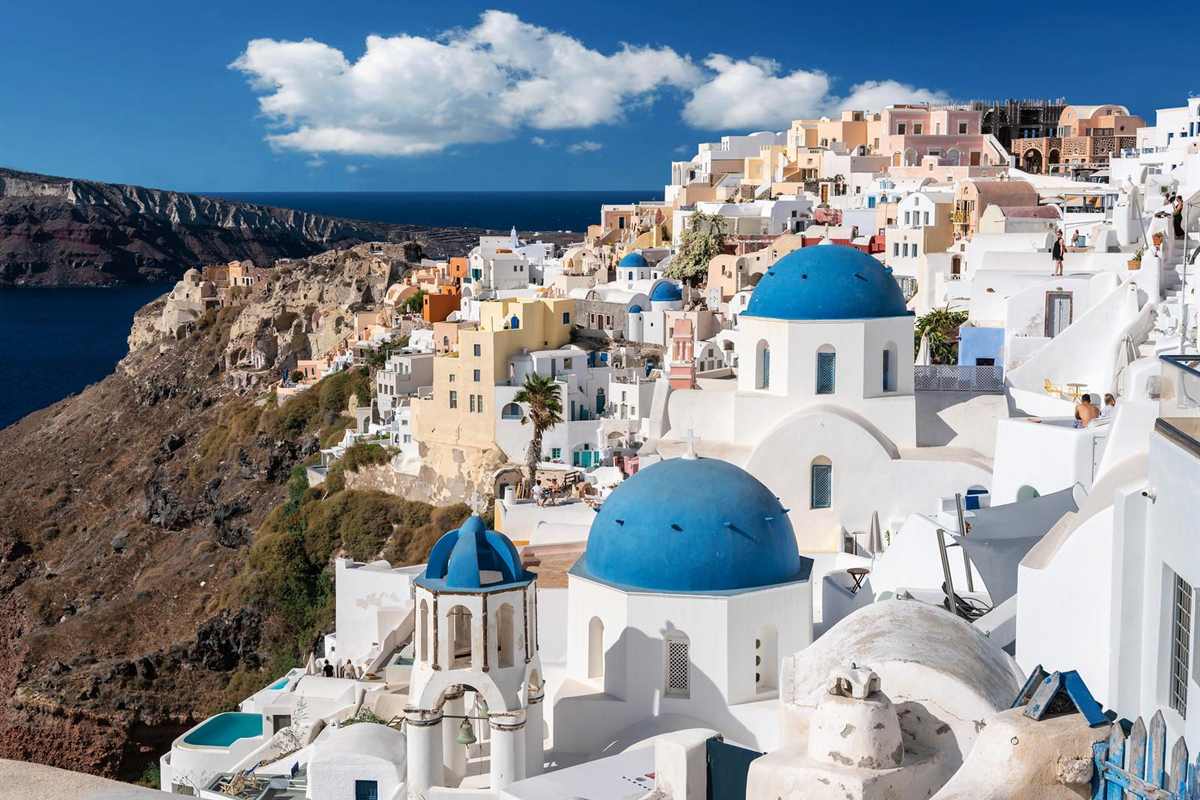
A Santorini shore excursion fits the caldera, Oia and Fira into the hours your cruise ship spends at anchor off the island. Compare it with other tours in Greece if your route calls at more ports.
This page covers the stops of the Oia tour, the tender ride to the Old Port, the Fira cable car, the meeting point, Athinios, the walking and the weather, the crowds, private tours, Akrotiri, wine and the beaches that other tours reach.
What does the Santorini shore excursion to Oia include?
The Santorini shore excursion to Oia from NST Santorini Tours is a sightseeing tour for cruise passengers with limited time. Its Includes box names one item: transport by air-conditioned vehicle. The listing also offers free cancellation up to 24 hours before the start.
The operator’s listing is titled “Shore Excursion to Oia for Cruise Ship Passengers”. It names NST Santorini Tours as the activity provider. The description calls the day a hassle-free sightseeing tour. It says the tour is specially designed for cruise ship passengers with limited time. So it is for people with only part of a day ashore.
The vehicle is the one thing the listing counts as included. The Includes box reads “Transportation by air-conditioned vehicle” and nothing more. The description adds that the group relaxes in the air-conditioned bus on the ride from the first stop to Oia.
The box names no meal, no ticket and no drink. Read this Santorini shore excursion as a transport and sightseeing tour. Plan any food or shopping as your own.
The highlights box lists four items. They are photos in Oia, free time in the village, views over the caldera, and a visit to Fira. The next section sets out the order of those stops, so each item has its place in the day.
Free cancellation is part of the listing. The rule reads: cancel up to 24 hours in advance for a full refund. Count back 24 hours from the start time of the date you pick, and cancel before that point.
The refund is tied to that limit, so check the time when you book. A Santorini shore excursion with this rule lets you book early and still change your plans.
How long is the Santorini shore excursion, and in what order are the stops?
The listing gives the length of the Santorini shore excursion as 4 hours. The order starts with a scenic stop in Imerovigli. Next come a bus ride to Oia, sightseeing and free time there, and then Fira, the capital.
The 4 hours appear under “Duration” on the listing, next to a note to check availability for starting times. So the start time belongs to the date you choose. The short length fits the aim of the tour: passengers with limited time ashore and a ship to return to.
Here is the order of the stops, as the operator’s description lists them.
- A scenic stop in Imerovigli, with views of the volcano and the caldera.
- A ride in the air-conditioned bus to Oia.
- Sightseeing on the streets of Oia, then free time at your own pace.
- Fira, the capital, with its streets and views of the Aegean Sea.
Oia is the centre of this Santorini shore excursion. The title names the village, and the longest paragraph of the description walks you through it. The first stop is a pause for views, not a village visit. The real sightseeing starts once the bus reaches Oia.
Free time follows the sightseeing in Oia, and the description says you explore at your own pace. Fira closes the list. The journey continues there after Oia, so the day ends in the capital and not in the village.
The listing adds one warning about the order: the tour itinerary can vary. Treat the list above as the plan for the day. It is not a promise of each stop in this exact sequence. Check the order again on the listing before you book your Santorini shore excursion.
What is Santorini, the island where your cruise ship anchors?
Santorini is a Greek island in the southern Aegean Sea, about 200 kilometres southeast of the mainland. It is the southernmost island of the Cyclades. A Santorini shore excursion explores the largest island of a small, circular group.
The island where a Santorini shore excursion takes place covers about 73 square kilometres. A census counted 15,480 people living on it. It lies between the islands of Ios and Anafi in the southern Cyclades.
The name in a Santorini shore excursion has a story. Santorini is a short form of Saint Irene, after an old church in the village of Perissa. The island has carried this name since at least the middle of the twelfth century.
The official name of the island is Thira, also written Thera. Thera comes from Theras, the leader of the Spartans who settled the island. This ancient name was revived in the nineteenth century as the official name. Even so, people still use the everyday name Santorini.
Thira is the largest island of the group. Fira and Oia both lie on it, so a Santorini shore excursion to either town stays on Thira. Almost all places to stay and tourist services are on Thira. It is also where the vast majority of visitors arrive and stay.
The municipality of Santorini is wider than the main island. It also holds Therasia, which is inhabited, and five uninhabited islands: Nea Kameni, Palaia Kameni, Aspronisi, Anydros and Christiana. Together they give the municipality a land area of 90 square kilometres.
How did a volcano shape the Santorini caldera?
A huge volcanic eruption about 3,600 years ago left the large caldera of Santorini. It was one of the largest eruptions in recorded history, and sea water now fills the crater. A Santorini shore excursion crosses land that this volcano shaped.
This was not the first eruption. The Thera volcano erupted again and again over hundreds of thousands of years. In a repeating cycle, it erupted violently, then collapsed into a roughly circular crater filled with sea water. Small islands formed the circle. The crater slowly refilled with magma, which built a new volcano.
Just before the Minoan eruption, the walls of the caldera formed a nearly continuous ring of islands. The only entrance lay between Thera and the tiny island of Aspronisi. The eruption was centred on a small island just north of Nea Kameni.
The eruption came in four major phases. The collapse of the caldera began in the third phase and finished in the fourth, which produced megatsunamis. A Santorini shore excursion with caldera views shows the result of that collapse.
The eruption lasted for weeks. Its column rose 30 to 35 kilometres and reached the stratosphere. Tsunamis 35 to 150 metres high devastated the northern coast of Crete, 110 kilometres away. These numbers show the scale of the event behind each caldera view on a Santorini shore excursion.
Today the caldera stretches 18 kilometres, from Cape Akrotiri in the south to Cape Agios Nikolaos in the north. Three fragments of the old island survived the eruption and rim the crater. Two newer islands lie inside it.
Nea Kameni lies in the centre of the caldera. This barren volcanic rock is about 2 kilometres wide, with a crater in the middle and sulphur vents all around. Eruptions still occur, and Nea Kameni has grown in modern times. A Santorini shore excursion therefore takes place beside a living volcano.
How do cruise passengers get ashore at the Old Port of Fira?
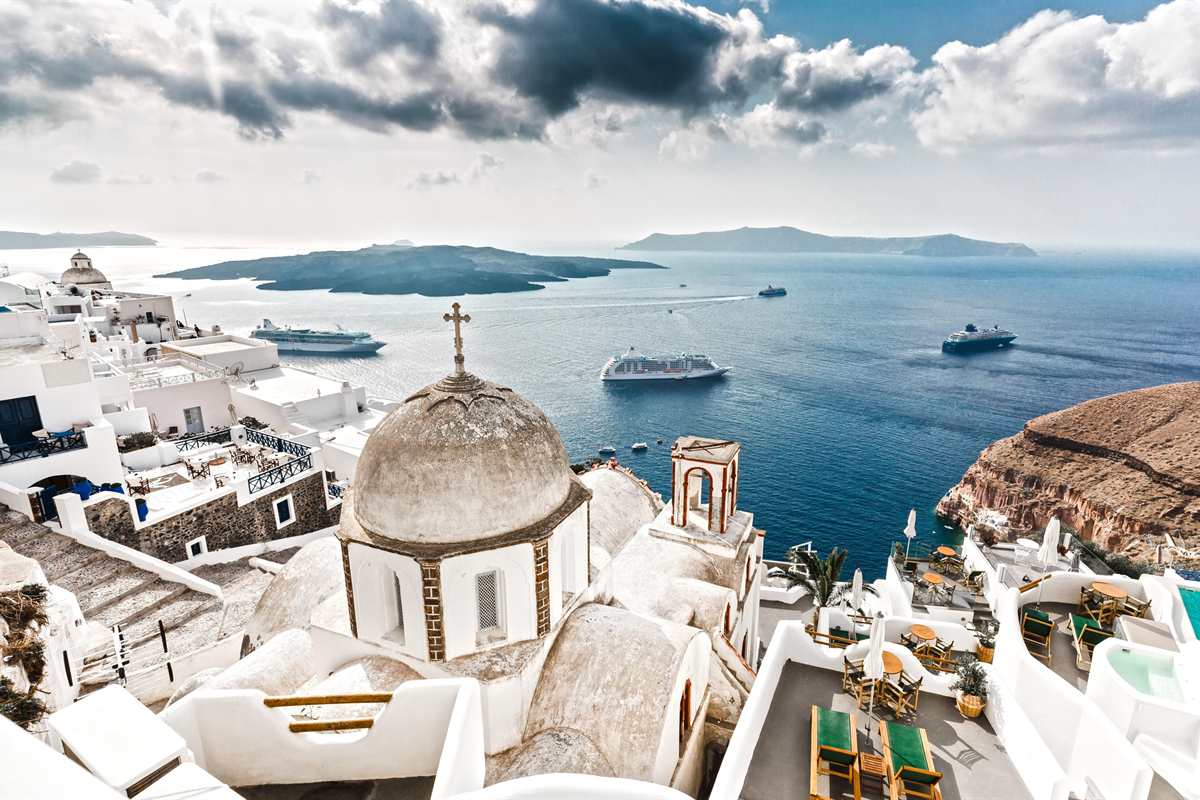
On a Santorini shore excursion, the cruise ship does not tie up at a quay. It anchors in the caldera. A tender boat then takes passengers to the Old Port at the base of the cliff.
Large cruise ships anchor in the small harbour between Fira and Nea Kameni, an island in the caldera. A tender is a boat that carries people to and from the shore. So a Santorini shore excursion from an anchored ship starts with a boat ride.
The Old Port, also called Gialos or Scala Pier, is the landing point for a Santorini shore excursion by tender. It lies at the foot of the steep caldera cliffs. There is no road from it up to the town. There is almost nothing to do there except take a boat or take a couple of pictures.
Locals with fishing boats occasionally transfer cruise passengers to the port. Larger, decorated shuttle boats carry the passengers of big ships to and from the docks below Fira. The operator’s listing for the Oia tour tells passengers to take the tender boat to the Fira Old Port.
Sea transport always depends on the weather, and that is true for a Santorini shore excursion too. For safety, cruise ships can delay or cancel their landing shuttles, especially in winter or in the rain. A travel wiki says the Old Port seems not to have changed over the last 50 years.
How does the Fira cable car link the Old Port with the town?
On a Santorini shore excursion, the Fira cable car links the Old Port with the town. The ride takes about 3 minutes. Its station stands 50 metres from the dock. The other way up is a stairway of 588 steps.
The Santorini Cable Car, known locally as the Teleferico, is a pulsed gondola lift between the Old Port and Fira. Each gondola carries six passengers. The lift moves 1,200 passengers per hour and climbs about 220 metres. Another source gives the ride as 3 to 5 minutes. Before it opened, people climbed the steep steps or rode mules.
A private tour seller says that passengers dropped at the Old Port take the cable car up to Fira. That ride links the landing with the town for a Santorini shore excursion. Visitors who did not arrive by sea can ride down too, and the ride down and up can be fun.
The cable car is designed for passengers with mobility challenges, including wheelchair users. A wheelchair must be no wider than 58 centimetres and no longer than 120 centimetres. The Municipality of Thera owns the lift, and a donation from the Loula and Evangelos Nomikos Foundation paid for it.
The other route up from the Old Port on a Santorini shore excursion is the Karavolades Stairs. Its 588 paved steps rise 200 metres up the cliff. It is also known as the Donkey Trail, because riders go up it on donkeys. There are hundreds of donkeys on the steps, and there are weight limits for riders.
The walk takes 1 to 1.5 hours. That is much longer than the cable car, so the steps are the slower start to a Santorini shore excursion. Walkers can ignore anyone who demands a ticket. The stairway is winding and narrow in parts, with only low walls. It is covered with slippery donkey droppings.
Where do you meet the host for the Santorini shore excursion?
The host of this Santorini shore excursion waits outside the cable car exit at the top, in Fira. The meeting time is 10:00 AM, and the representative waits until 10:30 AM. The listing names the spot Cable Car Fira Santorini – Teleferik.
Look for the sign. At the start of the Santorini shore excursion, the representative stands outside the exit with an “NST SHORE EXCURSION” sign. The listing also asks you to arrive as early as possible. The wait ends at 10:30 AM.
Ship timing comes first. For the 10:00 AM tour, the listing tells passengers to ask the ship’s Guest Relations team for priority disembarkation. You make that request on board, before you leave the ship for the tender boat.
Meeting points change from seller to seller, so check the booking of your own Santorini shore excursion. One private-tour seller says its driver waits at the top of the cable car station in Fira. The driver can also wait at the pier exit of Athinios Port. Either way, the driver holds a name board.
That seller also confirms your ship’s tender schedule the evening before. On the day, it says it watches the ship’s real schedule and adjusts the pick-up. It says your excursion starts when you come ashore, not when the ship was first due.
What is Athinios, and how is it different from the Old Port?
Athinios is the primary ferry port of Santorini, about 10 km south of Fira. The listing for this Santorini shore excursion says to take the tender boat to Fira Old Port, not Athinios Port.
Wikipedia calls Athinios the only port on Santorini with regular passenger ferry services. These link the island to Piraeus, the Cyclades, Crete and Rhodes. Steep, multi-colored volcanic cliffs surround the port, and a road zigzags backwards and forwards up to the top.
Wikivoyage adds the numbers. Buses meet each ferry arrival and take passengers to Fira in 15 minutes, and taxis are also available. The road out of the port makes seven 180-degree turns. Public buses always stand by at the port when a ferry arrives.
Ferry times are also on Wikivoyage. Standard ferryboats need about 7 to 9 hours from Piraeus, and fast ferries need about 4 to 5 hours. A daily ferry also runs from Heraklion on Crete in high season. Bus schedules for the port are handwritten and shown at the Fira bus stop the day before.
Wikivoyage also says cruise ships cannot always dock at Athinios because of their size. For a Santorini shore excursion, that matters. The Old Port of Fira is the other landing place, and Athinios is the port with the road.
That difference changes the first step of a Santorini shore excursion. The private-tour seller above says a tender to the Old Port means the cable car up to Fira. There the driver waits at the station exit.
A tender to Athinios means the driver waits right at the pier. That seller adds that taxis at Athinios are limited and disappear fast.


What can you see from the Imerovigli stop on the caldera rim?
Imerovigli is the first stop of the Santorini shore excursion, a halt for views over the volcano and the caldera. The village is built on the rim of the caldera, north of the island capital Fira. After the stop, the bus carries on to Oia.
Imerovigli is a tiny village just above Fira. It counts 469 permanent inhabitants in a recent census. Narrow, paved paths cross it, and all of its churches are built in the Cycladic style. The church of Ai-Stratis stands in the centre of the village.
A travel wiki lists Imerovigli as a popular town overlooking the caldera. It names the village the highest point of the caldera cliffs and calls the views of the island’s scenery magnificent. On the Santorini shore excursion, the stop is a scenic one. The tour listing names the volcano and the caldera as the sights.
The Monastery of Saint Nikolaos lies on the path that joins Imerovigli to Fira. Nearby Skaros Rock holds the remains of a Venetian castle. Marco Sanudo, then ruler of all the Cyclades, built it in the early 13th century.
Another tour seller calls Imerovigli the balcony of the Aegean and says panoramic views of the volcanic caldera await there. Outside a Santorini shore excursion, the public bus line from Fira to Oia runs via Imerovigli and Firostefani.
What is Oia, the village at the heart of the Santorini shore excursion?
Oia is a small village in the Cyclades, at the north end of Santorini. It stretches for almost two kilometres along the northern edge of the caldera. The Santorini shore excursion brings you here by bus.
The Santorini shore excursion listing writes the name as Oia, and other sources write Ia. A cruise travel site gives the sound as Eeh-Ah. The village lies in the South Aegean region and is part of the municipality of Santorini.
Oia stands on the steep slope of the caldera, at about 150 metres above sea level. Houses and restaurants are built into niches carved into the caldera on the seaward side. Narrow passageways run between them, and the village has a central square.
Nikolaou Nomikou is the name of the main street. It climbs the hill and winds round the caldera. The village is also known as the Eagle’s Nest. Fira is 11 km away. Driving from one end of the island to the other, from Exomytis to Oia, takes about an hour.
The Oia on the Santorini shore excursion is the village, and the Oia municipal unit is bigger. The unit covers the whole island of Therasia and the northwest part of Santorini. It counts 1,087 inhabitants in a recent census and has 19.4 square kilometres of land.
Beyond the sights of a Santorini shore excursion, Oia works as a normal village. It has a cultural centre, a bank, ATMs, a post office, a pharmacy, a health clinic and a bus station. Finikia lies immediately to the east, and Tholos about 500 metres to the north.
Films have used the village that the Santorini shore excursion visits. Oia was the centre of the story in the film Summer Lovers. Scenes of The Sisterhood of the Traveling Pants were shot there. Oia also appears in the opening sequences of Lara Croft Tomb Raider: The Cradle of Life.
Writers have used Oia too. The novel Since I Don’t Have You, by Louise Candlish, is set in Oia and London.
Where are the Three Blue Domes and the Church of Agia Ekaterini?
Both sights are in the village of Oia. The listing for this Santorini shore excursion names the Church of Agia Ekaterini and the Three Blue Domes there.
The listing gives no street name or map point for either sight of the Santorini shore excursion. It names them with the other sights of Oia: its streets, the traditional whitewashed houses, Fort Londsa and the windmills. Its highlights also promise photos of the Three Domes and a look at the white houses.
Oia has more than one blue-domed church. Wikipedia describes a complex of white-washed, blue-domed churches and traditional Cycladic houses on top of the cliff. It adds narrow alleys and blue-roofed churches with cupolas. It notes the town for its white and blue domed houses.
Firostefani has its own blue-domed church. Another tour seller’s small-group Santorini shore excursion starts there. It reaches Oia later and invites you to admire the iconic blue domes. Keep the two villages apart when you plan your photos.
Wikipedia gives two reasons for the white paint on the houses of Oia. The lime water lets rainwater run down the houses, so it can be collected. The other reason is the look. The cliff houses also use air-filled pumice, which keeps them warm in winter and cool in summer.
Wikipedia names the Panagia church among the restored churches of Oia. A cruise travel site describes Oia as a village of pastel-tinted and whitewashed houses set into the cliffside.
A cruise line’s page calls the architecture of Oia pure Cycladic. It describes a minimalistic style with white-washed cube houses and blue-domed churches. On a Santorini shore excursion, you meet that style in the streets of the village.
What is the Castle of Oia, also called Fort Londsa?
The Castle of Oia is the ruined Venetian castle at the top of the village, also called Fort Londsa. The listing for the Santorini shore excursion to Oia calls it historic and dates it to the 15th century.
Wikipedia says the castle that the Santorini shore excursion names was the seat of the Argyri family under the Venetians. It was part of the same Venetian defense system as Pyrgos. It was once one of the strongest fortresses on the island.
Today the ruin serves as a lookout point with a complete 360-degree view. Another tour seller lists a visit to the Venetian castle in the Oia stop of its small-group Santorini shore excursion. A cruise line’s page also speaks of the 15th-century castle in clifftop Oia.
Wikipedia’s history of Oia lists Agios Nikolaos Kastell as one of five local citadels under the da Corogna family. Its residential keep, Goulas, is now in the oldest part of the town, on its southwestern edge. The entry does not say that Goulas and Fort Londsa are the same place.
Pyrgos is the village that Wikipedia links to Oia’s castle. On top of its hill remain the ruins of a Venetian castle called Kasteli. It was once the administrative center of the island. Wikivoyage lists Pyrgos as the highest point on the island, with a monastery, a Venetian castle and narrow streets.
The castle of Oia is not the only Venetian castle on the island. Wikivoyage also lists a Venetian castle on top of a hill at Emporio, the second largest town on Thira. Of these castles, the listing for the Santorini shore excursion names only Fort Londsa.
What are the windmills of Oia, and what lies at Ammoudi Bay below?
The Santorini shore excursion listing names the windmills among the sights of Oia. Ammoudi Bay is the old fishing port on the western side of the village. There are 300 steps down to the port from Oia.
The listing for the Santorini shore excursion tells visitors to take in the island’s windmills during the walk through Oia. A reference page on the village says an old windmill is easy to recognise and appears on postcards. The two sources give no further detail about the windmills.
Ammoudi, also spelled Amoudi, is the old fishing port below Oia. The harbour is reached by steep stairs. At the bottom are tavernas and a pebble beach. A ferry connection to the island of Therasia leaves from the harbour village.
The jet ski chases in Lara Croft Tomb Raider: The Cradle of Life were shot in and around Ammoudi. The Santorini shore excursion listing names no stop at the bay, so this is a place fact only.
A second small harbour, the Bay of Armeni, lies below Oia to the south. Walkers reach it by steps, and the reference page says it can also be reached by mule. It was once an important boatbuilding centre, and small repairs are now done on a single wharf.
How did sea captains and an earthquake shape the history of Oia?
Oia grew rich from sea trade in the late nineteenth and early twentieth centuries. An earthquake in the middle of the twentieth century then destroyed part of the town. The Santorini shore excursion visits Oia, the village that was rebuilt afterwards.
Today the Santorini shore excursion stops in a village that was once a mariners’ town. Its merchant fleet traded across the eastern Mediterranean, especially from Alexandria to Russia. In the late nineteenth century it had about 2,500 residents and about 130 sailing ships. Wine from the land around it was exported to France, among other places.
The wealthy ship captains of the late nineteenth century built neo-classical mansions, one above the other. Two-story captains’ houses on the highest part of the village still show that former wealth. Crews lived in simpler homes: cave houses cut into the caldera rock and small seamen’s houses on its edge.
The whitewashed houses in the Santorini shore excursion listing have this sea story behind them. Churches in the village include ones built in memory of sailors.
The sea trade then collapsed, because steam ships arrived and shipping moved to Piraeus. Farming shrank as people left, especially for Piraeus and Laurium. Wars, economic depression and overfishing pulled the economy down further in the early twentieth century.
On 9 July in the middle of the twentieth century, an earthquake of magnitude 7.8 caused considerable damage. The strongest aftershock, of magnitude 7.2, had its centre off the northern coast of Santorini. People left again, and later in the twentieth century Oia had only 306 inhabitants.
Afterwards the village redeveloped into a tourist town, and today the Santorini shore excursion brings cruise passengers to it. The Greek National Tourism Organisation ran a programme to preserve and restore traditional houses in Oia. Seamen’s houses on the caldera edge became guest houses, hotels and restaurants.
The village community now works with geologists to map the ground. It limits building to lower the risk from future earthquakes in the village that the Santorini shore excursion visits.
How can you spend the free time in Oia on a Santorini shore excursion?
Free time in Oia lets you explore at your own pace, browse local shops or relax at a cafe. It is the part of a Santorini shore excursion that you plan yourself.
Kiosks in Oia sell handicrafts, jewellery and souvenirs. The village has small art galleries, such as Art Gallery Oia and The Art Gallery. The Weaving Mill, near the Maritime Museum, has looms and sells the fine textiles it makes. Farm products such as honey, wine, capers and fava beans are traded in the town too.
Cafes, bars, restaurants and tavernas line the coastal path. The village also has leafy squares and craft shops, which suit a browse and a lunch. Oia has ATMs, a post office, a health clinic and a pharmacy, all useful on a Santorini shore excursion.
If you prefer history to shopping on a Santorini shore excursion, Oia has a museum too. A restored 19th-century mansion, a block from the cliff-top, now holds the municipal museum of the maritime history of Thira. It displays rare figureheads, old nautical charts with English labels and seamen’s chests.
Oia is known for its sunset. Sunset viewing is a popular event every evening, from the Sunset Serenade point. The houses and the caldera catch the colours of the setting sun for a matter of seconds. The town fills with people who come to watch it.
This Santorini shore excursion runs in the morning, so the sunset is not part of it. Your free time is a daytime visit instead. The listing does not state how long it lasts, so choose your stops with care.
What is Fira, the capital and last stop of the tour?
Fira is the capital and largest town of Santorini. It is the last stop of the Santorini shore excursion to Oia. There you can explore its streets and enjoy views of the Aegean Sea.
Fira is a city of whitewashed houses. They stand on the edge of the 400-metre-high caldera on the western side of the island. The town lies 11 kilometres from Oia. Its name comes from another way of saying Thira, the ancient name of the island.
Fira became prominent in the late eighteenth century. Less piracy in the Aegean let islanders move further out from the existing castles. Eventually the town became the island’s administrative centre. It is also the island’s cultural centre, with the widest selection of shopping and dining.
The limited space on the caldera ridge gives Fira a tight layout. Narrow streets in the centre are open only to people on foot, motorcycles and donkeys. Only a small number of streets suit cars, and there is almost no parking. Walking is the easiest way to see the centre on a Santorini shore excursion.
On a Santorini shore excursion, the main street for shops and restaurants is Erythrou Stavrou. The central square is called Plateia Theotokopoulou, and it holds a bus and taxi station, banks and pharmacies. Fira bus station is the transit hub of the island, with buses from Oia, Kamari, Perissa, Akrotiri and the airport.
North of the centre, Fira flows into Firostefani, a quieter village. To the south lies the inland suburb of Karterados, which has no views. When much of the island closes up for the winter season, Fira stays open and active. It is much quieter, though.
What can you see in Fira before the Santorini shore excursion ends?
On a Santorini shore excursion, the listing names Fira’s streets and views, not its museums or churches. The town still holds two main museums and a number of churches. The Archaeological Museum of Thera stands 30 metres east of the cable car entrance.
The Museum of Prehistoric Thera stands at the southeast corner of the white Orthodox Cathedral of Ypapanti. It tells the story of Akrotiri and other Neolithic and Bronze Age settlements through artefacts. It also shows wall murals recovered from Akrotiri. The Archaeological Museum holds Proto-Cycladic objects from the third millennium BC and continues to the Classical period.
Smaller museums fill the town too. The Megaro Gyzi Museum sits in a 17th-century mansion and shows maps, engravings and dresses of the Cycladic islands. The Roger Tourte Exposition shows watercolours by a French artist in underground tunnels, which stay cool on hot summer days. The listing for the Santorini shore excursion names none of these museums.
The Three Bells of Fira is the Catholic Church of the Dormition. It is a much-photographed place with three bells and a blue dome. Two cave churches were built into the cliff face there in the mid-17th century. The cliff receded and destroyed them. An infirmary took their place and drew Jesuits. The present church dates to the 18th century.
Three more churches stand in Fira. The Cathedral of Ypapanti replaced a church that the Amorgos earthquake destroyed. The Cathedral of Saint John the Baptist is a baroque building in blue-gray and cream. The Dominican Convent, dates from the 16th century and ranks as the oldest Catholic nunnery in Greece. None is a stop on the Santorini shore excursion.
How do you get back to the ship at the end of the day?
The Santorini shore excursion ends near the Fira Cable Car, which gives convenient access back to the cruise port. The listing’s highlights also name the cable car ride down to the port, with views on the way.
The tour only brings you to the cable car. The listing for the Santorini shore excursion gives no time for the last tender, so the ship sets your deadline. Ask the ship for its last tender time before you go ashore, and count back from it. The listing also tells passengers to allow sufficient time for the cable car.
One private tour seller says it plans each return around the ship’s tender times and a buffer. It adds that the driver tells clients when it is time to return. Its aim is that clients board relaxed, not running. Leave the same gap between the end of your Santorini shore excursion and the tender back to the ship.
Fira offers a short walk to fill that gap. Agiou Mina Street runs along the crater rim from the south part of town to the cable car. Wikivoyage says it gives the views of Fira that visitors come to see. You can walk it north or south. Walking north puts the main part of town in front of you.
Watch your step on that street, because the same source warns of donkey droppings. In the early evening, Wikivoyage says, cruise passengers return to their vessels. The cafes of Fira then become much more relaxed. A Santorini shore excursion that ends near the cable car leaves you in that town, one ride from the port.
How much walking does the Santorini shore excursion involve?
The operator’s listing says the Santorini shore excursion involves over two hours of walking on uneven, cobbled ground. It also names people with mobility impairments as a group for whom the tour is not suitable.
The listing gives a second number for the walking. Expect around 10 minutes between the bus parking and the sightseeing areas, in both Oia and Fira. That means you make this short walk in each of the two villages. The listing gives no distance, so judge the walk by time, not by kilometres.
The listing also tells you what to put on. It asks for comfortable shoes and for suitable clothing for windy weather. For a Santorini shore excursion on foot, pick shoes you have already worn on a long walk. Dress for the wind, not only for the sun.
Another tour seller describes the island’s villages as hilly and mentions cobbled paths. That fits the listing’s note about uneven ground. Read the mobility rule before you book a Santorini shore excursion. If anyone in your group finds a long walk hard, choose another way to see the island.
What is the weather like on Santorini during the cruise season?
Santorini has hot, dry summers and wetter winters. Wikipedia lists average highs of 27.9 degrees Celsius in June and 30.2 in August. Average rain stays under four millimetres in each of June, July and August. Pack for sun and wind on a Santorini shore excursion.
Wikipedia, citing the National Observatory of Athens, describes a hot semi-arid climate. It has Mediterranean traits, such as dry summers and relatively wetter winters. It gives an average yearly rainfall of around 270 millimetres and an average yearly temperature of around 19 degrees Celsius.
Wikivoyage says the tourist season starts in April, around Greek Easter. In April and late spring, it says, temperatures are pleasant and the chance of rain is low. It calls this ideal for hiking from one town to another. Wildflowers bloom, and the barren islands turn colourful. Wikipedia lists an average April high of 19.6 degrees Celsius.
Wikivoyage names April to June and September to October as the shoulder seasons with milder weather. For milder weather on a Santorini shore excursion, those are the months it points to.
After late spring, Wikivoyage says, temperatures soar with an extreme UV index, and summers are extremely hot. The island has hardly any trees to give shade. Public life slows down, and restaurants and amenities close during the hottest hours, from noon to 3 p.m.
Wikipedia’s weather station records an average high of 30.1 degrees Celsius in July. The record high for July is 39.4 degrees. July also averages just 0.03 millimetres of rain. The station sits 183 metres above sea level. Plan for that heat if your Santorini shore excursion falls in midsummer.
Autumn brings a change. Wikivoyage says the weather turns cooler from September, though the chance of rain rises towards the end of the year. Wikipedia lists an average high of 27.2 degrees Celsius in September and 22.8 in October. Seasonal businesses start closing towards the end of October.
Winter is the wet season. Wikivoyage says Santorini receives the largest share of its yearly rain in the winter months. Wikipedia lists 54.6 millimetres of average rain in December and 52.7 in January. Wikivoyage calls December to March the off-season, with cooler temperatures, occasional rain and winds. Check the month before you choose a Santorini shore excursion.
How do cruise crowds and cable car queues affect the day?
On a busy summer day, a Santorini shore excursion shares the island with thousands of cruise passengers. One tour seller says they come ashore from multiple ships in the same two-hour window. The cable car queue at the Old Port, it adds, can run 45 minutes or more, so allow spare time.
Wikivoyage says Fira is bustling every summer day as cruise ships from all over the Mediterranean come and go. It adds that the cable car lifts 1,200 passengers per hour. Waiting lines are rare except when cruise ships arrive. In the early evening, the passengers return to their ships and the cafes become much more relaxed.
The operator’s listing for the Santorini shore excursion to Oia is open about this. It warns that cable car queues can be long and tells guests to allow enough time. It also says traffic delays and cable car queues are beyond the operator’s control, so the itinerary can vary.
The road adds to the wait on a Santorini shore excursion. The tour seller quoted above says the island’s single main road links Fira to Oia. It moves at the pace of the slowest tour bus ahead of you. Wikivoyage adds that Fira has almost no parking.
Season changes the crowds. Wikipedia says Oia gets crowded with people during the summer season. Wikivoyage says Fira stays open and active in winter, though much quieter. The tour seller quoted above times its Oia visit to arrive before the midday crowds build. It keeps the afternoon for Fira and a sit-down lunch.
Which other Santorini shore excursion tours leave from the port?
A cruise line’s own excursion list and other tour sellers offer tours built on food, photos, boats or walking. Each Santorini shore excursion below is named only with what its own listing states. The listings that state hours run from three to six.
One cruise line’s own excursion list gives each Santorini shore excursion a theme. The Greek Style Celebration tour drives to Pyrgos and Oia after the ship tenders to Athinios. It stops at a restaurant for a buffet meal with Greek food, wine, music and dances. The tour then continues to Fira before the return to the ship.
The same list names Ancient Secrets Of Crafting Greek Pies. A chef shows how to make Greek pies and tomatokeftedes, a tomato dish. Let’s Take A Selfie has a selfie tutor. Its stops include Oia’s blue-domed churches and the Metropolitan Church of Ypapanti Thira. Highlights Of Santorini By Land And Sea walks through Oia and cruises the caldera.
One tour seller lists a Santorini shore excursion for walkers. It is a hiking tour from Fira to Oia that covers the entire 10-kilometer trail. The same seller lists a seven-stop, five-hour drive in one private vehicle. It also lists an Oia and Pyrgos tour with a hands-on farm visit and a farm-to-table lunch.
Other listings tie the day to the port. One Santorini shore excursion for cruise ships uses a boat transfer and is titled Skip Cable Car. The listing gives 3 to 5 hours. A six-hour tour has an easy meeting point at the top of the Fira cable car.
How does a private Santorini shore excursion differ from a small-group tour?
A private Santorini shore excursion carries only your own group and lets you set the stops. One small-group tour in another seller’s listing takes up to 12 people. It changes its stop order each day to fit everyone’s pickup place.
A small-group Santorini shore excursion is a shared day. The same listing says all participants still see the listed highlights, but the stop order can change. Standard departures from Fira Town are at 10:30 and 14:00. Pickup times shift with the place where each group starts. A shared tour fixes one plan for everyone.
A private Santorini shore excursion is built around you. Listings offer private land tours of 3 up to 8 hours. A local driver helps plan the route, and one listing adds an option to extend the tour. A six-hour private tour in another listing lets you skip any stop that does not interest you. It promises a return on time.
One tour company plans its private tours around the ship’s tender schedule. It confirms that schedule the evening before. It says port agency tours have fixed stops and fixed times, while its own days do not. Its V-Class minivan takes families of up to seven or eight, and its drivers speak English as standard.
Another seller’s private Santorini shore excursion targets the cable car queue. It meets you at the Old Port with a sign showing your name. It says it can arrange a private water transfer to Ammoudi Bay, so you avoid the queue entirely. Its air-conditioned Mercedes SUV has WiFi and bottled water. It also says it adjusts to ship delays.
What is Akrotiri, the Bronze Age town on other shore tours?
Akrotiri is a Cycladic Bronze Age settlement on the volcanic island of Santorini. Ash from an eruption buried it and helped preserve its frescoes. The Oia tour in this post does not stop there, but other Santorini shore excursion tours do.
Akrotiri lies at the southwestern tip of the island. The name comes from a nearby village, and its ancient name is unknown. The town grew from a small fishing and farming village. A reference page says no Minoan site outside Crete is better known. Linear A writing and matching art styles tie the town to the Minoan world.
Only the southern tip of a large town has been dug up so far. The remains include:
- houses of up to three storeys, with streets and squares between them
- walls that stand up to eight metres high
- wall paintings that kept their colour under the ash
- huge storage jars and stone staircases that survive in the houses
- pipes with running water and water closets, the oldest such utilities discovered
Diggers found no human remains and only a single gold object. A reference page says this indicates an orderly evacuation, with little or no loss of life. One cruise line lists a Santorini shore excursion that visits Akrotiri and calls it the Pompeii of the Bronze Age. It says volcanic ash preserved the buildings.
One tour company pairs the Minoan site with a wine tasting on a private Santorini shore excursion. It says Akrotiri sees a fraction of the visitors that Oia does. It also says five to six hours in port cover Oia, Fira and one more stop, such as Akrotiri. Check that a listing names Akrotiri before you book.
What makes Santorini wine and its volcanic vineyards different?
Santorini wine grows in dry volcanic soil. The island’s wines carry an EU protected designation of origin. Its classified wines are Santorini, Nykteri and Vinsanto. The Oia tour lists no winery stop, so a Santorini shore excursion with wine tastings means choosing a different tour.
Growers train the vines into low baskets, with the grapes hanging inside the ring. They plant different varieties together and are not always sure which is which until the harvest in mid-August. Wikivoyage says Assyrtiko grows as a shrub rather than a vine. Only about 1,200 hectares of land lie under vine, and tourism puts that small area at risk.
Before you pick a Santorini shore excursion with wine, learn two dry white names. A wine labelled Santorini holds at least 75% Assyrtiko, with Athiri, Aidani or both making up the rest. Both are bone-dry. Nykteri means working the night away in Greek, because growers traditionally picked the grapes before sunrise. Nykteri ages in oak for at least three months.
One seller’s private Santorini shore excursion adds a cliffside winery, where Assyrtiko grown in volcanic soil comes with local mezes. The same seller lists a private wine tour with three wineries and about 12 tastings. Another seller’s three-winery tour ends with the Oia sunset. A cruise line’s selfie tour adds a glass of local wine at a hilltop restaurant.
Wikivoyage names Megalochori village as known for its wineries and Vothonas as the centre of the wine industry. It calls Vourvoulos, an inland town, known for its vineyards. A cruise travel site counts 10 wineries on the Wine Road. The first seller also lists a Santorini shore excursion with a farm visit and a food and wine experience.
Which Santorini beaches, from the Red Beach to Kamari, do other tours reach?
Other tours reach the Red Beach, the White Beach and the Black Beach of Perivolos. One cruise line’s cooking class meets at a restaurant near Kamari Beach. The Oia tour lists no beach stop, so swim time on a Santorini shore excursion means a different tour.
Beaches lie on the outer side of the island, because the caldera coast is steep cliff. Wikivoyage says the common colours are black, white and red. It says the beaches are generally pebbles of varying sizes, so proper footwear helps. Wikipedia adds that the water at the darker beaches is significantly warmer, because the lava acts as a heat absorber.
The Red Beach lies south of Akrotiri. Its name comes from the red sand and the iron-rich rock in the towering cliff face. The White Beach is reachable only by sea, so a Santorini shore excursion there means a boat. It has no pier, so visitors wade ashore through waist-deep water. It is small and has no facilities.
A catamaran cruise listed among Santorini shore excursions sails to the Red Beach, the White Beach and the hot springs. The seller provides snorkel and swim gear, a barbecue and seafood meal, and an open bar. One private-tour seller says a longer port stop suits a catamaran cruise. A second catamaran listing caps its group at 18 guests.
Another seller’s 5-hour Santorini shore excursion ends at the Black Beach of Perivolos, with free time to swim. A 6-hour private tour visits the Red Beach and the Black Beach. Kamari has a black sand beach and lies about 10 km southeast of Fira. Perissa lies about 15 km southeast. Both have sun chairs, umbrellas and water-sports gear for rent.
What else do cruise passengers ask about a Santorini shore excursion?
Where is Santorini’s airport, and does a Santorini shore excursion use it?
No. The Santorini shore excursion in this post starts at the top of the cable car in Fira. Santorini (Thira) National Airport, code JTR, lies north of Monolithos. Wikivoyage puts it southeast of Fira, a drive of about 10 minutes.
Buses between Fira and the airport take 10 to 15 minutes each way. The airport is very small, and luggage can be dropped off only two hours before a flight. Regular flights from Athens take 30 to 45 minutes.
Can you take the public bus instead of a Santorini shore excursion?
KTEL Santorini, the public bus service, connects all points of the island with Fira. Wikivoyage says tickets are sold on the bus, cash only, so bring coins. There are no route numbers, and not all buses show their route, so ask the driver or the ticket office.
Almost every line branches out from Fira Bus Station. To go from one side of the island to the other, change buses at Fira. You pay for the second leg. Peak-season buses run up to every 15 minutes to Oia, Kamari and Perissa. Low-season services end by 19:00.
What is Nea Kameni, and how do visitors reach it?
Wikivoyage calls Nea Kameni the New Burnt Island, the summit of the current volcano. Boats reach it from Fira Old Port in about 10 minutes, and daily boat tours run from tour agencies. Volcanologists monitor its activity continuously.
A 1-kilometre trail over uneven gravel leads to the active sulphur vents and the 130-metre summit. The island has no supplies, shade or toilets, so bring water and proper hiking shoes. The Oia tour lists no boat trip, so a Santorini shore excursion to the volcano means a different tour.
Which local dishes does Santorini serve?
Wikivoyage says the volcanic soil, dry climate and lack of trees shaped the island’s crops. Fava is a split-pea puree, served warm with olive oil and lemon. Santorini’s white aubergine has fewer seeds and a much sweeter taste than the mainland kind, but it has become rare.
Chlorotyri is a local goat-milk cheese. Apochti is pork loin that is salted, pickled and air-dried. Kopania are sweets of powdered barley rusks with raisins or sesame seeds. Use Wikivoyage’s menu test when free time on a Santorini shore excursion turns into a meal. If the menu lists moussaka but not fava, look elsewhere.
Is Santorini linked to the legend of Atlantis, and what other names has it had?
Wikivoyage reports a local legend that Santorini was once home to Atlantis, destroyed by the eruption. It adds that historians dispute the claim. Wikipedia says it has been suggested that the eruption is the source of the legend.
The Phoenicians knew the island as Kalliste, and Herodotus says they lived on it for eight generations. A modern tradition gives the name Strongyle, meaning the circular one. So the island of a Santorini shore excursion has been Kalliste, Strongyle, Thera and Santorini.