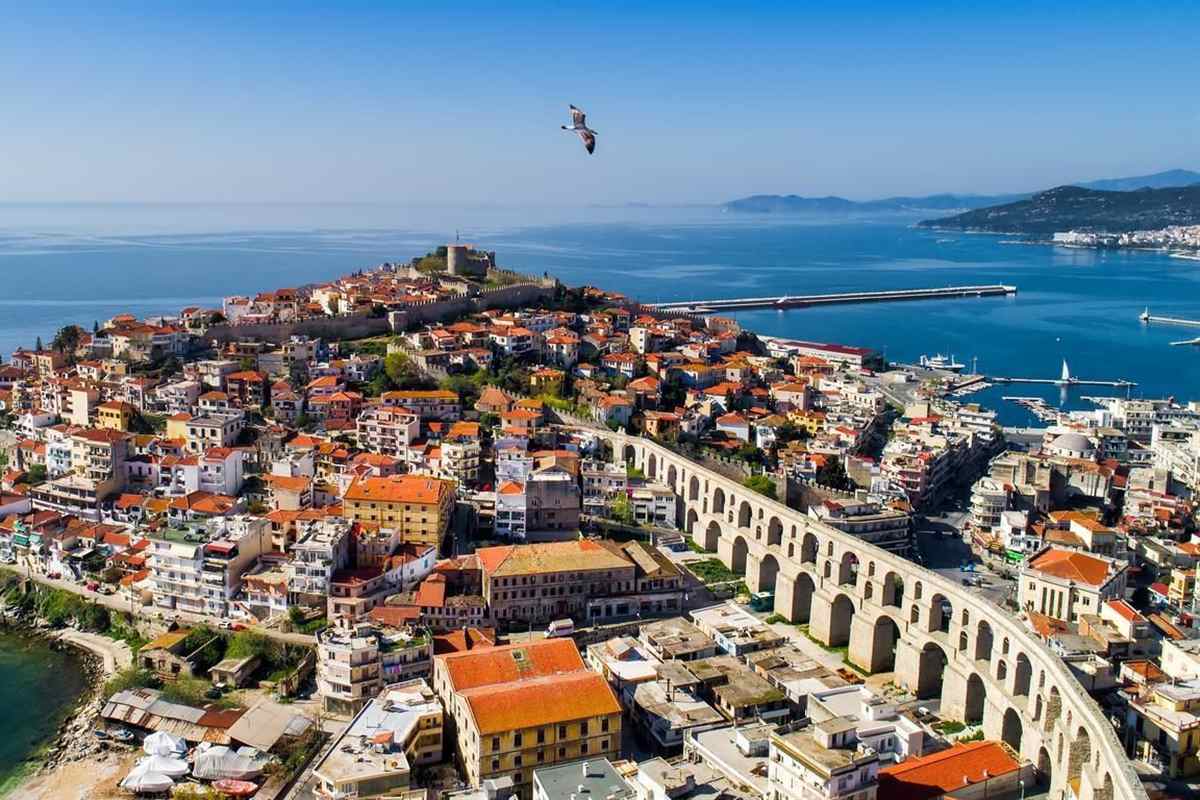
A Kavala and Philippi day trip runs east from Thessaloniki to the Roman ruins of Philippi, a beach near Kavala and the castle above the old town. For a longer stay in the north, the full range of tours in Greece is one click away.
This page covers what the day trip includes, the stop order and timing, the meeting point in Thessaloniki, the Via Egnatia, the ruins of Philippi, the Prison of Apostle Paul, the Battle of Philippi, the museum, the beach stop, Kavala and its castle, the old town of Panagia, the Kamares aqueduct and the questions travellers ask.
What does the Kavala and Philippi day trip include?
The Kavala and Philippi day trip is a full-day bus tour from Thessaloniki, run by Ammon Express. It includes bus transport to all locations, an English-speaking tour leader-archaeologist, and basic travel insurance during transportation.
The operator describes the day as a trip to northern Greece that combines history, culture and relaxation. The operator’s listing calls it a full day trip with Kavala, Philippi and a beach. The operator’s own page lists six inclusions:
- Pickup and drop-off at the meeting point in Thessaloniki
- Bus transportation to all locations
- An air-conditioned, comfortable bus
- An English-speaking tour leader-archaeologist
- Basic travel insurance during transportation
- A baby seat, available on request
The bus carries the group between all the stops, so the day needs no car of your own. The insurance covers the transportation part of the day.
Four items sit outside the Kavala and Philippi day trip. The operator’s page lists them as not included:
- The entrance fee to the Philippi archaeological site and museum
- The tour inside the archaeological site and museum
- Sunbeds and umbrellas, which are optional
- Lunch and drinks
The entrance fee is paid apart from the tour. The operator’s listing marks the Philippi visit with an extra fee, which matches that rule.
You can cancel for free until one day before the start and get your money back in full. A change of plan more than one day ahead therefore loses no money on the Kavala and Philippi day trip.
How long is the Kavala and Philippi day trip, and in what order are the stops?
The Kavala and Philippi day trip lasts about 10.5 hours. The bus drives to the archaeological site of Philippi first, then to a beach near Kavala. The day ends with a walk through Kavala Old Town and Castle and the drive back to Thessaloniki.
The operator’s own page splits the day into five legs:
- Drive to Philippi: 2 hours
- Visit to the archaeological site of Philippi: 1.5 hours
- Free time at a beach near Kavala: 2.5 hours
- Walking tour in Kavala Old Town and Castle: 1 hour
- Return to Thessaloniki: 2 hours
The two drives take 2 hours each, so the road fills 4 hours of the day. The three stops fill 5 hours between them. The beach is the longest stop, and Philippi comes second.
The order gives the Kavala and Philippi day trip a clear shape. The history stop comes first, before the free time at the beach. Kavala comes last, so the day finishes in the city before the drive home.
The operator’s listing for the same tour shows the legs in different blocks. It lists a bus leg of 2.5 hours and a visit of 1.5 hours. Two short bus legs of 30 minutes and 15 minutes follow. A Kavala visit of 75 minutes comes last. The listing does not show the beach as its own line.
Winter changes the Kavala and Philippi day trip. In the winter season the beach stop is swapped. The group gets extra time in Kavala’s old town and a meal at a traditional tavern. The operator’s page gives no separate winter timetable.
The operator also says the schedule can change with the weather conditions. The listing adds that its itinerary is for reference only. It is subject to change, so the leg times work as a plan, not a fixed promise.
Where do you meet the bus in Thessaloniki?
The bus for the Kavala and Philippi day trip meets at the Statue of Venizelos in Thessaloniki. The meeting time is 7:50 in the morning, and the bus departs at 8 in the morning.
The operator’s own page names the Statue of Venizelos in Thessaloniki as the meeting point. It lists pickup and drop-off at the same statue. The operator’s listing gives the address as Egnatia 78, Thessaloniki 546 24. It shows the day ending back at Egnatia 78.
Both the operator’s page and the listing want you at the meeting point ten minutes or more before the bus leaves. The 7:50 meeting time sits exactly 10 minutes ahead of the 8 o’clock start. Plan to stand at the statue by 7:50 on the morning of the Kavala and Philippi day trip.
The listing’s address uses the street name Egnatia. Wikipedia calls Egnatia Street the main commercial street in downtown Thessaloniki, about 3 km long. It is named for the Roman-era Via Egnatia, which passed near the city. That name ties the start of the Kavala and Philippi day trip to Roman history.
Once the bus pulls away, the operator’s page lists the drive to Philippi as 2 hours. That is the first leg of the Kavala and Philippi day trip, before the visit to the ancient site.
What was the Via Egnatia, the Roman road through Philippi?
The Via Egnatia was a Roman road built in the 2nd century BC. It ran from the Adriatic Sea to Byzantium, and Philippi lay on its route. The Kavala and Philippi day trip reaches that place today.
Wikipedia says the road started at Dyrrachium, now Durrës, on the Adriatic Sea. It crossed the Roman provinces of Illyricum, Macedonia and Thracia. It reached the northern Aegean coast at Thessalonica. From there it ran through Thrace to Byzantium, later Constantinople and now Istanbul.
The site of Philippi controlled a stretch of the great east-west royal route across Macedonia. The Roman Republic rebuilt that route in the 2nd century BC as part of the Via Egnatia.
The road covered about 1,120 km in total, which is 696 miles. It was about 6 metres wide. Its surface was large polygonal stone slabs or a hard layer of sand.
Milestones with inscriptions in two languages record that Gnaeus Egnatius, proconsul of Macedonia, ordered the road. The exact date is uncertain. The Romans built it to link colonies from the Adriatic Sea to the Bosphorus. It continued the Via Appia, the road from Rome. Philippi, a major sight of the Kavala and Philippi day trip, stood on this link.
The Apostle Paul used the road on his second missionary journey, travelling from Philippi to Thessalonica. Milestones record that the emperor Trajan made extensive repairs before a campaign against the Parthians. By the 5th century AD, the road had largely fallen into disuse because of violent instability in the region.
The Eastern Roman Empire later revived it. Procopius records repairs by the emperor Justinian I in the 6th century. Almost all Byzantine overland trade with western Europe travelled along the road. Armies of the Crusades followed it to Constantinople.
Kavala, where the Kavala and Philippi day trip ends, also sat on the road. Wikipedia says the military Roman road passed through the city and helped trade flourish. Today a modern highway, Egnatia Odos, runs in parallel to the old road. It links Thessaloniki and the Turkish border on the Evros river. Its name means Via Egnatia in Greek.
The operator’s listing does not name the Via Egnatia as a stop. On a Kavala and Philippi day trip, the road is background history, not a place on the schedule.
What is Philippi, the UNESCO site on the Kavala and Philippi day trip?
Philippi is an ancient Greek city. King Philip II of Macedon renamed it in the middle of the fourth century BC. Its ruins are a UNESCO World Heritage Site, and the Kavala and Philippi day trip visits them.
The city began as a settlement called Crenides, which is Greek for “Fountains”. Colonists from Thasos founded it. Philip II then conquered it and gave it his own name. Philip II was the father of Alexander the Great.
The Macedonians aimed to take control of the neighbouring gold mines and to hold a garrison at a strategic passage. Philip added strong fortifications, sent in colonists and had the marsh partly drained. He also set up a mint in the city.
The ruins on the Kavala and Philippi day trip lie about 13 kilometres north-west of Kavala. The modern village of Filippoi stands beside them, inside the modern city of Kavala.
UNESCO classified the site as a World Heritage Site for three reasons. It has exceptional Roman architecture. Its layout is a smaller reflection of Rome itself. It is also important in early Christianity. The listed area covers 87.545 hectares, with a buffer zone of 176.291 hectares around it.
The city did not last. An earthquake in the early seventh century almost totally destroyed it, and it never recovered. People abandoned it in the fourteenth century, after the Ottoman conquest. So the stop on the Kavala and Philippi day trip is an archaeological site, not a living town.
What do you see at the forum, the basilicas and the theatre of Philippi?
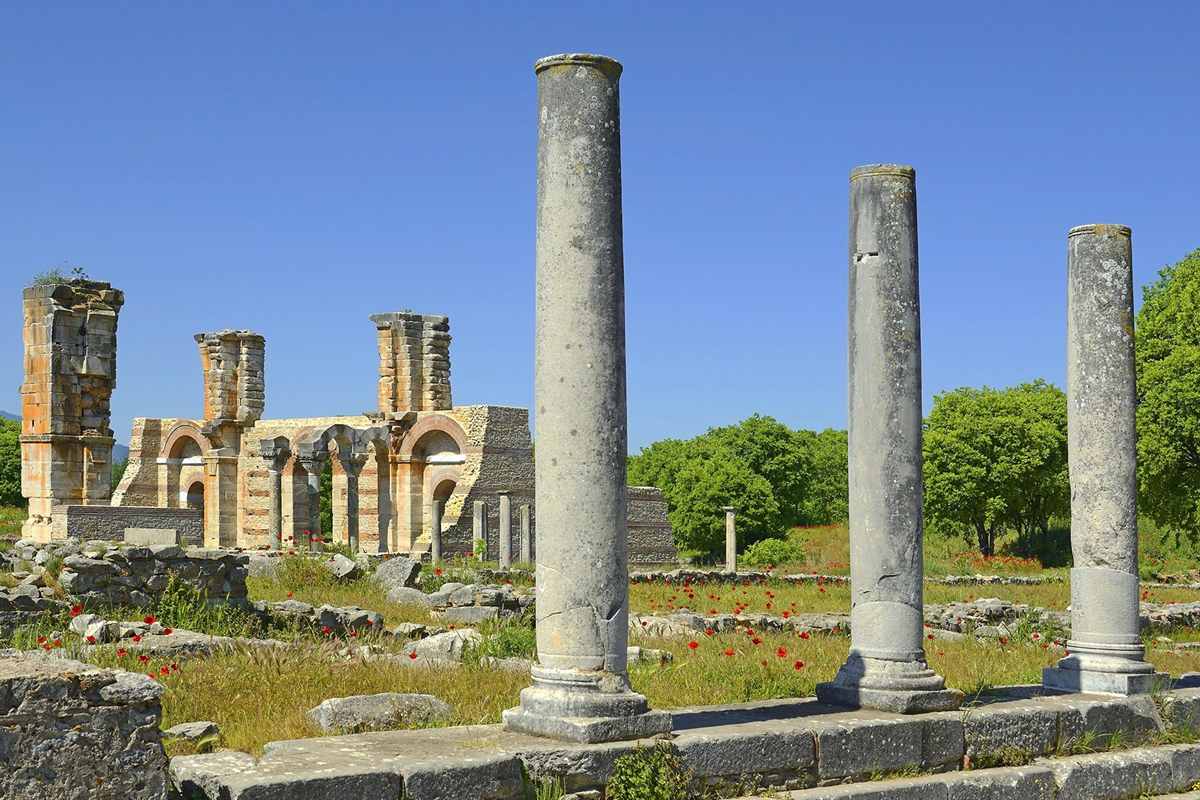
The Kavala and Philippi day trip shows Roman forum ruins, early Christian basilicas and a Greek theatre. The operator’s listing names the Roman Forum, the basilicas and the Theatre of Philippi among its sights.
The Romans built the forum a little to the east of the old Greek agora. On the Kavala and Philippi day trip, you see its two terraces on both sides of the main road. Builders worked on it in phases, between the reigns of Emperor Claudius and Emperor Antoninus Pius.
Under the forum lie the foundations of an older house. The monuments of the Roman colony show its wealth, and they look imposing for such a small urban area. An abundance of Latin inscriptions tells the same story of a prosperous city.
The theatre on the Kavala and Philippi day trip is older than the Romans. It is one of the Greek remains at Philippi. The walls and a small temple for the city’s founding hero are others. The Romans later enlarged the theatre to hold Roman games.
A travel blog says the theatre is the first sight inside the entrance. The same blog says that summer performances still take place there.
Seven churches rose at Philippi between the middle of the fourth century and the end of the sixth century. A number of them rivalled the buildings of Thessalonica and Constantinople in size and decoration.
The plan and decoration of Basilica B are linked to Hagia Sophia and to Saint Irene in Constantinople. That link gives the church a special place in the history of early Christian art.
French archaeologists dug at the site in the early twentieth century. They uncovered the Greek theatre, the forum, Basilicas A and B, the baths and the walls. Greek archaeologists later found the bishop’s quarter, large private houses and more basilicas.
The ruins therefore cover three eras: the Greek city, the Roman colony and the early Christian town. One visit on the Kavala and Philippi day trip shows Greek, Roman and early Christian remains side by side.
What is the Prison of Apostle Paul at Philippi?
The Prison of Apostle Paul is a site at Philippi tied to early Christianity. The operator’s listing names it as a sight on the Kavala and Philippi day trip. A travel blog places it in a small cave, downhill from ruins of churches and temples.
Wikipedia’s page on Paul tells what happened in Philippi, the city that a Kavala and Philippi day trip visits. Paul drove a spirit of divination out of a servant girl. Her masters lost the income from her soothsaying. They seized Paul and Silas, and the two men were put in jail.
After an earthquake, the gates of the prison fell apart. Paul and Silas stayed where they were, and the event led the jailer to convert. The travel blog sends readers to Acts 16:16-40 for the full story.
The same blog says Christians will want to see the prison where Paul and Silas were held. A Kavala and Philippi day trip gives them that chance, because the operator’s listing names the prison as a sight.
Wikipedia’s page on Philippi gives the background. Paul came on his second missionary journey, around AD 49 or 50, with Silas and Timothy. He is believed to have preached for the first time on European soil in Philippi.
Lydia of Thyatira, a seller of purple cloth, was baptised there. Wikipedia regards her as the first documented convert to Christianity in Europe. A modern baptistry stands on the traditional site. The listing for this Kavala and Philippi day trip does not name it as a stop.
Wikipedia dates the Epistle to the Philippians, Paul’s letter to Philippi’s church, to around AD 61 to 62. Travellers on a Kavala and Philippi day trip can find it in the Bible as the book of Philippians. Wikipedia adds that Philippi had one of the oldest congregations in Europe.
What happened at the Battle of Philippi?
The Battle of Philippi was the last battle of a Roman civil war. It was fought in two parts in October of 42 BC. Antony and Octavian beat Brutus and Cassius on the plain west of the ancient city. The Kavala and Philippi day trip visits that city’s ruins.
Brutus and Cassius led the plot against Julius Caesar and were called the Liberators. The Second Triumvirate declared the war in the name of avenging his assassination in 44 BC. Up to 200,000 men fought. The triumvirs had 19 legions, and the Liberators had 17.
The first fight came on 3 October. Brutus drove back Octavian’s troops and entered their camp. In the south, Antony defeated Cassius, who died by suicide after a false report that Brutus had failed too. Octavian’s side lost about 16,000 men, and Cassius’s side lost 8,000. Apart from that death, the day was close to a draw.
The second fight came on 23 October. Soldiers packed into solid ranks and fought face to face with swords. Brutus’s army broke apart, and Brutus took his own life. That left the triumvirs in control of the Roman Republic. Plutarch says Antony covered Brutus’s body with a purple garment as a sign of respect.
The listing for the Kavala and Philippi day trip does not name the battlefield as a stop. Wikipedia says Philippi is the place where the battle took place.
Plutarch also reports that a ghost told Brutus, “I shall see thee at Philippi”. Shakespeare’s play Julius Caesar includes this scene. A Kavala and Philippi day trip visits the town named in the ghost’s warning.
What is in the Archaeological Museum of Philippi?
The Archaeological Museum of Philippi has two sections. The ground floor shows prehistoric to Roman finds, and the first floor shows Christian Philippi. The Kavala and Philippi day trip names the museum as one of its sights.
The operator’s page for the Kavala and Philippi day trip promises a visit to the UNESCO site and the museum. In the listing, the museum comes right after the Roman Forum, the grand basilicas and the Theatre of Philippi.
The ground floor runs from prehistory to the Roman age. It holds naturalistic figurines from the Neolithic settlement at Dikili Tash. It also holds Hellenistic funerary stelae, which are carved grave stones, and marble sculptures from the Roman forum and theatre.
A history website names more pieces on show. They include a relief of a dancing maenad from the theatre and a bust of the Roman emperor Antoninus Pius. The list also has a relief with a funerary meal. It adds a weight with the portrait of Empress Eudoxia I. A gold wreath and other tomb objects complete it.
The same website lists inscriptions and says the garden outside holds more of them. On the Kavala and Philippi day trip you can link the sculptures to the forum and theatre they came from.
The first floor tells the story of Christian Philippi. It runs from the city’s heyday to its abandonment after the Turkish occupation in the late 14th century. Here you find inscriptions on mosaics and architectural members, which are parts of buildings, from the Early Christian basilicas.
The history website calls this floor a collection of Christian art. Since the Kavala and Philippi day trip also lists the basilicas, these pieces match ruins on the route.
How does the beach stop near Kavala work, and where do you eat?
The Kavala and Philippi day trip has 2.5 hours of free time at a serene beach near Kavala. The operator’s page says so. The listing adds a meal at a seaside taverna, and the beach itself is not named.
Neither the operator’s page nor the listing names the beach, so the exact spot is not stated. The listing calls it a tranquil beach and describes golden sands and clear water. You can swim, relax on the sand, or simply enjoy the peaceful seaside atmosphere.
On the Kavala and Philippi day trip, lunch and beverages are not included. Sunbeds and umbrellas are optional extras, paid apart from the tour. The listing names a seaside taverna for the meal, with fresh local flavors and views of the Aegean.
The operator’s page says the schedule can change with the weather conditions. The listing says its itinerary is for reference only and subject to change. A Kavala travel page on Wikivoyage says the swimming season runs from late spring to mid-October. Keep these facts in mind when you plan a swim on the Kavala and Philippi day trip.
The operator’s bring list for the Kavala and Philippi day trip is short:
- Sunscreen, a hat and sunglasses
- Comfortable footwear and flip-flops
- A water bottle and snacks
A regional tourism site adds swimwear and a towel to its day-trip bag for the Kavala area. It also says to carry cash or a card, depending on your plans.
What is Kavala, the port city at the end of the tour?
Kavala is a city in northern Greece and the principal seaport of eastern Macedonia. It sits on the Bay of Kavala, across from the island of Thasos. It is the final stop of the Kavala and Philippi day trip.
The Kavala and Philippi day trip reaches a regional capital. Kavala is the capital of the Kavala regional unit, and a recent census counted 66,376 people in the municipality. The city lies 160 kilometres east of Thessaloniki, on the A2 motorway. It is an important economic centre of Northern Greece, with commerce, tourism, fishing and oil-related activities.
The Kavala and Philippi day trip ends in a city with three historic names. In antiquity it was Neapolis, which means “new city”. In the Early Middle Ages it was renamed Christoupolis, “city of Christ”. From the 16th century on, it has been Kavala.
Settlers from Thasos founded Neapolis in the late 7th century BC. The colonies were founded to use the gold and silver mines, especially those of the nearby Pangaion mountain. At the end of the 6th century BC, Neapolis claimed independence from Thasos. It began issuing its own silver coins, with the head of Gorgo on one side.
In 411 BC the Spartans and the Thasians besieged the town, but it stayed faithful to Athens. The goddess Parthenos was worshipped there in the Archaic period, and her head is now the symbol of the municipality. A large Ionic temple of Thasian marble later replaced the Archaic one.
Kavala has served as a gateway for travellers and merchants between Europe and the Middle East since antiquity. It was also the port of Philippi, long before the Kavala and Philippi day trip existed. Today ferries leave its harbour for Thasos, Lemnos and Mytilene. The city’s nickname is “the cyan city”.
What is the Castle of Kavala above the old town?
The Castle of Kavala is a Byzantine fortress at the highest point of the old town. It offers 360-degree views of the Aegean Sea and the city below. The Kavala and Philippi day trip includes it in the walking tour of the old town.
Kavala was fortified in the Byzantine era. In the 6th century, Byzantine emperor Justinian I fortified the city to protect it from barbarian raids. A Greek inscription on a defensive tower of the city walls dates to about 830 to 840 AD. It is still visible today. Remains of Byzantine fortifications also stand at points across the old town.
The Ottomans captured the city in the 14th century. They also extended the Byzantine fortress on the hill. Under Turkish rule, the castle and the city walls were repaired. The biggest part of the castle was built in the 15th century. A castle with Byzantine and Ottoman layers is part of the Kavala and Philippi day trip.
The castle stands on a hill above the town. The walk up from the harbour takes 15 to 20 minutes. Inside the castle are an arsenal and a food storage. A simple cafe inside gives a place to stop and look over the sea and the city.
The listing for the Kavala and Philippi day trip places the castle high above the city. That matches the hill setting.
What is Panagia, the old town of Kavala?
Panagia is the old town of Kavala. The operator’s listing names it as a stop on the Kavala and Philippi day trip. It mentions cobblestone streets and views of the harbour. Wikipedia adds colourful local architecture.
Wikipedia describes the old town of the Kavala and Philippi day trip as a place of winding alleys. Traditional tavernas lead up the peninsula. At the end of the old town stands Panagia Church. Wikivoyage says its forecourt gives a good view of the island of Thasos.
The Imaret is one of the greatest landmarks of Kavala, says Wikipedia. Muhammad Ali Pasha founded it in the early 19th century as a gift to the town. It stands on the Panagia peninsula, on top of older Byzantine walls, and it is 120 metres long. The complex included:
- a primary school and two madrasas
- a library and a printing press
- a mosque with a single dome, no longer open for worship
- a hamam, a cistern and fountains
The 61 rooms once held up to 300 students and now serve as hotel suites. Lead domes cover the roof, and the style is Ottoman Baroque. The kitchens accepted all students and travellers, whatever their religion.
Muhammad Ali moved to Kavala with his family when he was young. He later founded the dynasty that ruled Egypt. Wikivoyage says the Imaret now belongs to the Egyptian state. So the old town of the Kavala and Philippi day trip keeps a link to Egypt.
His house is now a museum at the top of the old town. It covers 330 square metres and was the largest house in the town in its day. A bronze statue of Muhammad Ali on a horse stands beside it. The Kavala and Philippi day trip moves from Roman ruins at Philippi to Ottoman-era buildings in Kavala.


What are the Kamares, the old aqueduct of Kavala?
The Kamares are the old aqueduct of Kavala, a line of 60 arches that stands up to 25 metres high. The Kavala and Philippi day trip ends its sightseeing in the city that holds them.
Wikipedia says Kamares is the popular name of the Aqueduct of Kavala, and the word means arches. It calls the aqueduct well preserved and one of the landmarks of the city. Wikivoyage adds that the aqueduct is 280 metres long, with arches in four different sizes.
The Kavala and Philippi day trip listing does not name the Kamares as a stop. Treat them as a sight of the city. Wikivoyage says old houses were built into the monument. It also lists a walk called the Water Road, from the aqueduct to the source.
The aqueduct is of Roman origin, like the Roman Forum of Philippi on the Kavala and Philippi day trip. Wikipedia says a Byzantine barrier wall of the early 14th century probably also worked as an aqueduct. The Ottomans built the present structure in the 16th century.
In that century Ibrahim Pasha, Grand Vizier of Suleiman the Magnificent, rebuilt the late Roman aqueduct. Wikipedia says his work helped the town grow and prosper. As late as the early 20th century, the aqueduct supplied the city with drinking water from Mount Pangaeus. Wikipedia also says the Kamares divide the old and new parts of Kavala.
What else do travellers ask about a Kavala and Philippi day trip?
Why is Kavala linked with tobacco?
Tobacco shaped Kavala, the city where the Kavala and Philippi day trip ends. After the Greco-Turkish War, thousands of refugees from Anatolia moved to the area. Wikipedia says their labour helped the city grow in the processing and trading of tobacco.
Buildings for storing and processing tobacco from that era are still preserved in the city. Between the wars, Kavala was the fourth largest city in Greece, after Athens, Thessaloniki and Patras.
Wikipedia also lists the Kavala Municipality Tobacco Museum among the city’s attractions. It shows the commercial history of tobacco and the tools used. The listing for the Kavala and Philippi day trip names none of these tobacco sights.
What does the Archaeological Museum of Kavala hold?
It holds finds from Neapolis, the ancient city that is now Kavala, and from other sites in the area. Wikipedia says the finds cover prehistory to Roman times.
The first floor shows items from the wider region of Thrace. They include clay figurines, sarcophagi, coins of Macedonian kings, black-figure wares, a painted cist grave and metal pots. A Cycladic amphora and a red-figure hydria are of major note.
Roman-era architectural pieces and stelai (carved stones with reliefs and inscriptions) stand in the atrium and courtyard. Wikipedia says the museum is closed on Mondays. The listing for the Kavala and Philippi day trip does not name this museum.
What is Thasos, the island near Kavala?
Thasos is a Greek island in the northern Aegean Sea. Wikipedia calls it the northernmost major Greek island and the 12th largest by area. It covers 380 square kilometres and has about 13,000 people.
Tourism is the island’s main economic activity. Its main farm products are honey, almonds, walnuts, olives, olive oil and wine. The local Throumba olive has a protected designation of origin.
Wine, nuts and marble from Thasos were well known in ancient times. Greeks from Paros founded a colony there around 650 BC. The operator’s listing for the Kavala and Philippi day trip does not name Thasos as a stop.
Where does the name Kavala come from?
Wikipedia says the origin of the name is disputed. One idea points to an ancient Greek settlement called Skavala near the town. Another links the name to the Italian word cavallo, which means horse.
The horse idea rests on the old road. Wikipedia says the city sits on the ancient Via Egnatia, where imperial couriers changed horses. On this idea, the last stop on the Kavala and Philippi day trip is named for “the horses”.
What local dishes does Kavala offer?
Fish and seafood lead the cooking of Kavala, says Wikipedia, along with local meat and farm products. Refugees from Pontus and Asia Minor also influenced the traditional recipes.
Wikipedia names sardines, shrimp salad called garidosalata, mussels with rice, herring saganaki and anchovies wrapped in grape leaves. It also names gouna, which is sun-dried mackerel on the grill. Lamb with spinach and stuffed eggplants appear on its list too.
The area also produces grapes, wine and tsipouro. Kourabiedes, sugar-coated almond biscuits from Nea Karvali, are named as well. The listing for the Kavala and Philippi day trip names no dishes, only a seaside taverna.