The Apostle Paul tour Athens and Corinth is a private day by car from Athens that visits the places tied to Paul’s stay in Greece, from the Areopagus hill to the ruins of Ancient Corinth. Our list of tours in Greece holds more trips for the days before and after.
Below you find what the Apostle Paul tour Athens and Corinth includes, how the day is timed, Paul’s road to Greece and his Areopagus speech, the hill and the Ancient Agora, Saint Dionysius, the Isthmus and the Corinth Canal, Kenchreai, Paul in Ancient Corinth with his two letters, Acrocorinth and the museum, and the questions travellers ask.
What does the Apostle Paul tour Athens and Corinth include?
The Apostle Paul tour Athens and Corinth is a private day trip run by the activity provider Colours of Greece. It includes hotel pickup and drop-off in Athens, an air-conditioned vehicle, WiFi on board and bottled water.
The operator’s listing describes the day as a trace of Paul’s footsteps. It sets them in two cities of the ancient world, Athens and Corinth. It names five highlights. They are the Ancient Agora of Athens and the Areopagus. The others are the Isthmus Canal, the ruins of Ancient Corinth and the port of Kechries.
The Apostle Paul tour Athens and Corinth is private, with just your own group of up to 20 people. Parties of 1 to 4 people ride in a sedan. The driver is a professional who speaks English and has in-depth knowledge of history. The day begins in Athens and ends back in Athens.
A licensed local expert to accompany you into the archaeological sites is not included. The driver is not licensed to lead visitors inside the sites. Entrance fees to the archaeological sites and museums are not included either, so you pay them separately.
Airport pickup is optional and comes at an additional cost. Hotel pickup is listed as included, and the listing sends you to its availability check for the details. Cancel the Apostle Paul tour Athens and Corinth at least 24 hours before the scheduled departure for a full refund.
How long is the Apostle Paul tour Athens and Corinth, and how is the day timed?
The Apostle Paul tour Athens and Corinth lasts 8 hours. The listing names eight stops and four drives, and the drives add up to 2 hours 45 minutes. Starting times appear when you check availability for a date.
The day starts at the pickup point in Athens. A 30-minute transfer leads to the Holy Church of Saint Dionysius the Areopagite. The listing sets a 20-minute photo stop there. The Ancient Agora of Athens follows for 1 hour, then the Areopagus for 30 minutes. The three Athens stops fill 1 hour 50 minutes together.
A 1-hour transfer then heads to the Isthmus of Corinth, with 20 minutes there. Kechries gets another 20 minutes. After a 15-minute transfer comes Acrocorinth for 30 minutes. The Archaeological Museum of Ancient Corinth takes 45 minutes.
Ancient Corinth closes the stops with 1 hour on site. The five stops from the Isthmus to Ancient Corinth fill 2 hours 55 minutes. Four legs run 1 hour each. They are the Ancient Agora, the drive to the Isthmus, Ancient Corinth and the last drive back to Athens. The shortest drive lasts 15 minutes, between Kechries and Acrocorinth.
The listing marks four stops of the Apostle Paul tour Athens and Corinth as self-led. They are the Ancient Agora, Acrocorinth, the museum and Ancient Corinth. The listing also flags the Ancient Corinth stop with an extra fee.
The listed legs add up to 7 hours 30 minutes, against 8 hours for the whole tour. Stops fill 4 hours 45 minutes of that total. The listing says itineraries are for reference only and subject to change. Treat the timing of the Apostle Paul tour Athens and Corinth as a plan, not a promise.
Who was the Apostle Paul, and why did he travel to Greece?
Paul, born Saul of Tarsus, was a Christian apostle who spread the teachings of Jesus. According to the Acts of the Apostles, a vision of a man begging for help brought him to Macedonia. The Apostle Paul tour Athens and Corinth follows part of that journey.
The man behind the Apostle Paul tour Athens and Corinth came from Tarsus, in the Roman province of Cilicia. Saul was his Jewish name. Paulus was a second name for speaking to a Greco-Roman audience. Acts says he was a Roman citizen and a leather worker or tent maker.
According to Acts, Paul was a Pharisee who took part in the persecution of early followers of Jesus. On his way to Damascus he saw a bright light, heard Christ speak and was blinded. He later made three missionary journeys to non-Jewish communities.
Paul was not one of the Twelve Apostles. His letters and the Acts of the Apostles are the main sources on his life. One estimate puts the journeys recorded in Acts at over 12,000 kilometres by land and over 8,000 by sea. The Apostle Paul tour Athens and Corinth covers two cities on that long road.
On his second journey, Paul travelled with Silas and Timothy. After the vision, the group left for Macedonia. Conflict met Paul in Thessalonica and Berea in northern Greece. He was carried to Athens as a place of safety. The Apostle Paul tour Athens and Corinth picks up the story in Athens.
What did Paul say on the Areopagus in Athens?
According to the Acts of the Apostles, Paul spoke about an altar marked “to an unknown god”. He also spoke of one Creator as the object of worship. The Apostle Paul tour Athens and Corinth includes the Areopagus, where Acts places the speech.
Acts 17 holds the fullest report of any speech from Paul’s missionary career. Before it, Paul waited in Athens for Silas and Timothy and was distressed to see the city full of idols. He went daily to the synagogue and the Agora, the marketplace, to preach about the Resurrection of Jesus.
Epicurean and Stoic philosophers met his ideas with confusion and wonder. They took him to the Areopagus, the high court in Athens, to explain himself. The Greek national tourism organisation says he was never chased out of Athens for his preaching. The Ancient Agora and the Areopagus are both highlights of the Apostle Paul tour Athens and Corinth.
The speech addresses five main issues:
- the ignorance of pagan worship
- one Creator as the object of worship
- God’s relationship to humanity
- idols of gold, silver and stone as objects of false worship
- a closing call to end the ignorance
Paul quotes Greek philosophers and poets in the speech. He alludes to passages from Epimenides and from Aratus or Cleanthes. Aratus was a poet educated in Stoic philosophy. One scholar, Robert Paul Seesengood, conjectures that preaching a foreign god in Athens was illegal. If so, the speech was both a guest lecture and a trial.
After the speech, a woman named Damaris became a follower of Paul. From Athens he went on to Corinth, and the Apostle Paul tour Athens and Corinth links the same two cities.
What are the Areopagus hill and the Ancient Agora of Athens today?
The Areopagus is a rocky hill northwest of the Acropolis. The Ancient Agora of Athens is the old marketplace of the city. The Apostle Paul tour Athens and Corinth stops at both: 1 hour at the Agora, 30 minutes at the Areopagus.
The hill’s Greek name is Areios Pagos, meaning Hill of Ares. The English name comes from the Late Latin form of it. In The Eumenides, a play of 458 BC, Aeschylus sets the trial of Orestes on the hill. Cicero said people dropped the words “of the Areopagus” when they said the council ruled Athens.
The council had ended as a political body by at least the early 5th century AD. Today, two other tour sellers describe a panoramic view from the hill: one of the Agora, one of the Acropolis. One also mentions a plaque engraved with Paul’s sermon. The Apostle Paul tour Athens and Corinth lists this stop as sightseeing.
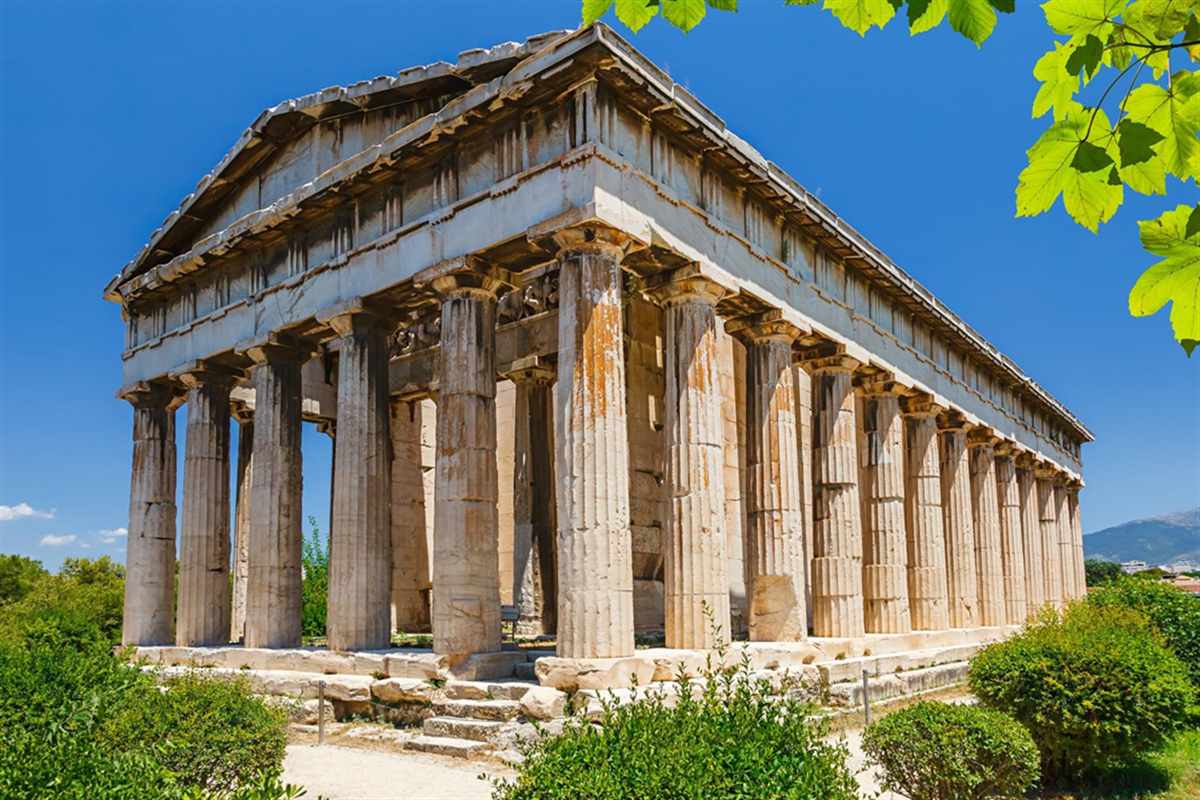
Market Hill, called the Agoraios Kolonos, bounds the Agora on the west. The Temple of Hephaestus stands on top of it. Work on it began in 449 BC. Six columns line each short side, and thirteen line each long side. From the 7th century into the 19th century, it served as the Greek Orthodox church of Saint George Akamates.
King Attalos II of Pergamon built the Stoa of Attalos, a hall 115 by 20 metres, on the east side. Its ground floor had 42 closed rooms at the rear that served as shops. The American School of Classical Studies at Athens rebuilt it in the 1950s. The Apostle Paul tour Athens and Corinth marks the Agora stop as self-led.
Who was Dionysius the Areopagite, and what is his church in Athens?
Dionysius the Areopagite was an Athenian judge at the Areopagus Court who lived in the first century. The Apostle Paul tour Athens and Corinth makes a photo stop of 20 minutes. It is at the Holy Church of Saint Dionysius the Areopagite, Patron Saint of Athens.
According to the Acts of the Apostles, Dionysius became a Christian after he heard Paul preach. He then became the first Bishop of Athens, although another count puts Hierotheus first. The Catholic and Eastern Orthodox churches honour him as a saint, and his memory is celebrated on October 3.
Athens treats him as its patron saint and as the protector of judges. Two large churches in the city carry his name. One stands in Kolonaki on Skoufa Street. A booking site’s copy of the Apostle Paul tour Athens and Corinth listing puts the church stop there. The other, on Panepistimiou Avenue, is the main Catholic church of Athens.
Dionysius left his name on the hill as well. Under Byzantine rule, a church and a monastery named for him stood on the Areopagus. That hill is a stop on the Apostle Paul tour Athens and Corinth. Today the pedestrian walkway around the Acropolis, which passes through the rock of the Areios Pagos, bears his name too.
Do not mix him up with Saint Denis, the first Bishop of Paris. A set of later writings, the Corpus Dionysiacum, also uses his name. Scholars date it to the 5th or 6th century. It shaped medieval Christian thought. The church stop on the Apostle Paul tour Athens and Corinth honours the first-century judge, not those later writings.


What are the Isthmus of Corinth and the Corinth Canal?
The Isthmus of Corinth is the narrow land bridge that joins the Peloponnese to mainland Greece. It is 6.3 kilometres wide, and the Corinth Canal cuts through it. The Apostle Paul tour Athens and Corinth stops there for 20 minutes.
The Gulf of Corinth lies west of the isthmus, and the Saronic Gulf lies east. In the first century AD the geographer Strabo noted a stele there. One inscription faced east and read “Here is not Peloponnesus, but Ionia”. The other faced west and read “Here is Peloponnesus, not Ionia”. Plutarch credited the hero Theseus with raising it.
The Apostle Paul tour Athens and Corinth lists the Isthmus Canal as a highlight. In the 7th century BC the tyrant Periander dropped a canal plan. He built the Diolkos instead, a stone road for dragging ships overland. Remnants of it still lie beside the canal. Writers name the cost, a lack of labour or fear for Corinth’s trade.
Julius Caesar and Caligula both considered a canal but were assassinated first. Nero broke the ground in AD 67, but the work stopped after his death. The canal on the Apostle Paul tour Athens and Corinth is a modern work. The idea revived after Greece won independence from the Ottoman Empire, and builders finished the cut in the 19th century.
The canal links the two gulfs and has no locks. It is 6.4 kilometres long and 8 metres deep, and 24.6 metres wide at sea level. A ship that passes through avoids a 700-kilometre journey around the Peloponnese. Today it is mainly a tourist attraction. The Apostle Paul tour Athens and Corinth treats it as a sightseeing stop.
What is Kenchreai, the eastern port of Corinth?
Kenchreai was the eastern of the two main ports of Ancient Corinth, on the Saronic Gulf. It served ships coming from Athens, Ionia, Cyprus and the Levant. The Apostle Paul tour Athens and Corinth spells the port Kechries.
Kenchreai lies about 8 kilometres southeast of modern Corinth, at the eastern end of the Corinth Canal. A village with a school and a church stands on the site today. The Apostle Paul tour Athens and Corinth visits the port right after the isthmus. Earthquakes have lowered the coast a little since ancient times.
According to the Acts of the Apostles, Paul stopped at Kenchreai on his second missionary journey. There he had his hair cut to fulfil a vow, probably a Nazirite vow. His letter to the Romans names a woman called Phoebe in the local assembly. The Apostle Paul tour Athens and Corinth describes the port as historic.
Kenchreai flourished during the Roman Empire. Its crescent-shaped harbour was enclosed by massive concrete breakwaters and protected by sea-walls. Ancient writing and inscriptions attest to cults of Aphrodite, Isis, Asklepios, Poseidon, Dionysos and Pan. The community was small but prosperous, and it stood out for its social, cultural and religious diversity.
Excavators sponsored by the American School of Classical Studies have partly uncovered the harbour. They found rooms by the waterfront, probably warehouses, plus fishtanks, mosaic floors and a Christian basilica. They also found over a hundred glass panels from the fourth century, still packed in crates. The Apostle Paul tour Athens and Corinth allots 20 minutes to this sightseeing stop.
What did Paul do in Ancient Corinth, and which letters did he write to the Corinthians?
According to the Acts of the Apostles, Paul lived in Corinth for about 18 months. He worked there as a tentmaker and later wrote two letters to the Corinthians. The Apostle Paul tour Athens and Corinth gives the ruins 1 hour, with an extra fee.
The Apostle Paul tour Athens and Corinth reaches a city Paul first visited in AD 49 or 50, says Wikipedia. According to the Acts of the Apostles, he met a Jew named Aquila and his wife Priscilla. They had left Italy when Claudius deported all Jews from Rome. Paul lived and worked with them, because they were tentmakers too.
According to the Acts of the Apostles, the Jews of Corinth brought Paul before the Roman governor Gallio. Gallio refused to judge the case. Wikipedia dates his time as governor to AD 51 to 52. One tour seller places the hearing at the Bema. Wikipedia lists the Bema as an important monument, later the Church of Apostle Paul.
The city that received First Corinthians is a stop on the Apostle Paul tour Athens and Corinth. It answers problems in the Corinth church. These include divisions, marriage, food offered to idols, worship, spiritual gifts and the resurrection of Jesus. The earliest manuscript is Papyrus 46, dated between 175 and 225 CE.
Wikipedia attributes Second Corinthians to Paul and a co-author named Timothy. It is addressed to the church in Corinth and Christians in Achaea. Wikipedia places the writing of First Corinthians in Ephesus and Second Corinthians in Macedonia. The letters themselves show that Paul wrote at least four letters to Corinth, but the New Testament holds only two.
What are Acrocorinth and the Archaeological Museum of Ancient Corinth?
Acrocorinth is the fortified rock above Ancient Corinth. The Archaeological Museum of Ancient Corinth holds finds from the city below. The Apostle Paul tour Athens and Corinth visits both, one after the other.
The Acrocorinth stop on the Apostle Paul tour Athens and Corinth lasts 30 minutes and is self-led. Wikipedia calls Acrocorinth a monolithic rock that overlooks the ancient city. The hill was occupied without a break from archaic times to the early 19th century. Leo Sgouros defended it against the Crusaders for three years.
The Byzantine Empire fortified the hill heavily. Three circuit walls formed the man-made defence of the hill. On the highest peak stood a temple of Aphrodite, which became a church and then a mosque. Archaeologists have also worked at the Sanctuary of Demeter and Kore on the slopes of Acrocorinth. The museum houses finds from this work.
The museum stop on the Apostle Paul tour Athens and Corinth lasts 45 minutes and is self-led. The museum stands inside the archaeological site of Ancient Corinth. The architect Stuart Thompson designed it, and the American School of Classical Studies at Athens built it. Thompson drew on the architectural model of the Chicago school.
Its Classical gallery holds finds from the Geometric, Archaic, Classical and Hellenistic city, including objects from the Tenea cemetery. The Roman gallery shows mosaics from Roman villas. The atrium holds Greek and Latin inscriptions and finds that prove a Jewish community lived in the Roman city. Next on the Apostle Paul tour Athens and Corinth comes Ancient Corinth itself.
What else do travellers ask about the Apostle Paul tour Athens and Corinth?
Is the Apostle Paul tour Athens and Corinth only for religious visitors?
No. The operator’s listing calls the Apostle Paul tour Athens and Corinth a historical and spiritual journey. The visitgreece.gr page says Paul’s route in Greece can touch believers and also everybody who loves history.
According to Wikipedia, religion in Greece is dominated by Christianity, in particular the Greek Orthodox Church. The same article says the Greek Constitution recognises Eastern Orthodoxy as the “prevailing” faith. It also guarantees freedom of religious belief for all.
Did Paul visit Greek places beyond Athens and Corinth?
Yes, says the visitgreece.gr page. By island tradition, Paul landed in the port of the ancient city on Samothrace, now called Paliapoli. In memory, locals built a three-aisled Early Christian church there, using pieces of ancient buildings.
The page names Neapoli as the place where Paul first reached European land. In Philippi, it names Lydia as the first person baptised. There, Paul and Silas were caned and jailed. A massive earthquake spread panic, and the prison doors opened. The Apostle Paul tour Athens and Corinth keeps to the two cities in its listing.
Does Athens have a church named for Paul?
Yes. The visitgreece.gr page says a church of Apostle Paul was founded very close to the heart of Athens. Two years later, Queen Olga set the foundations of a new and larger church. This happened under Metropolitan bishop Prokopios and Mayor Labros Kallifronas, says the page.
An Archbishop of Athens ruled that Paul’s Vespers must be held on the Areopagus, the page adds. The Apostle Paul tour Athens and Corinth does not list this church as a stop.
What is the Temple of Apollo in Ancient Corinth?
Wikipedia dates the Temple of Apollo to the mid-6th century BC. It calls the temple a dominating monument, one of the only features of the site visible since antiquity. Another Wikipedia article calls it an emblem of the city that reflected its growth and prosperity.
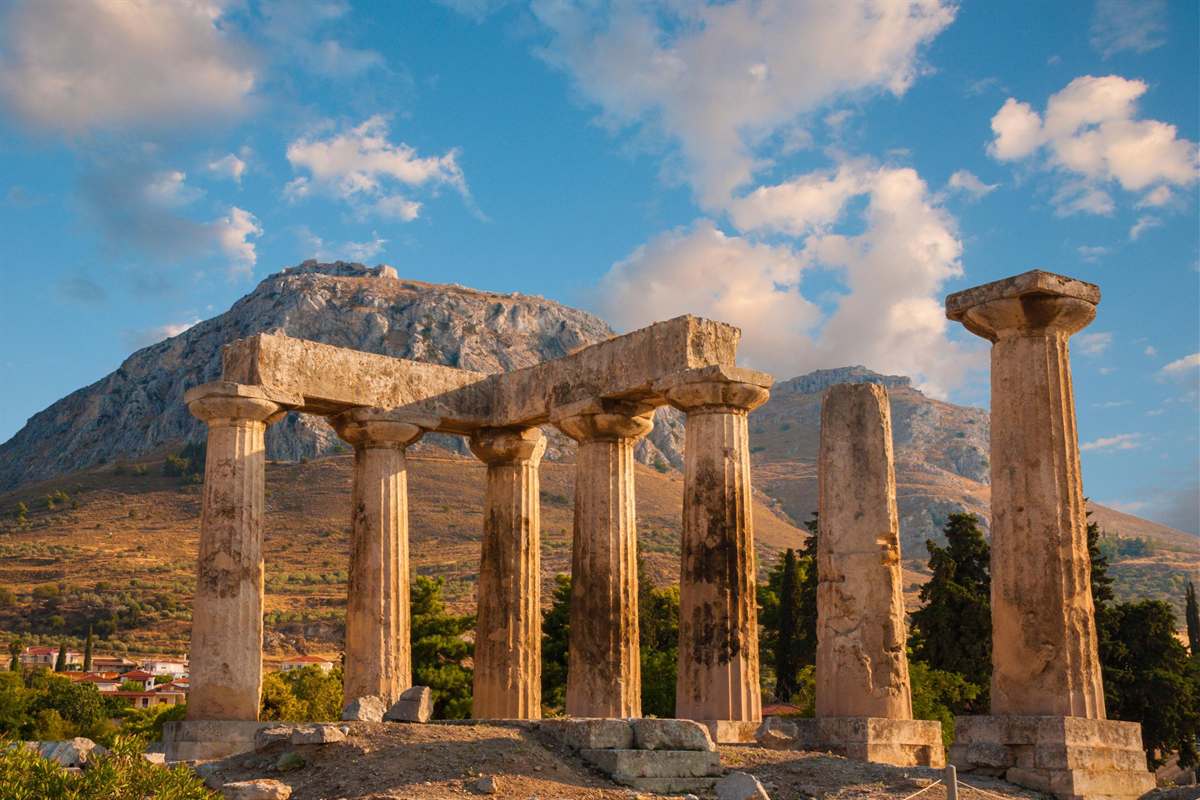
A photo on Wikipedia’s Acrocorinth page shows the temple with Acrocorinth in the background. The Apostle Paul tour Athens and Corinth names the stop Ancient Corinth, not single monuments inside it.
What do I bring and wear on the Apostle Paul tour Athens and Corinth?
The listing’s what-to-bring list holds one line: comfortable shoes. Another copy of the listing, on a booking site, adds a hat and sunscreen. It says the weather in Greece can be hot and sunny.
That copy also calls the day suitable for all fitness levels and offers a child seat on request. The listing gives no walking distances.