Sip and paint Thessaloniki is a hands-on art class where you sit down with a glass of Greek wine and paint a canvas, a mug or a ceramic plate. Our homepage lists more tours in Greece for days out around Thessaloniki.
This page covers what the class includes, how the session runs, where the art space is, who can join, the item you paint, the Greek designs and colours, the wine, what to wear, what is not included and what to see in the city around the class.
What does the sip and paint Thessaloniki class include?
The sip and paint Thessaloniki class includes Greek wine and all painting materials. You choose a canvas, a ceramic mug or a ceramic plate, and you take your finished artwork home. The activity provider is Like a Local SKG.
You are welcomed with a glass of Greek wine and a warm “Yamas” greeting. At the sip and paint Thessaloniki class, you then sip your wine as you paint. The operator’s listing says you create at a Mediterranean pace. It counts the Greek music as part of the class too.
The operator’s listing names seven items as included:
- Greek wine
- All painting materials
- Your choice of a canvas, a ceramic mug or a ceramic plate
- Step-by-step help from the instructor
- All necessary equipment
- Greek music and a relaxed Mediterranean atmosphere
- Your finished handmade artwork to take home
The operator’s own website lists a shorter set of four inclusions. These are the workshop, the choice of item, all painting materials and supplies, and the finished artwork to take home.
The operator’s listing also names a short set of extras that sit outside the sip and paint Thessaloniki class, such as mailing your piece home.
How long is the class, and how does the session run step by step?
The sip and paint Thessaloniki class lasts 1.5 hours. The operator’s own website gives the same length as approximately 1 hour 30 minutes. The session runs in six steps: welcome, choosing, the theme, sketching, painting, and photos with your piece to take home.
That is 90 minutes in total. For the sip and paint Thessaloniki class, the operator’s listing does not print the start times. It says you see them when you check availability. The listing also does not split the time into minutes for each step, so the order is the fixed plan.
The operator’s own website names four stages. They are Arrival and Welcome, Introduction to the Workshop, Relax and Enjoy, and Take Home Your Creation. The operator’s listing gives more detail, so the six steps below follow its story.
Step one is the welcome. You arrive at a cozy art space in Thessaloniki and receive your glass of Greek wine.
Step two is the choice. You choose what you want to paint: a canvas, a mug or a ceramic plate. Then you take your seat as soft Greek music plays in the background.
Step three is the theme. Your friendly instructor introduces a theme inspired by Greek culture and shows you the basic techniques. At the sip and paint Thessaloniki class, this introduction comes before the sketch.
Step four is the sketch. You start by sketching your design. The painting comes after the sketch, not before it.
Step five is the painting. You slowly bring your design to life, sip your wine and enjoy light conversation. You also hear local stories about everyday life. The listing says there is no pressure, just creativity, laughter and a welcoming atmosphere.
Step six is the finish. You admire your finished piece, take photos and leave with your handmade creation. The operator’s listing calls it a unique souvenir and a memory from Thessaloniki. That is how the sip and paint Thessaloniki class ends.
Where is the art space for sip and paint Thessaloniki?
The art space for sip and paint Thessaloniki sits at Moskof 12, Thessaloniki 546 27. The operator’s listing prints this address and calls the place a cozy art space. OpenStreetMap lists Moskof 12 in the Fragkomahalas neighbourhood.
The operator’s listing also prints the address in Greek, as Μοσκώφ 12. That spelling helps when you type the street into a map app or show it to a taxi driver. Search it with the number 12 to find the building for sip and paint Thessaloniki. The listing gives no walking directions and no transport advice.
Three sources describe the area around this address. OpenStreetMap lists a pedestrian stretch of Moskof under Ladadika. Wikivoyage places Ladadika on the west side of the centre, next to the port. Wikipedia adds that the so-called Frankish district, with French and Italian merchants and residents, was located beside Ladadika.
Wikipedia says the core of Ladadika is surrounded by Tsimiski, Salaminas, Kountourioti and I. Dragoumi streets. It does not say that Moskof lies inside that core. Use the street address, not the district name, to find the door.
The operator’s own website calls its sip and paint Thessaloniki venue a welcoming studio in the heart of the city. The operator’s listing uses the words cozy art space for the same kind of place.
Wikivoyage gives three tips for finding your way in the centre. A street that goes downhill leads you to the waterfront. The biggest streets parallel to the sea, starting from the sea, are Leoforos Nikis, Tsimiski, Egnatia, Agiou Dimitriou and Kassandrou. Licensed taxis are dark blue with a taxi light.
The operator’s listing asks guests to arrive 5 minutes earlier, to get settled and to choose their painting item. Build those 5 minutes into your walk to the art space for sip and paint Thessaloniki.
Who can join, and do you need painting experience?
You do not need painting experience for sip and paint Thessaloniki. The operator’s listing says no prior painting experience is needed, and the instructor leads you step by step. The operator’s own website calls the activity suitable for everyone.
The operator’s listing says the class teaches basic painting techniques and takes you through the process step by step. That is the reason it gives for needing no experience. A friendly instructor introduces the theme and shows the basics before you start. The operator’s own website lists beginner-friendly painting techniques among its highlights.
Beginners and experienced painters can both join. The operator’s own website says the class suits an experienced artist and a first-time painter alike. The same page names three kinds of guests: friends, a partner, or a solo traveller. So sip and paint Thessaloniki works for a group, a couple or one person.
The operator’s listing names no age limit. The operator’s own website has a children option for guests up to 16 years old. It also says non-alcoholic drinks can be provided for underage guests on request. Ask the host about age rules before you bring children.
Tell the host before the day, not at the door. The operator’s listing asks guests to inform the host in advance about any allergies and about any accommodations they need. If you plan to join sip and paint Thessaloniki with special needs, send that message early.
Canvas, mug or plate: which item do you paint?
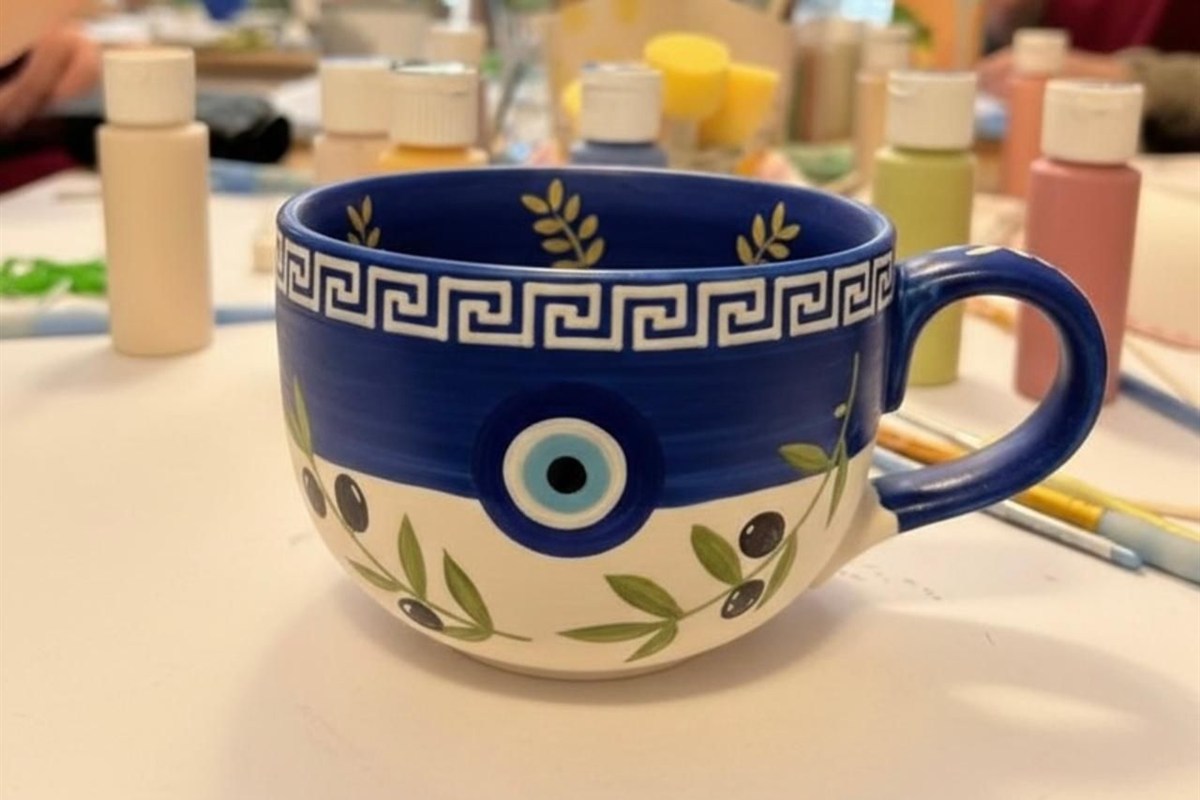
At sip and paint Thessaloniki you choose from three items: a canvas, a ceramic mug or a ceramic plate. The operator’s listing counts that choice as part of the class, and you leave with your finished handmade piece.
The listing for sip and paint Thessaloniki calls the mug and the plate ceramic. The third option is a canvas. The highlights, the description and the list of inclusions all repeat the same three names. The choice comes before you take your seat. The operator’s own page calls this step choosing your painting surface.
The listing’s summary says the class teaches basic painting techniques. It adds that you are led through creating a canvas, a ceramic mug or a ceramic plate. It names no extra steps for any one item. So at sip and paint Thessaloniki the choice rests on your own taste.
Start from what you want to carry home. A sip and paint Thessaloniki class ends with you taking the finished piece away, so the item becomes your souvenir. The listing gives no sizes for the canvas, the mug or the plate. Ask the operator if size matters to you.
The listing does not say how the mug or plate is finished. It does not say whether either item is safe for food or for a dishwasher. Ask the operator before you plan to drink from your mug or serve food on your plate. Until you hear back, treat a sip and paint Thessaloniki piece as a keepsake.
How did ancient Greek potters paint their vases?
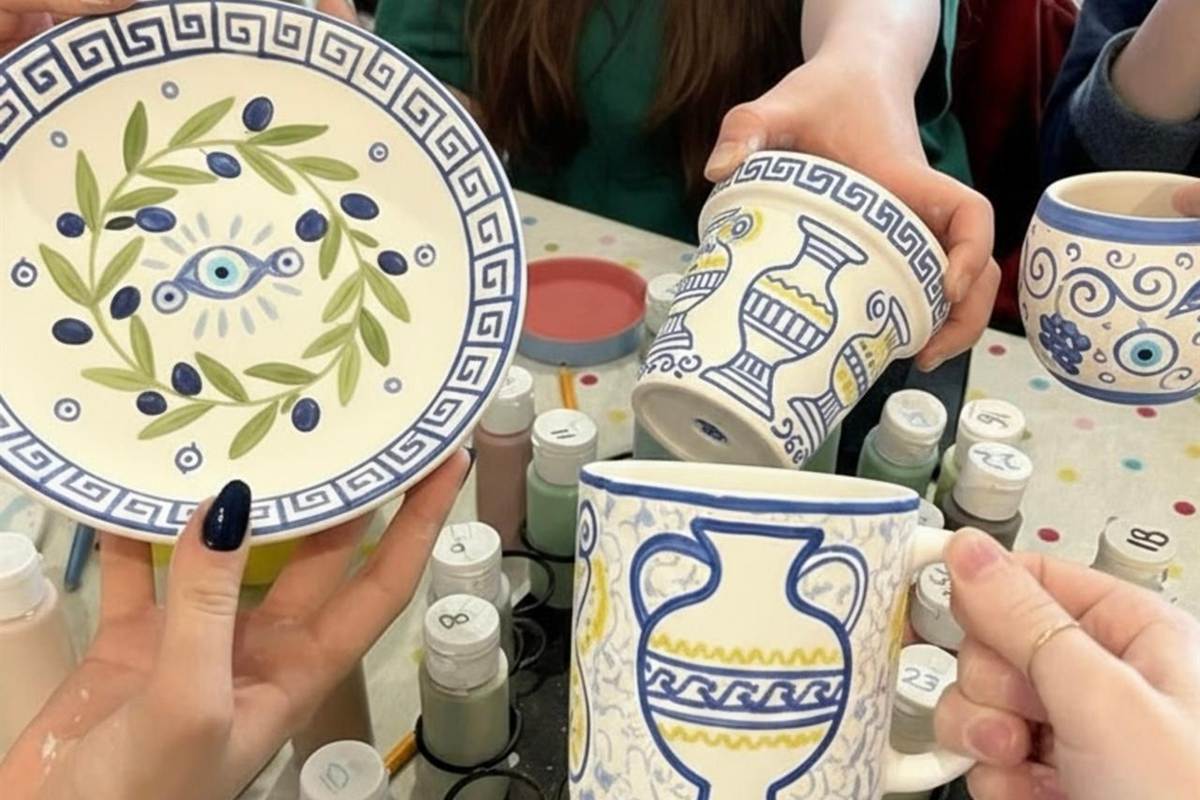
Greek potters painted vases long before any sip and paint Thessaloniki class existed. They worked in the black-figure style from about 700 BC. The red-figure style, from around 530 BC, reversed the colours.
Black-figure painting was developed around 700 BC in Corinth. Attic painters switched to it between about 635 BC and the end of that century. The style became established in Athens around 600 BC. Attic potters also had excellent, iron-rich clay from Attica.
The painter put the figure on the vase with a clay slip. Inner outlines and details were incised into the slip, and two other earth pigments added red and white. The success of the work was judged only after a complicated, three-phase firing.
Red-figure is the reverse of black-figure. The background is painted black, while the figures and details stay in the natural red or orange colour. The first red-figure vases were made around 530 BC, and the invention is credited to the Andokides Painter.
In black-figure work, details had to be scratched into the painted surface. That was less accurate than putting detail on directly with a brush. Within decades red-figure replaced black-figure as the dominant style. Mainstream red-figure pottery ceased around 360 BC. The last Athenian vases with figures date to around 320 BC at the latest.
Black-figure painting was the first art style to give rise to a significant number of identifiable artists. Exekias (545-520 BC) is generally considered the absolute master of that style. He signed 12 of his surviving vessels as potter.
Painted vases also travelled, a little like the piece you carry home from sip and paint Thessaloniki. Finer pottery from Attica was imported by other civilizations around the Mediterranean, such as the Etruscans in Italy. One vase shape, the krater, was used to dilute wine.
All of this is history, not part of sip and paint Thessaloniki. The operator’s listing names no ancient technique. It offers a canvas, a mug or a plate and basic painting techniques.
Which Greek themes and symbols inspire the designs?
At the sip and paint Thessaloniki class, your instructor presents a theme inspired by Greek culture. Local stories about Greek symbols are told as you paint. The operator’s listing names no single symbol, so this section tells two Greek ones as facts about Greek art.
The operator’s own website says the designs for sip and paint Thessaloniki draw on Greece’s rich artistic heritage. The meander and the evil eye are two symbols tied to Greece. The listing does not say the class paints either one.
The meander is a border made from one continuous line, shaped into a repeated motif. It is also called the Greek key or the Greek fret, but those names are modern. The name recalls the twisting path of the Maeander River in Asia Minor.
Meanders are common decorative elements in Greek and Roman art. In ancient Greece they appear in architectural friezes. A photo from Rhodes shows one laid into a street pavement of beach stones. The design also appears far from Greece, on Shang bronzes in China and in Mayan art.
The evil eye is a belief in a curse brought by a harmful glare. In modern Greece it is called kako mati, or simply mati, which means “eye”. Peter Walcot’s book Envy and the Greeks listed more than one hundred ancient works that mention it.
Ancient Greeks placed talismans in their houses and wore amulets against it. In Greece, these amulets take the form of an eye looking back at someone. A Pew Research survey found that 66 percent of adults in Greece reported believing in the evil eye.
Blue and white disks of concentric circles represent an evil eye. They are common protective talismans in West Asia and the Balkans, found on the prows of boats.
The listing promises stories about Greek symbols but prints no list. So for sip and paint Thessaloniki, the meander and the evil eye stay background facts about Greek art.
Which colours and materials do you use at sip and paint Thessaloniki?
At sip and paint Thessaloniki you paint with acrylic paints, brushes and markers, and the class supplies all of them. The operator’s listing names Mediterranean colours such as blue, white and terracotta.
At sip and paint Thessaloniki, the listing says you paint in colours like blue, white and terracotta. These three are examples, not a full palette. The operator’s own website calls them Mediterranean-inspired colours. It adds that you learn simple painting techniques as you paint.
Terracotta is one of the three colours for sip and paint Thessaloniki. The word means “baked earth” in Italian and comes from the Latin terra cocta, “cooked earth”. Terracotta is a clay-based ceramic fired at relatively low temperatures. The word is also used for a brownish-orange colour.
Acrylic paint is a fast-drying paint made of pigment suspended in an acrylic polymer emulsion. Water-based acrylics become water-resistant when dry. Wet acrylic paint washes off brushes and skin with water. The operator’s listing names paints, brushes and markers only.
Acrylics work on paper, canvas and a range of other materials. Painters can thin them with water for a matte, watercolour-like look. Acrylic medium gives the paint a rich, glossy look instead.
The acrylic paint in the sip and paint Thessaloniki class has an artistic history too. Mexican mural painters such as Diego Rivera and David Alfaro Siqueiros were among the first to try it. They were impressed by its durability.
What is sip and paint, and where did the idea come from?
Sip and paint is a class where an artist gives step-by-step instructions for a painting. You drink wine or another drink while you paint, and you keep the result. Wikipedia calls it the paint and sip industry. The sip and paint Thessaloniki class follows the same idea with Greek wine.
Wikipedia says these businesses hire professional artists to teach the painting. Guests reproduce a pre-selected work of art, and they keep their creations when the class ends. The classes treat painting as a fun way to relieve stress, not as a technical skill that needs hard practice.
The drink has a purpose in this format. Wikipedia says alcohol is used to reduce inhibitions and overthinking, so the creative process feels easier. In a sip and paint Thessaloniki session, the wine is part of the class. The operator’s listing counts it as included.
Wikipedia’s history section names two studio brands in the United States. Sips ‘N Strokes began near Birmingham, Alabama, early in the 21st century. Its founder, Wendy Lovoy, offered painting classes for children and adults. The studio was among the first to use a bring-your-own-beverage format for adult classes.
Painting with a Twist followed five years later in Mandeville, Louisiana, set up by Cathy Deano and Renee Maloney. The page names no single inventor of the format.
Wikipedia says paint and sip studios are mainly franchises. Guests bring their own drinks or buy them where the studio holds a liquor license. A sip and paint Thessaloniki class handles the drink differently, because the Greek wine is included.
Which Greek wine do you sip during the class?
The operator’s listing names Greek wine in three colours: white, red and rosé. It does not name the grape, the winery or the label. So the sip and paint Thessaloniki listing gives the colours, but not the bottle.
The facts below describe Greek wine in general, not the bottle you receive in the sip and paint Thessaloniki class. Wikipedia calls Greece one of the oldest wine-producing regions in the world. By its account, Greece has the second-oldest grape wine remains ever found, plus the earliest known traces of crushed grapes. It counts approximately 200 vine varieties.
Thessaloniki lies in Macedonia, and Wikipedia lists six wine areas under that region. They are Amyntaio, Epanomi, Goumenissa, Naoussa, Pieria and Chalkidiki. A sip and paint Thessaloniki class takes place in the same region as these wine areas.
Xinomavro is the red grape of the region. Its name means “sour black”. Wikipedia calls it the predominant grape variety in Macedonia, centred on the town of Naousa. Its wine has a rich tannic character, ages well, and has a taste that recalls tomatoes and olives. The Naoussa Protected Designation of Origin requires 100% Xinomavro grapes.
For white wine, Wikipedia names three grapes that grow in Macedonia. Malagousia gives elegant, full-bodied wines with perfumed aromas. Roditis, whose name means the “pink” or “rose” grape, makes light white wines with citrus flavours. Athiri is a lower-acid grape and one of the oldest, now planted in Macedonia, Attica and Rhodes.
Rosé is the third colour on the sip and paint Thessaloniki list, and it has a northern link too. Negoska is found in Northern Greece and also gives rosé and red wines. It is blended into the PDO Goumenissa wine.
The sip and paint Thessaloniki class pours a Greek white, red or rosé. The listing leaves the grape and the label open. None of these local names is a promise about your glass.
What do you wear and bring to the class?
Wear clothes that can get dirty. For sip and paint Thessaloniki, the operator’s listing names this as the one item to bring. It warns that paint can stain, so choose an outfit you are happy to see marked.
The listing says it twice. Its “What to bring” list holds one entry: clothes that can get dirty. Its “Know before you go” notes ask for clothes you do not mind getting paint on. Certain colours can stain. The listing sets no other dress code.
The included list names an apron and all necessary equipment. Wikipedia describes an apron as a garment covering the front of the body, over clothing, to protect the clothing underneath. Its stated purposes include protecting clothes and skin from stains and marks. That fits a sip and paint Thessaloniki class, where the listing warns about stains.
The listing supplies the apron and still asks for clothes you do not mind marking. Treat the apron as extra cover, not a replacement for old clothes. The included list also covers all painting materials, so you bring no paints or tools of your own.
The listing names acrylic paints among the materials. Wikipedia calls acrylic a fast-drying paint and says water-based acrylic becomes water-resistant when dry. Dry acrylic paint is generally non-removable from a solid surface it sticks to. These facts fit the stain warning at sip and paint Thessaloniki: paint that dries stays water-resistant.
Wet acrylic is different. Wikipedia says water removes it easily from skin and brushes. It adds that oils or warm, soapy water also lift it from skin. Rinse paint from your hands while it is still wet.
The listing also has a “Not allowed” line: weapons or sharp objects. It gives no reason for the rule. Keep both out of your bag when you head to the class for sip and paint Thessaloniki.
What is not included, and can your artwork be shipped home?
Shipping is not part of the booking for sip and paint Thessaloniki. The operator’s listing puts shipping of your artwork, “if you prefer it mailed”, on its not-included list. It gives no method for mailing, so ask the operator first.
The listing’s not-included list holds four items:
- Shipping of your artwork, if you prefer it mailed.
- Personalised design requests outside the standard theme.
- Extra drinks or refreshments.
- Tips for the instructor, which the listing marks as optional.
The finished artwork to take home sits on the included list, apart from shipping. Nothing on the included list covers these four items.
The shipping line is short: shipping of your artwork, if you prefer it mailed. The listing does not say who arranges the mailing, how to request it or how long it takes. For sip and paint Thessaloniki, the listing’s own route home is simple. At the end you leave with your handmade creation.
At sip and paint Thessaloniki, each session follows a theme drawn from Greek culture. Personalised design requests outside the standard theme are not included. The listing does not define what counts as outside the theme, so ask before you plan a custom design.
Extra drinks or refreshments are outside the booking too. The included list names Greek wine and no other drink or snack. Tips for the instructor are marked optional on the listing. Whether to leave one at sip and paint Thessaloniki is your choice.
What is Thessaloniki, the city where the class takes place?
Thessaloniki is the second-largest city in Greece. It is the capital of Central Macedonia and the largest city of Northern Greece. The operator’s listing sets the sip and paint Thessaloniki class inside this city.
The city of sip and paint Thessaloniki lies on the Thermaic Gulf, at the northwest corner of the Aegean Sea. The delta of the Axios bounds it on the west, and Mount Chortiatis bounds it on the east. Its nickname is the Nymph of the Thermaic Gulf.
Over 300,000 people live in the city proper, and slightly over one million live in the metropolitan area. Wikipedia calls Thessaloniki Greece’s second major economic, industrial, commercial and political centre. Its main university, Aristotle University, is the largest in Greece and the Balkans.
Sip and paint Thessaloniki takes place in a port city. Wikipedia calls the city a major transportation hub for Greece and southeastern Europe, notably through the Port of Thessaloniki. Wikivoyage says it was once the biggest port of the Balkans. The city has also held the title of European Youth Capital.
Anyone who books sip and paint Thessaloniki paints in a city with a long story. King Philip II of Macedon named a daughter Thessalonike, meaning Thessaly Victory, after a victory in Thessaly. Cassander, a later king of Macedon, married her and founded the city in her name in 315 BC.
The city grew into a major metropolis of the Roman Empire. Later it became the second-largest and wealthiest city of the Byzantine Empire after Constantinople. In Greek it also has the nickname i Symprotevousa, which means “the co-capital”.
During the Ottoman years a large Jewish community formed there, at times even the majority. That gave the city the name “The Jerusalem of the Balkans”. Muslims, Jews and Christians lived together there for over 400 years.
Which other sip and paint workshops run in Thessaloniki?
Two other painting workshops in Thessaloniki appear on pages that state their details. One was a wine glass and candle evening, and the other is an acrylic canvas workshop. Neither is the same as sip and paint Thessaloniki.
An events site listed a Paint and Sip evening called Spring Bloom at Craftopia Creative Hub in Thessaloniki. It was set for a Friday from 6 to 8 in the evening. Guests painted a wine glass and decorated a candle, and the workshop was in English.
Guests brought their own drink, and the organiser provided the glassware and light snacks. On the operator’s listing for sip and paint Thessaloniki, Greek wine is included. The events page now marks the evening as ended and says cancellations and changes were not allowed.
Another workshop seller lists an acrylic painting workshop in Thessaloniki. A professional artist leads it, and it lasts 3.5 hours. Guests paint a 30 by 30 cm canvas. The page names two subjects: a house in front of the sea and a Cycladic balcony. All painting materials are provided.
The seller pitches it as a team bonding activity and welcomes beginners. The page lists light snacks and drinks, not wine. So it is a painting class, not a second sip and paint Thessaloniki session.
Each page states its own details. Compare the length, the drink and the items before you book sip and paint Thessaloniki or any similar workshop.
What can you see in Thessaloniki before or after the class?
Before or after sip and paint Thessaloniki, you can see the White Tower and Aristotelous Square. You can also see the Arch and Rotunda of Galerius and the Ladadika district. These are facts about places in the city, not stops on the class. The operator’s listing names no sights.
The White Tower is a monument and museum on the waterfront. It stands 34 metres high above ground level. The Ottomans used it as a fortress, a garrison and a prison. A convict whitewashed it in exchange for his freedom, and that gave the tower its name. Today it is the symbol of the city.
Aristotelous Square is the main city square. It sits on Nikis avenue, on the waterfront, in the city centre. The French architect Ernest Hébrard designed it. Festivals and the yearly Christmas and carnival celebrations take place there. The Aristotelous Promenade, lined with cafes and restaurants, climbs uphill from the square to the Roman Forum.
History fans can add the Arch of Galerius to a day with sip and paint Thessaloniki. The arch stands where Egnatia and Dimitriou Gounari streets meet. Its sculpted marble panels celebrate the victory of Galerius over the Sassanid Persian ruler Narses.
The Rotunda of Galerius is 125 metres northeast of the arch. Both are early fourth-century monuments, and both are on UNESCO’s World Heritage List. The Rotunda has been a mausoleum, a church, a mosque and a church again. Its walls are more than 6 metres thick, which has helped it withstand earthquakes.
The name Ladadika comes from the olive oil shops in the area. The district now holds bars, restaurants and pubs in old oil stores and merchant warehouses. They open onto pedestrian streets and small squares. Plan a drink there after sip and paint Thessaloniki. The Ministry of Culture listed Ladadika as a heritage site.
Ano Poli, the Upper Town, is the highest point in Thessaloniki. It survived the Great Fire. So it keeps small stone-paved streets, old squares and homes in old Greek and Ottoman style. The Heptapyrgion fort and a large part of the city’s remaining walls stand there too.
The waterfront promenade, Nea Paralia, has 12 thematic gardens and parks. In summer it fills with people on long evening walks, which Thessalonians call volta. Add a stroll there to your day of sip and paint Thessaloniki.


How do group size and free cancellation work for sip and paint Thessaloniki?
Sip and paint Thessaloniki runs as a standard group of up to 15 people. The operator’s listing lets you cancel without charge until one day before your class, and it then refunds the full amount.
The group size is a ceiling. The listing calls it a standard group and sets the limit at 15 people. It names no minimum, so a class of sip and paint Thessaloniki can hold fewer guests than that.
The listing keeps the whole rule to a single line. A full refund means you get back everything you paid. The listing prints no rule for a cancellation made later than 24 hours ahead. Cancel early if your plans are unsure.
Other pages word the rule differently. The operator’s own website sets the same one-day limit for a free cancellation. A ticket site lists a class with the same title. It sets the cut-off at 11:00 in the morning, one day before the date of use. Read the rule on the page where you book sip and paint Thessaloniki.
What else do people ask about sip and paint Thessaloniki?
What does “Yamas” mean when the wine arrives?
The operator’s own website calls “Yamas” a traditional word of welcome. Neither the listing nor that website translates it. Say it as you raise your glass at sip and paint Thessaloniki.
Wikipedia’s list of toasts gives the Greek forms “στην υγειά σου/μας” and “γειά”. It marks “γειά” as meaning “for health”. It adds that the general theme of a toast is good luck or good health.
Wikivoyage’s Greek phrasebook says the greeting “Γεια σας” means literally “your health”. So the same word for health sits in the Greek toast and in the Greek hello.
The phrasebook also gives “Ένα ποτήρι κόκκινο/λευκό κρασί, παρακαλώ” for “A glass of red/white wine, please”.
Does the class come with a Digital Companion?
The operator’s own website says the sip and paint Thessaloniki experience includes a Digital Companion. It describes immersive audio. The audio explores Greek artistic traditions and ceramic craftsmanship. It also covers the history of pottery in Greece and the cultural inspiration behind your session.
The operator’s listing does not mention it. Ask the operator how the audio reaches you before your sip and paint Thessaloniki class.
How late can you book, and where can you get help in town?
The operator’s own website says the latest booking is accepted up to 8 hours before the activity. The limit is counted in hours, not days. Book early if you want a sure place at sip and paint Thessaloniki.
Need help in the city before your sip and paint Thessaloniki class? Wikivoyage lists a Tourist Information Center at Tsimiski 136, at Aristotelous Square. It adds that tourist info booths also stand at the central bus stations.
What is ceramic glaze, and does the class use it?
Ceramic glaze is a glassy coating on ceramics. Wikipedia says it is used for decoration and to make an item impermeable to liquids. It also minimises the adherence of pollutants.
Glaze is applied by spraying, dipping, trailing or brushing on a watery suspension of unfired glaze. The colour after firing can differ greatly from the colour before firing.
Wikipedia dates the first glazes on stone materials to the fourth millennium BC. It adds that lead glazes have been used for about 2,000 years in China, around the Mediterranean and in Europe.
The listing for sip and paint Thessaloniki names no glaze and no kiln. Treat glaze as a craft fact, not a step of the class.
Why do painters work in layers with acrylic paint?
Wikipedia says acrylic washes cannot be rehydrated once dry, unlike watercolour washes. So painters apply the paint in layers. The same page lists retarders, which slow drying and extend working time, and flow releases, which help colours blend.
Painters can also build thick layers. Gel and moulding paste are sometimes used to create relief features. Wikipedia credits the German chemist Otto Röhm with inventing acrylic resin, which led to acrylic paint.
The operator’s listing gives no drying time for sip and paint Thessaloniki. Ask about it before you carry your piece home.