This 3 day classical tour starts and ends in Athens and visits the classical sites of the Peloponnese and Delphi. Find more tours of this kind on our tours in Greece page.
3 Day Tour of Greece – Classical Tour
The most outstanding classical sites are visited on this tour, reminding the visitor of Greece’s ancient glory.
What does a 3 day classical tour include?
A 3 day classical tour includes an air-conditioned coach, hotel nights in Olympia and Delphi, two breakfasts and two dinners. A licensed tour leader and the site visits are part of the plan, from Athens and back.
Three operators describe the coach as air-conditioned. One adds wifi on board, and another lists headsets. Two operators rate the hotels three or four stars, and one serves breakfast and dinner at the hotel. Two operators call the tour leader licensed, and two say the tour leader speaks English. One operator offers a vegetarian meal on request.
The itinerary lists dinner on day 1, breakfast and dinner on day 2, and breakfast on day 3. Two operators leave lunch out of a 3 day classical tour. Drinks and tips are not included either. One operator says the hotel stay tax is paid directly to the hotel.
Three operators list entrance fees, and one of them words it as all admission tickets. A fourth operator names only the visits: Epidaurus, Mycenae, Olympia, Delphi and a short stop at Nafplion. Ask whether tickets are part of the booking.
Two operators include hotel pick-up in Athens, and one adds hotel drop-off. One says gathering everyone takes up to about 1 hour, with a day 1 departure at about 8:45. Another sends an email with a meeting point if your hotel is not on its list. A 3 day classical tour ends back in Athens.
How far are the drives on a 3 day classical tour?
The leg from Olympia to Delphi on day 2 of a 3 day classical tour is about 225 km. A route planner gives 3 hours 40 minutes by car for that drive.
On day 1, the Corinth Canal to Epidaurus is 55 km, about 1 hour 17 minutes. Epidaurus to Nafplion adds 26 km, about 31 minutes, and Mycenae lies 21 km from Nafplion.
A direct drive from Athens to Mycenae is 128 km, about 1 hour 27 minutes. The coach goes through the canal, Epidaurus and Nafplion first. From Mycenae to Olympia, a direct drive is 163 km and 2 hours 42 minutes. On a 3 day classical tour, the coach reaches Olympia through Tripolis and Megalopolis.
These figures are car times from route planners. The coach adds short stops at the canal and at Nafplion, plus the site visits. On day 2 the Olympia site comes in the morning, so the drive to Delphi follows the visit.
Day 3 of a 3 day classical tour has a shorter drive than day 2. Delphi to Athens is 156 km, about 2 hours 49 minutes by car. The day starts with the Delphi site and museum, then a couple of hours of free time. The coach drives through Arachova, Levadia and Thebes. It reaches Athens early in the evening.
DAY 1: Mycenae to Olympia
Leave by the coastal road for the Corinth Canal (short stop). Drive on and visit the theatre of Epidaurus, famous for its remarkable acoustics. Then proceed to the town of Nafplion (short stop), drive on to Mycenae and visit the archaeological site and the Tomb of Agamemnon. Then depart for Olympia through the central Peloponnesus and the towns of Tripolis and Megalopolis. Dinner and overnight in Olympia, the cradle of the Olympic Games. (D)
What do you see at the Corinth Canal and the theatre of Epidaurus?
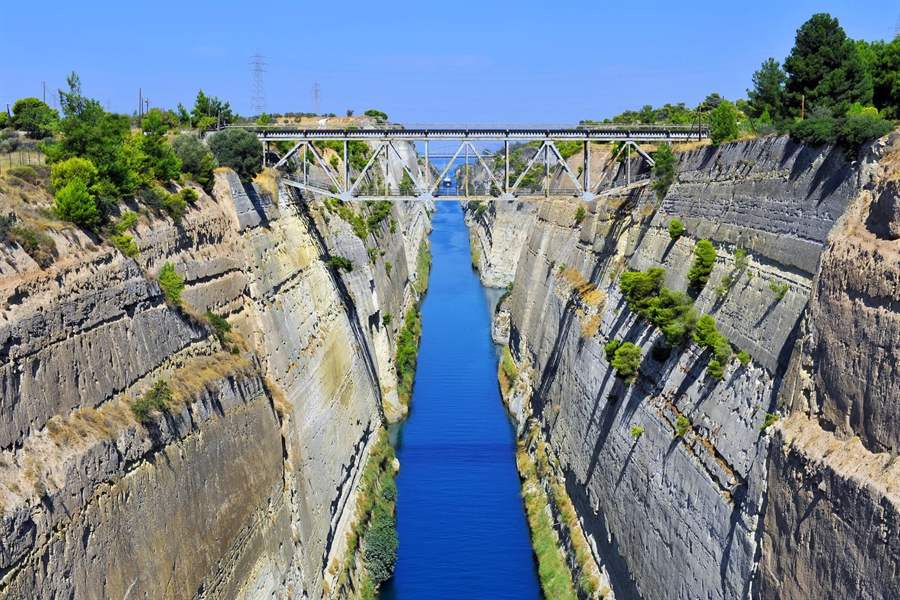
The Corinth Canal is the first stop on a 3 day classical tour. The lock-free cut is 6,343 metres long and 8 metres deep. Its channel is 24.6 metres across at the surface. The theatre of Epidaurus follows and seats up to 14,000 people.
Coaches on a 3 day classical tour halt at the canal only briefly. Itineraries call it a short stop for pictures. The walls are limestone, and the water lies at sea level.
The canal on a 3 day classical tour was finished in the 19th century after eleven years of work. Between its opening and the Second World War, work on the walls closed it for four years in total. In that war the main bridge was destroyed, and a rail and road bridge, built in 25 days, replaced it.
Itineraries for a 3 day classical tour list Epidaurus as a visit, while the canal and Nafplion get short stops. The theatre dates to the 4th century BC, and its designer was Polykleitos the Younger. One itinerary calls the sanctuary of Asklepios the first long stop of the day.
Tour leaders tell the tale that unamplified spoken words reach all 14,000 seats almost perfectly. Measurements moderate this claim, because intelligibility is not guaranteed and the voice needs good projection. On a 3 day classical tour, the shape of the theatre and its limestone seat rows both affect the sound.
The theatre belonged to the Asklepieion, the healing sanctuary of Asclepius, where ill people went hoping for a cure. Plays still run there in the Epidaurus Festival each summer. A 3 day classical tour visits a theatre that is still in use.
What is Nafplion, the town of the short stop?
Nafplion is a coastal city in Argolis and was the first capital of modern Greece. A 3 day classical tour stops here briefly for pictures, then drives on to Mycenae.
Operator itineraries for a 3 day classical tour call the stop short or brief and give no length for it. Much of the old town lies on a peninsula that sticks out into the Argolic Gulf.
Nafplion remained the capital until King Otto chose to move it to Athens. Ioannis Kapodistrias, first head of state of liberated Greece, first set foot on the mainland here.
The Venetians built the fortress of Palamidi on the crest of a hill 216 metres high. It was the final major building project of the Venetian empire overseas. Six of its eight bastions carry names of ancient Greek leaders and heroes, such as Leonidas.
Bourtzi is the Venetian water castle in the middle of the harbour. There, the Venetians built a mound of boulders and attached a chain to it. The chain was connected to the city to keep hostile ships out of the harbour.
What is Mycenae, and what is the Tomb of Agamemnon?
Mycenae is an archaeological site 11 kilometres north of Argos that gave its name to the Mycenaean age. The Tomb of Agamemnon is another name for its domed Treasury of Atreus. Both sit on day one of a 3 day classical tour.
The Mycenaean period runs from about 1,600 BC to about 1,100 BC. UNESCO lists the site together with nearby Tiryns. Homer’s Iliad names Agamemnon as king of Mycenae.
The Mycenae site on a 3 day classical tour includes the Lion Gate. Its builders used a relieving triangle to support the weight of the stones. That triangle is a limestone slab. Two lionesses, carved in high relief, stand on it on either side of a Minoan-type column.
Grave Circle A is 27.5 metres across. Heinrich Schliemann dug it in the nineteenth century. Its shafts held nineteen bodies: two children, eight men and nine women. Around 1,250 BC the extended fortifications of Mycenae took the circle inside the new wall.
The programme of a 3 day classical tour lists the Tomb of Agamemnon, which is the Treasury of Atreus. The origin of the name Treasury of Atreus is uncertain and probably dates to the 18th century. Pausanias, who visited in the 2nd century AD, did not link the tomb to Atreus or Agamemnon.
The tomb that a 3 day classical tour visits has a burial chamber 13.2 metres high and 14.5 metres across. For over a thousand years, no stone dome in the world was taller or wider.

What is Ancient Olympia, the cradle of the Olympic Games?
Olympia is a small town in Elis, in the western Peloponnese. Tradition dates the first Games there to 776 BC. The coach on a 3 day classical tour spends the night in Olympia and visits the site next morning.
On day two of a 3 day classical tour, the visit covers the sanctuary of Olympian Zeus. The sacred precinct, the Altis, was primarily dedicated to Zeus. It measured more than 183 metres on each side.
The Temple of Zeus dates to the middle of the fifth century BC. Its statue of Zeus, one of the Seven Wonders of the Ancient World, was gold and ivory.
The Temple of Hera, built about 600 to 580 BC, is the oldest temple at Olympia. Its columns were first wooden and were later replaced by stone. The round Philippeion celebrated the victory of Philip II and originally held gold and ivory statues of his family.
The stadium on a 3 day classical tour is a field with start and end lines marked by curbing. Its third version was 192.27 metres long. At first the stadion was the only event, a race over about 190 metres.
The Games ran every four years until the fourth century AD. Today a parabolic mirror focuses the sun’s rays at the Temple of Hera and kindles the Olympic flame. An actress as high priestess hands the torch to the first relay bearer. The morning visit on a 3 day classical tour also includes the museum.
DAY 2: Olympia to Delphi
In the morning visit the archaeological site with the Sanctuary of Olympian Zeus, the ancient stadium and the archaeological museum. Then drive on through the plains of Ilia and Achaia and over the magnificent cable stayed bridge which crosses the Corinthian bay from Rion to Antirion. Pass by the picturesque towns of Nafpaktos (Lepanto) and Itea, arrive in Delphi. Dinner and overnight stay. (B,D)
What do you pass between Olympia and Delphi?
A 3 day classical tour crosses the plains of Ilia and Achaia on day two. It then crosses the Corinthian bay by cable-stayed bridge from Rion to Antirion. It passes Nafpaktos and Itea before Delphi.
Elis is also known as Ilia. Its region included the sanctuary at Olympia, where a 3 day classical tour spends the morning of day two. Wikipedia calls the plain over northern Elis and the adjacent part of Achaea the richest farmland in the Peloponnese.
Patras, the capital of Achaea, is Greece’s third largest city. Its easternmost suburb, Rio, lies about 7 km northeast of the city centre. A 3 day classical tour reaches the bridge there. The cable-stayed bridge links Rio with Antirrio on the mainland.
A 3 day classical tour passes by Nafpaktos. A blog on the Venetian castle says the walls divided the fortification into five successive defensive zones. Miguel de Cervantes, author of Don Quixote, suffered a serious injury to his left hand at the Battle of Lepanto. A statue of him stands at the port.
Next on a 3 day classical tour comes Itea, which has a harbour and a small marina. In antiquity the nearby port of Kirra served as the port of Delphi. A cruise-port page gives a 20-minute bus or taxi ride from the Itea pier to Delphi.
What do the rugs of Arachova add to the last day?
The rugs add a craft story to the drive home. The old plan calls Arachova renowned for colorful rugs and carpets. Visit Greece names the karpitia as the famed carpets of Arachova. A 3 day classical tour drives through the village on the last day.
Weaving came from need. Visit Greece says mothers blessed newlywed daughters with the wish to learn the loom. Every girl learned to weave from a young age. The women made the household’s clothes and the dowry. They took raw wool from the shepherds, spun it and dyed it with pigments from plants.
The craft had begun to fade by the time Arachova became a gateway for visitors travelling to Delphi. The village’s first folk art fair briefly revived interest. The later Ski Centre and the tourism boom then led weaving to decline once more.
Frommer’s says the Mount Parnassos ski centre has transformed Arachova into a kind of “boutique village”. A 3 day classical tour drives through it.
The Folklore Museum of Arachova shows examples of local weaving and keeps a rare archive of 20th-century patterns. The courtyard of the church of Saint George carries relief slabs with designs from Arachova weavings.
Frommer’s says tourists once paused in Arachova on the way to and from Delphi. They drank a coffee and bought hand-loomed wool flokates, thick rugs and spreads, and tagaria, brightly colored wool bags.
A number of shops on the main street still sell woodcarvings, copper and weavings. Other shops have local honey, cheese and herbs, including mountain tea. Ask your operator about a stop in Arachova on a 3 day classical tour.
DAY 3: Delphi to Athens
In the morning visit the archaeological site and the museum. A couple of hours free time in Delphi before departing and drive through the village of Arachova, renowned for its colorful rugs and carpets. Return to Athens via Levadia and Thebes. Arrive in Athens early in the evening. (B)
Which season suits a 3 day classical tour, and what do you pack?
Komoot calls spring and autumn the milder seasons at Mycenae, so they suit a 3 day classical tour. Summers there are hot and dry, with temperatures frequently exceeding 30°C. Pack water, a hat, sunscreen and sturdy shoes.
On day one the route passes Tripolis, which lies at about 650 m. Its mean daily high is 9.8°C in January and 31.2°C in July. Snow or sleet can occur there a number of times between November and early April.
Two towns close to the sites show the summer heat. Argos, 11 km south of Mycenae, has a July mean daily high of 34.0°C. Pyrgos, 16 km west of Olympia, has 32.0°C in July. In October the figures drop to 24.7°C for Argos and 24.8°C for Pyrgos.
Olympia has trees growing over the site like a grove, but seeing it all requires extensive walking. Mycenae stands on a hill 274 m above sea level. Its paths are unpaved and uneven, with inclines and steps.
For Epidaurus, Komoot highly recommends comfortable walking shoes with good grip, because of the uneven ancient stone surfaces and steps. Wear them for the whole 3 day classical tour.
On day three the route drives through Arachova, which sits at about 970 m, where winter brings snow. Delphi lies on the southwestern slope of Mount Parnassus. Pack a warm layer for a winter 3 day classical tour.
What else do travellers ask about a 3 day classical tour?
Which holidays close the sites?
The hh.gr pages for Olympia, Mycenae and Epidaurus list the same closing dates. They are 1 January, 25 March, Labour Day, Easter Sunday, and 25 and 26 December.
When do the gates close?
Epidaurus closes at 17:00 from 1 November to 28 February and at 18:00 in March. Olympia closes at 15:30 from 1 November to 31 March and at 20:00 from 1 April to 31 August. Mycenae closes at 15:30 from November to March. A winter 3 day classical tour meets the shorter hours.
Does one ticket cover each place?
On hh.gr, the Olympia ticket covers the site and two museums. The Mycenae ticket covers the Tholos Tomb of Atreus, the site and the museum. The Epidaurus ticket covers the site and the museum. Keytours lists entrance fees in its 3 day classical tour. Another seller lists all admission tickets in its 3-day tour.
Can wheelchair users join?
Komoot calls access at Mycenae limited for wheelchairs. It says Epidaurus presents significant challenges for wheelchair users, and exploring the upper seating areas is difficult. One seller lists its 3-day tour as not wheelchair accessible. Ask the operator before you book a 3 day classical tour.
Which languages and days do the tours run?
Fantasy Travel names English plus French or Italian. It lists departures on the majority of Mondays from November to March. From April to October it lists the majority of Mondays, Tuesdays, Thursdays and Saturdays. Check the dates before you book a 3 day classical tour.