This 4 day classical tour starts and ends in Athens and joins the classical sites of the Peloponnese with Delphi and Meteora. Browse the tours in Greece page for more trips like this one.
4 Day Classical Tour of Greece with Meteora
Classical sites are combined with a visit to Meteora and its famous monasteries.
What does a 4 day classical tour include?
A 4 day classical tour includes three hotel nights, in Olympia, Delphi and Kalambaka, with breakfast and dinner. Operator listings also name an air-conditioned coach, a licensed English-speaking leader and entrance fees to the main sites.
Hotels come in two grades. Keytours lists 4-star or 3-star rooms. Astoria Travel names 3-star choices for each stop, such as Kronion in Olympia, Hermes in Delphi and Orfeas in Kalambaka. Fantasy Travel books one night in each place, and its Kalambaka stop sits in the Meteora area.
The meal plan on a 4 day classical tour starts with dinner on day one. Days two and three bring breakfast and dinner, and day four brings breakfast. Astoria Travel lists lunch as optional and not included, and offers dinners as a half-board choice. Chat Tours adds that drinks and tips are not included.
The Filippis Tours 4 day classical tour runs four days and three nights on a half-board basis. Entrance fees cover the sites of Mycenae, Epidaurus, Olympia and Delphi. They also cover the museums of Epidaurus, Olympia and Delphi, and Meteora monasteries.
Filippis Tours offers free pick-up and drop-off from centrally located hotels in Athens. It says the hotel city tax is paid directly at the hotel. At Astoria Travel the pick-up starts at 07:30, and the bus leaves the terminal at 08:30. Fantasy Travel departs at about 08:45.
How far are the drives on a 4 day classical tour?
Direct roads run 262.2 km from Athens to Olympia and about 225 km on to Delphi. Delphi to Kalambaka is 208 km, and Kalambaka to Athens is 336 km. Astoria Travel ends each travel day of its 4 day classical tour between 18:15 and 19:30.
A car needs 3 hours 41 minutes to reach Olympia from Athens. The Corinth Canal is 78.5 km from Athens, and Epidaurus is 127.9 km away. Astoria Travel’s timetable for a 4 day classical tour shows the canal at 10:00 for a 20 minute stop. Epidaurus follows at 11:15 and Olympia at 18:30.
Day two covers about 225 km from Olympia to Delphi, which takes 3 hours 40 minutes by car. On a 4 day classical tour, Astoria Travel starts the Olympia visit at 09:15. An optional lunch stop follows at 13:00. The group checks in at Delphi at 18:15.
Delphi to Kalambaka is the shortest of the four direct legs: 208 km, or 2 hours 52 minutes by car. Astoria Travel’s coach leaves Delphi at 15:15, after a morning visit that starts at 09:00, and arrives at 19:00.
Kalambaka to Athens is the longest direct leg: 336 km, or 3 hours 32 minutes by car. On the same timetable, the bus leaves Kalambaka at 14:00 and reaches central Athens at 19:30, after the Meteora visit.
DAY 1: Mycenae to Olympia
Leave by the coastal road for the Corinth Canal (short stop). Drive on and visit the theatre of Epidaurus, famous for its remarkable acoustics. Then proceed to the town of Nafplion (short stop), drive on to Mycenae and visit the archaeological site and the Tomb of Agamemnon. Then depart for Olympia through the central Peloponnesus and the towns of Tripolis and Megalopolis. Dinner and overnight in Olympia, the cradle of the Olympic Games. (D)
Why does a 4 day classical tour sleep in Olympia?
A 4 day classical tour sleeps in Olympia because day one’s drive ends there, next to the ancient site. Day two then starts with the Sanctuary of Zeus, the ancient stadium and the Archaeological Museum.
On Fantasy Travel’s 4 day classical tour, day one ends in Olympia with a well-earned rest. Filippis Tours has the coach pass Tripolis and Megalopolis in the afternoon before it arrives there. Wikipedia says the village serves the adjacent archaeological site, and visitors walk over a bridge to reach the main gate.
Astoria Travel lists Neda as a 3-star Olympia hotel for its 4 day classical tour. It lists Olympic Village, Europa and Arty Grand as 4-star ones. A hotel listing puts the Neda Hotel 300 metres from the excavations. Its balconies look over the town or the forest.
Chat Tours says dinner is at the hotel on its 4 day classical tour. One travel site describes Olympia as a traditional village with lush greenery and tourist facilities. Keytours lists a souvenir shopping stop in Olympia as an optional activity.
What do the museums of Ancient Olympia show?
On a 4 day classical tour, the Archaeological Museum of Olympia shows the Hermes of Praxiteles and the Nike. It also holds the Temple of Zeus pediments and a rich bronze collection. The Museum of the History of the Olympic Games tells the story of the Games.
The Archaeological Museum has twelve halls, and the Hermes of Praxiteles has a hall to itself. The group is cut from a block of Parian marble and shows Hermes with the infant Dionysus. Hermes measures 2.10 m. Art historians argue about who made it.
Visitors on a 4 day classical tour also see the Nike of Paionios. It shows the goddess of victory descending from the sky. The Messenians and Naupaktians dedicated the statue to Zeus.
The Temple of Zeus pediments hold two myths. The east pediment shows the preparation for the chariot race between Pelops and Oinomaos. The west pediment shows the Centaurs and Lapiths, with Apollo at the centre. The metopes show the Twelve Labours of Hercules.
City-states dedicated bronze cauldrons, helmets and shields to Zeus in gratitude for their victories. One helmet, dated to 490 BC, carries the words “Miltiades offered to Zeus”. The Athenian general dedicated it after his victory at Marathon.
The Museum of the History of the Olympic Games is housed in the first Archaeological Museum building. That building first held the Hermes and the Nike.
About 400 ancient works cover the second millennium BC to the fifth century AD. Themes include the prehistory of sport, Zeus and his worship, Elis, women and sport, and the winners.
Six operator itineraries for a 4 day classical tour name the Archaeological Museum, not the Games museum. Ask your tour leader whether there is time for it.
DAY 2: Olympia to Delphi
In the morning visit the archaeological site with the Sanctuary of Olympian Zeus, the ancient stadium and the archaeological museum. Then drive on through the plains of Ilia and Achaia and over the magnificent cable stayed bridge which crosses the Corinthian Bay from Rion to Antirion. Pass by the picturesque towns of Nafpaktos (Lepanto) and Itea, arrive in Delphi. Dinner and overnight stay. (B,D)
What is the Rio-Antirio bridge on the way to Delphi?
The Rio-Antirio bridge is a cable-stayed bridge across the 2.4 km Strait of Rio, linking the Peloponnese with mainland Greece. On day two of a 4 day classical tour, the coach crosses it on the drive from Olympia to Delphi.
On a 4 day classical tour, the coach drives through the plains of Ilia and Achaia, then reaches Rio. Rio lies on the Peloponnese side, and the bridge runs to Antirio on mainland Greece. It has five spans and four pylons, and its cable-stayed part is 2,252 m long. The longest single span measures 560 m.
The official name honours Charilaos Trikoupis, a 19th-century prime minister who suggested a bridge here. Before it opened, travellers reached the Peloponnese only by ferry or over the Isthmus of Corinth.
The bridge was inaugurated a week before the Athens Olympics, and Olympic torchbearers made the first official crossing. The deck holds the A5 motorway: four traffic lanes in all, an emergency lane and a footpath for walkers. On a 4 day classical tour, the coach crosses a deck with an 80 km/h speed limit.
The coach on a 4 day classical tour crosses water that reaches 65 m in depth. The hills on both sides make a wind tunnel, where 110 km/h winds are common. In an earthquake, the piers can move sideways on the sea floor, and a gravel bed absorbs the energy.

What are Nafpaktos and Itea, the towns on the road to Delphi?
Nafpaktos and Itea are two port towns by the Gulf of Corinth, 52 km apart. Nafpaktos is also called Lepanto, its Venetian name, and Itea lies 8 km from Delphi. The coach passes both on day two of a 4 day classical tour.
Nafpaktos lies 9 km northeast of Antirio, so a 4 day classical tour reaches it soon after the bridge. Venice held the town in the 15th century and built strong fortifications there. The fortress fell to the Ottomans before that century ended. The port and the castle are still the main attraction, and both keep well preserved Venetian remains.
In the 16th century, the Ottoman navy used Nafpaktos as a naval station. The Holy League, led by Spain and Venice, defeated the Ottoman fleet in the Gulf of Patras. More than 450 warships took part. A 4 day classical tour crosses the strait between that gulf and the Gulf of Corinth.
Itea is a port on the Gulf of Itea, a bay that reaches north from the Gulf of Corinth. Its Greek name means willow. The day-two plan of a 4 day classical tour names Itea last, just before Delphi.
Between Itea and the town of Amfissa lies the Olive Grove of Amfissa, which covers 5,500 hectares. Greece has no larger continuous olive grove. A large part of it belongs to the Delphi landscape, which runs from the Delphi site to Itea.
DAY 3: Delphi to Kalambaka
In the morning visit the archaeological site and the museum. Depart for Kalambaka, a small town situated at the foot of the astonishing rock formations of Meteora. Dinner and overnight stay. (B,D)
What can you see at Meteora on the last day of a 4 day classical tour?
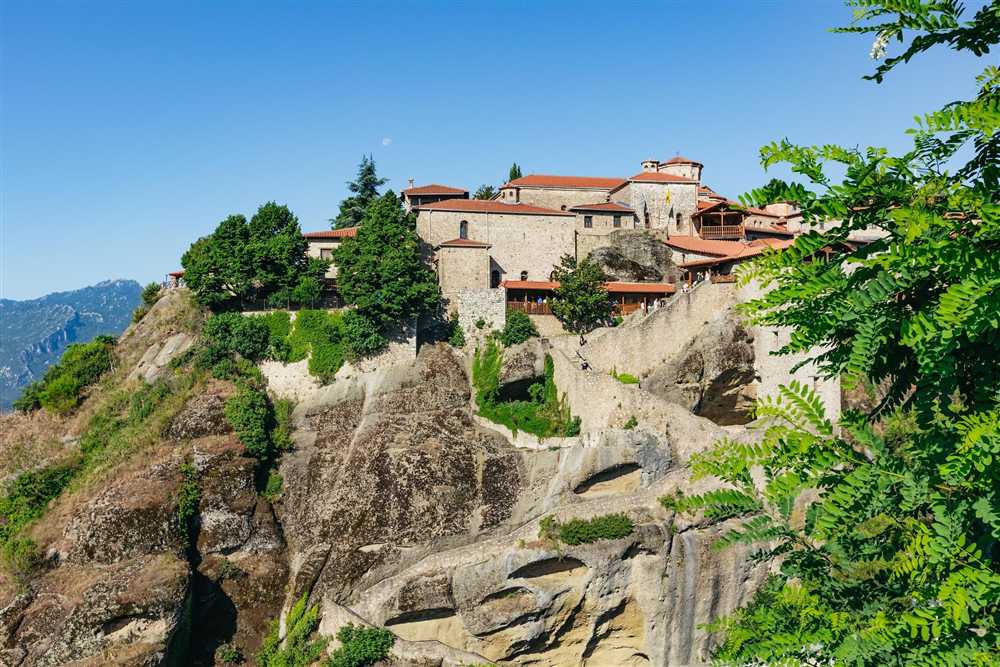
On day four of a 4 day classical tour, the group drives from Kalambaka to Meteora. It enters two of the six monasteries. One itinerary leaves at 08:30 and is back in Kalambaka at 12:30. One operator names the Great Meteoron and Saint Stephen.
Which two monasteries you enter depends on the day. Astoria Travel’s 4 day classical tour visits the two that are open. One operator swaps in Varlaam for the Great Meteoron every Tuesday. Another lists four options by season: Saint Stephen, Varlaam, the Great Meteoron and Rousanou.
None of these 4 day classical tour itineraries names a lookout, so ask your operator about viewpoint stops.
One photo writer names two viewpoints. Sunset Rock sits in the first car park at the top of Meteora that has no monastery. Sunset Point frames Roussanou with Saint Nicholas and the Great Meteoron behind it. Another writer lists an unsigned viewpoint on the road between the Great Meteoron and Roussanou.
Pyxari is a rock with cave hermitages on its cliffs, once home to ascetics. The Holy Trinity monastery stands on a vertical column of rock. It was a filming location for the James Bond movie For Your Eyes Only. None of the monastery lists above includes it.
What do you pass on the return drive from Meteora to Athens?
The group returns through Trikala and Lamia, with a short stop at Thermopylae, and reaches Athens in the early evening. Operator pages for a 4 day classical tour give arrival times between 6:30 pm and 7:30 pm.
One 4 day classical tour itinerary has lunch in Kalambaka first. The group leaves for Athens at 14:00, with a short stop near Lamia, and reaches the centre at 19:30. That is 5.5 hours from departure to arrival, stop included. Fantasy Travel plans to reach Athens at about 19:00. Another operator says the arrival depends on traffic.
On a 4 day classical tour, Trikala comes first. Wikipedia says the city is considered the birthplace of Asclepius and straddles the Lithaios river. A castle that Justinian built in the 6th century stands on the acropolis of ancient Trikke. Further south, at the start of the Lamian War, Antipatros took refuge behind the walls of Lamia.
Thermopylae is the narrowest part of the highway between north and south Greece. The Greeks fought in front of the Phocian wall at the same narrow point.
The naval Battle of Artemisium was fought at the same time. The Persians then overran Boeotia and captured the evacuated city of Athens, where your 4 day classical tour ends.
DAY 4: Meteora to Athens
Visit Meteora. Amidst striking scenery, perched on huge rocks which seem to be suspended in mid-air, stand ageless monasteries where you can see exquisite specimens of Byzantine art. Return to Athens via Trikala, Lamia, Thermopylae (visit the monument of Leonidas). Arrive in Athens early in the evening. (B)
Which season suits a 4 day classical tour, and what do you pack?
Spring and autumn suit a 4 day classical tour. A climate site rates them the right seasons for archaeological sites. It says summer can be too hot on the mainland, especially in July and August. Pack comfortable walking shoes and clothes for the season.
Day one of a 4 day classical tour crosses the Peloponnese. Olympia, the first overnight stop, has hot dry summers. July highs reach 30°C, with 13 hours of sun a day. Tripoli, on the road there, can pass 38°C in summer.
Olympia reaches 14°C by day in January, with rain on 13 days and 116 mm in the month. Snow or sleet can fall at Tripoli between November and early April. At Kalambaka, the Meteora town, January days reach 8°C and nights drop to -1°C. Rain there is concentrated mainly in January and February.
A Kalambaka climate page says visitor levels are higher from June to September and quietest in February and March. Chat Tours runs its 4 day classical tour every Monday from November to March. From April to October it runs every Monday, Tuesday and Saturday.
Filippis Tours recommends comfortable walking shoes because of uneven ground at archaeological sites. A climate site lists light clothing, sunscreen, sunglasses and a sweatshirt for the evening in summer. For winter in inland and mountain areas, it lists a down jacket, a hat, gloves and a scarf.
What else do travellers ask about a 4 day classical tour?
Can I take a big suitcase on a 4 day classical tour?
A Key Tours reply to a traveller says there is no limit on the size of suitcases.
Do you change hotel every night?
Yes. Fantasy Travel lists one night in Olympia, one in Delphi and one in Kalambaka, the Meteora area. Filippis Tours counts four days and three nights. Astoria Travel names 3-star and 4-star hotels in each of those three towns.
What is the dress code at the monasteries?
Fantasy Travel asks for long trousers for men and skirts below the knee for women. The monasteries lend long skirts at every entrance.
Which language does the tour leader speak on a 4 day classical tour?
Chat Tours lists an English-speaking licensed tour leader. A Key Tours reply says its Spanish departure has a Spanish-speaking tour leader only, with no audio in English. Ask the operator about the language of your date.
How does a 4 day classical tour differ from a 3 day tour?
Fantasy Travel’s 3 day tour lists two hotel nights, in Olympia and Delphi. It returns to Athens from Delphi on day three. Its 4 day tour adds a night in Kalambaka and a visit to two Meteora monasteries.