
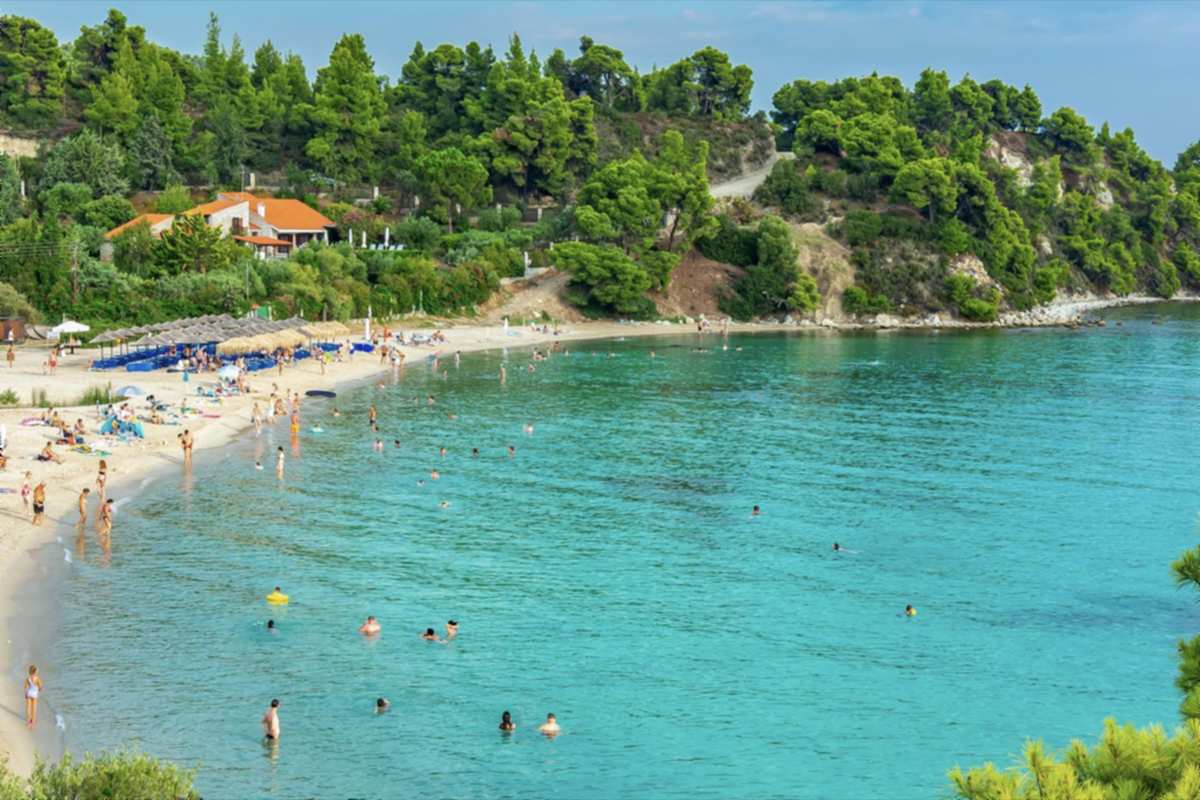
A Halkidiki day trip from Thessaloniki takes a bus south to an olive grove, a swim stop on the Sithonia coast and a sunset over the Aegean Sea, then returns to the city the same evening. Add another northern Greece day from our list of tours in Greece.
This page covers what the day includes, the timings, the meeting point at Nea Elvetia metro station, the tour leader and the bus, Halkidiki and Sithonia, the olive grove, the packaging facility and the tasting, spoon sweets, Kalogria Beach, the sea, the sunset, Nikiti and other Sithonia places, what to bring and the questions travellers ask.
What does the Halkidiki day trip from Thessaloniki include?
The Halkidiki day trip from Thessaloniki is an 8-hour bus tour run by Ammon Express. It joins an olive grove visit with a swim at Kalogria Beach on Sithonia. The day closes with a sunset over the Aegean Sea.
Ammon Express names the tour the Halkidiki/Sithonia Swim, Sunset & Olive Tour. The name lists the three parts of the day: a swim, a sunset and olives. The operator calls it a full-day bus trip, with round-trip transport from Thessaloniki.
The plan in brief has six steps. It starts with a walk through an olive grove, a packaging facility and a tasting. Then comes a drive through Sithonia, free time at Kalogria Beach and the sunset. The operator’s own page gives each leg a time, and the next section lists them.
The Halkidiki day trip from Thessaloniki includes four things:
- pickup and drop-off
- bus transportation to all locations
- an English-speaking tour leader
- basic travel insurance during transportation
The bus covers every location on the plan, so the day needs no second ticket for transport. Three items sit outside the tour, so plan for them yourself:
- the olive grove tour and tasting, an optional extra that you pay for separately
- sunbeds and umbrellas, which are optional too
- lunch, beverages and personal expenses
The operator’s plan has no lunch stop, so lunch is yours to arrange. The booking listing for the Halkidiki day trip from Thessaloniki lets you cancel for free until 24 hours before the start. The refund is full. It also says the day does not suit travellers with mobility impairments.
How long is the Halkidiki day trip from Thessaloniki, and how is the day timed?
The Halkidiki day trip from Thessaloniki lasts 8 hours. The operator’s own page splits that time into five legs. Three are drives and two are stops, and the 3 hours at Kalogria Beach form the longest block.
Here is the plan as the operator lists it, in order:
- drive to Periapton: 1 hour 15 minutes
- olive grove and tasting experience: 1 hour
- drive to Kalogria Beach: 45 minutes
- free time at Kalogria Beach: 3 hours
- drive back to Thessaloniki: 2 hours
Add the five legs and the sum is exactly 8 hours. Driving takes 4 hours in all, and the two stops take the other 4 hours. The two drives out add up to 2 hours, and the drive back takes 2 hours too.
The olive leg is named the olive grove and tasting experience, and the plan gives it one hour. The beach leg is the only one called free time. The ride back is the second longest block of the day, behind the beach.
On the Halkidiki day trip from Thessaloniki, the clock runs as follows. The bus reaches the olive stop after 1 hour 15 minutes. You leave it after 2 hours 15 minutes and arrive at Kalogria Beach at the 3-hour mark. The beach time ends at the 6-hour mark. The bus is back at the end of hour 8.
The booking listing shows the olive visit as 75 minutes, while the operator’s own page says one hour. It lists Kalogria Beach as 3 hours of visit and swimming, as the operator does. For the Halkidiki day trip from Thessaloniki, neither page gives a clock time for the start. The booking listing shows starting times once you check availability.
Where do you meet the bus at Nea Elvetia metro station?
The Halkidiki day trip from Thessaloniki starts at Nea Elvetia metro station. The listing gives the street as Michail Psellou, Thessaloniki 542 49. The operator asks you to be there at least 10 minutes before the bus leaves.
Nea Elvetia is a station on Line 1 of the Thessaloniki Metro. It is the last stop at the eastern end of the line. The station takes its name from the Nea Elvetia district of Thessaloniki. The Greek name means “New Switzerland”.
The idea of a station here is old. Wikipedia says the first plan for a station in this area is more than a century old. That plan showed an overground station, while today’s station is underground.
On the Halkidiki day trip from Thessaloniki, this station is both the start and the end of the day. The included list names pickup and drop-off at Nea Elvetia, and the operator’s plan closes with a return to it. The listings name no other meeting place.
The Thessaloniki Metro is an underground rapid transit system in Greece’s second largest city. It has two lines and 18 stations. The trains are fully automated and driverless, the first system of its kind in Greece. Line 1 runs from the New Railway Station to Nea Elvetia. A French and Italian group of companies, Thessaloniki Metro Automatic, runs the system.
Wikipedia’s fact box lists 3.5 minutes between trains and a system length of 14.4 kilometres. Line 1 alone measures 9.6 kilometres. Line 1 ends at Nea Elvetia, so riders for the Halkidiki day trip from Thessaloniki ride to the last stop.
Drivers have one fact to check before the Halkidiki day trip from Thessaloniki. The metro’s initial design created 650 park-and-ride spaces at Nea Elvetia. The tour listings say nothing about parking, so ask the operator before you leave a car there.
The metro also changed the city’s archaeology. Building it triggered the largest archaeological dig in northern Greek history. The finds are primarily Roman, early Christian and Byzantine.
Who leads the tour, and what is the bus like?
An English-speaking tour leader who is an archaeologist leads the Halkidiki day trip from Thessaloniki. The group rides in an air-conditioned, comfortable bus, and the listing says bus transportation covers all locations.
The listing names the role and nothing more about the person. It gives no name, no group size and no talk plan, so none of them appear here. What it does state is that the leader speaks English and is an archaeologist.
The bus is the base of the Halkidiki day trip from Thessaloniki. The included list says air-conditioned and comfortable, and it adds bus transportation to all locations. The listings give no seat count and no bus model.
Basic travel insurance comes with the tour. The listing words it as “basic travel insurance (during transportation)”. It does not describe the cover, so ask the operator what it covers on your Halkidiki day trip from Thessaloniki.
The operator’s own page adds a detail for families: a baby seat is available upon request. The booking listing does not mention the seat. Request it from the operator before the day.
The weather can change the plan. Both pages say the itinerary of the Halkidiki day trip from Thessaloniki can be modified in unfavourable weather. They do not say which stops change.
What is Halkidiki, the peninsula with three fingers south of Thessaloniki?
Halkidiki is a peninsula and regional unit in Greece, with three fingers that reach into the northwestern Aegean Sea. A Halkidiki day trip from Thessaloniki heads south, because Halkidiki borders the Thessaloniki regional unit on its north side.
Halkidiki lies in coastal Macedonia. From west to east, its three fingers are Kassandra, Sithonia and Athos. In Greek, these peninsulas are also referred to as “legs”. Two gulfs separate the fingers from each other. Wikipedia lists three spellings of the name: Chalkidiki, Halkidiki and Chalcidice.
Halkidiki covers 2,918 square kilometres, and Wikipedia lists a census population of 102,085. Its largest towns are Nea Moudania, Nea Kallikrateia and Polygyros. Polygyros, the capital, lies in the centre of the peninsula. The operator’s page sends the Halkidiki day trip from Thessaloniki on to the Sithonia peninsula for the swim.
The autonomous Mount Athos region forms the easternmost part of the peninsula. Its highest peak reaches 2,033 metres above sea level. The Thermaic Gulf lies to the west and the Strymonian and Ierissos gulfs to the east. Inland, the Cholomontas mountains lie in the north-central part, and the highest peak near Taxiarchis reaches 1,165 metres.
The peninsula behind a Halkidiki day trip from Thessaloniki has ancient roots. The first Greek settlers came from Chalcis and Eretria around the 8th century BC. During the Ottoman period, the peninsula was important for its gold mining.
The climate of Halkidiki is mainly Mediterranean, with cool, wet winters and hot, relatively dry summers. Wikivoyage lists Chalkidiki as one of the main tourist areas of Greece. In summer, a Halkidiki day trip from Thessaloniki meets that hot, relatively dry weather.
What is Sithonia, the middle finger of Halkidiki?
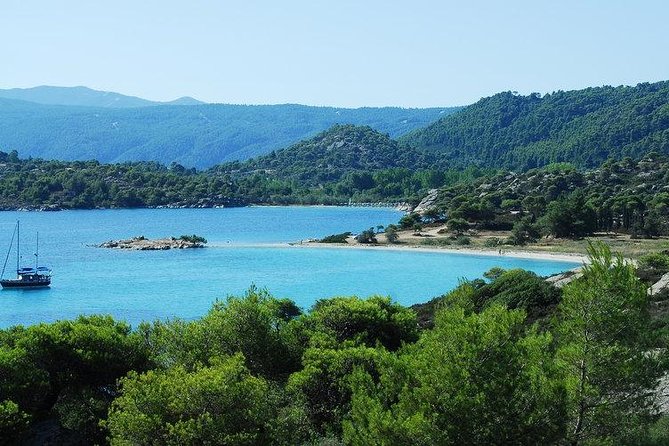
Sithonia, also called Longos, is the middle finger of Halkidiki. The Singitic Gulf lies to its east and the Toronean Gulf to its west. The swim stop of this Halkidiki day trip from Thessaloniki sits on this finger.
Sithonia is a narrow peninsula. It is also the name of a municipality that covers the whole peninsula and measures 516.8 square kilometres. Itamos and Dragoudelis are the peaks in the centre, and Mount Itamos, at 817 metres, is the highest. Vineyards, forests, grasslands, shrubland and mountains cover the land.
The operator’s listing includes a drive through Sithonia on the Halkidiki day trip from Thessaloniki. Wikivoyage says the inside of the peninsula is very mountainous. Its mountains are much higher than those on Kassandra, but not as high as Mount Athos.
Wikivoyage calls Sithonia calmer and less developed than Kassandra, the western finger. It says noisy discos are rare there and the beaches are not as crowded. A Halkidiki day trip from Thessaloniki therefore lands on the calmer finger, although summer traffic and tourism have grown significantly.
Travellers on a Halkidiki day trip from Thessaloniki who want to know more about Sithonia can start with its villages. The main villages are Nikiti, Neos Marmaras, Parthenonas, Sarti, Sykia, Vourvourou and Agios Nikolaos. The municipal unit, at 322.9 square kilometres, has four communities, including Metagkitsi.
Wikivoyage says the hotels were built later, so their architecture is more sophisticated. Wikipedia lists the windmills in Sykia among the historic places of the peninsula. Islands off the coast include Kelyfos to the west and Diaporos to the east. Wikivoyage also lists thousands of goats grazing free on the mountains.
What happens at the olive grove on the Halkidiki day trip from Thessaloniki?
The first stop on the Halkidiki day trip from Thessaloniki is an olive grove. You walk among the trees and learn about olive cultivation, as the operator’s own page describes the visit.
The operator’s itinerary lists a drive to Periapton, followed by the olive grove. The listing says the tour starts there. It covers the history of olive cultivation and its deep significance in Greek culture. The operator’s page adds that you walk among the trees.
The listing says these ancient trees have shaped local life for centuries. It also promises insight into the delicate art of olive farming, set in a calm landscape. Olive farming is the theme of this stop on the Halkidiki day trip from Thessaloniki. The next facts come from Wikipedia and show what that farming involves.
Wikipedia describes the olive tree like this:
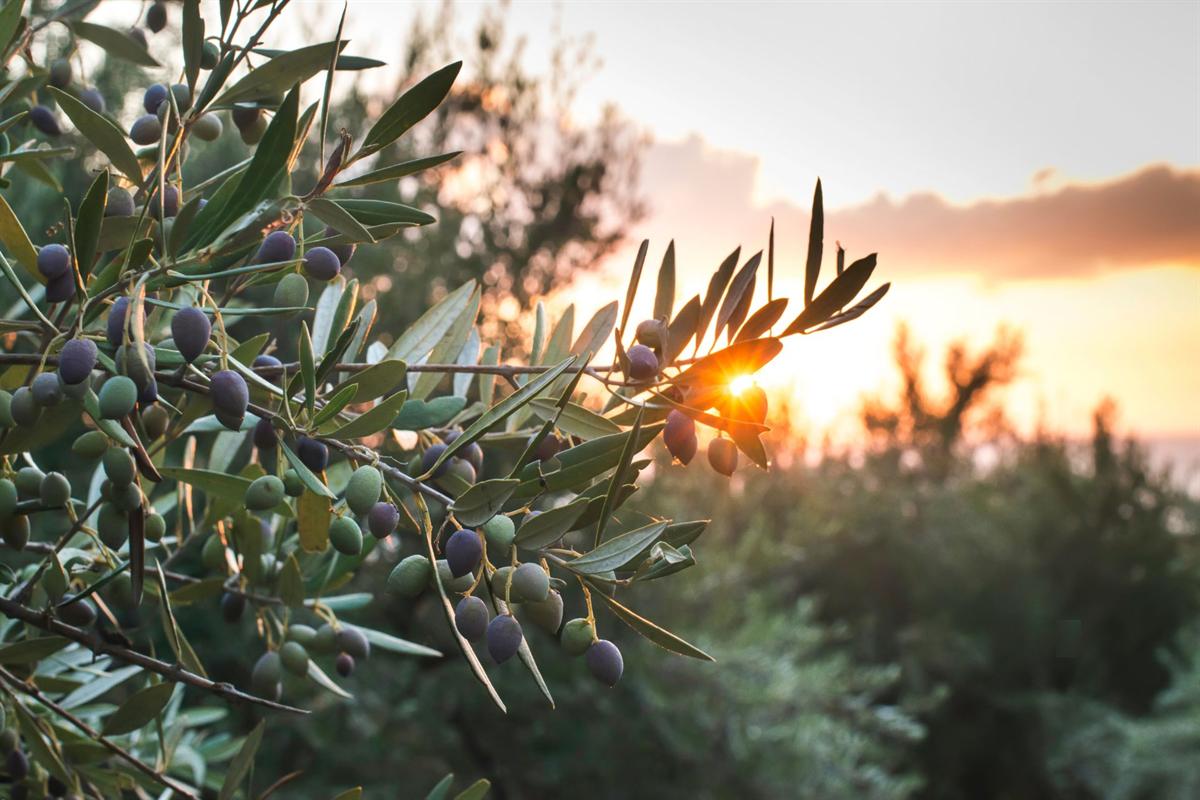
- It is an evergreen with grey bark, about 10 metres (35 feet) tall.
- Its leaves are oblong, grey-green above and whitish below.
- It likes hot weather and sunny positions without shade.
- It prefers limestone slopes and crags and coastal climates.
- It tolerates drought well because of its sturdy and extensive root systems.
- When extreme cold damages or kills the parts above ground, the rootstock can survive and produce new shoots.
- Trees grown from seed or suckers give poor yields unless they are budded or grafted.
- Wild trees have thinner-fleshed and smaller fruits than cultivated trees.
Wikipedia says olive trees can remain productive for centuries when pruned correctly and regularly. Table olive varieties are more delicate to harvest, since damaged fruit becomes bitter. Where the terrain is too mountainous for machines, olives in Italy, Croatia and Greece are harvested by hand. Keep these facts in mind on the Halkidiki day trip from Thessaloniki.
How are olives sorted and packed at the packaging facility?
The Halkidiki day trip from Thessaloniki includes a packaging facility. The listing says you see how olives are prepared for market, from sorting to packaging. You can also pack your own olives.
The listing calls the process meticulous. On the Halkidiki day trip from Thessaloniki, this stop comes right after the grove walk. You step inside the facility and witness the work from sorting to packaging. The operator’s own page says it in fewer words: you explore a packaging facility and package your own olives.
The hands-on step is the one both pages stress. With expert help, you package your very own olives rather than only watch. The listing gives no further detail on the sorting line or the packs. So the packing is the part of the Halkidiki day trip from Thessaloniki that you do with your own hands.
Wikivoyage lists olives and olive oil among the local products of Halkidiki. Production areas include the Pallini peninsula, Ormylia and Nea Moudania. Wikipedia adds that about 80% of harvested olives are processed into oil. The rest are cured and fermented as table olives. An olive cultivar can produce oil, table olives or both.
The fruit is a small drupe, 1 to 2.5 centimetres long when ripe. Fruit quality matters for table olives. The olive fruit fly lays eggs in the fruit, and the pulp around the puncture rots and becomes bitter. This is general olive science, not a sorting rule for the Halkidiki day trip from Thessaloniki.
What do you taste at the olive tasting?
The Halkidiki day trip from Thessaloniki tasting offers local olives, olive spreads, sweet olive treats and olive-infused chocolates. The operator’s own page also lists local olive oil, so the tasting runs from savoury to sweet.
Olives lead the tasting list of the Halkidiki day trip from Thessaloniki. A raw olive is naturally very bitter and sharp, so makers cure and ferment it before anyone eats it. Curing with lye takes days, while curing with brine or salt packing takes months.
Colour tells you how ripe an olive was at picking. The International Olive Council sorts table olives into three groups. Green olives are picked full-size but unripe. Semi-ripe olives are picked as their colour begins to turn. Black olives are picked fully ripe, in shades of purple, brown or black.
Olive spreads and olive oil start from the same fruit. Olive oil comes from pressing whole olives. Its make-up changes with the cultivar, the elevation, the harvest time and the extraction method. Hundreds of cultivars exist. So each oil you taste on a Halkidiki day trip from Thessaloniki carries the mark of its own olives.
The sweet items on the Halkidiki day trip from Thessaloniki tasting list are the olive treats and the olive-infused chocolates. Both start from the same fruit as the spreads and the oil. So the tasting shows one tree in five forms: olives, spreads, oil, treats and chocolate.


Why do olive trees matter so much in Greek life?
Olive trees matter in Greek life because the olive was one of the first fruit trees people grew. Greece is also a world leader in olive production. The olive tasting on a Halkidiki day trip from Thessaloniki sits inside that long story.
People first cultivated the olive in the Eastern Mediterranean between 6,000 and 4,000 BC. It spread around the Mediterranean through trade and migration. Olive cultivation helped Mediterranean civilisations grow and prosper. It remains a defining feature of local landscapes, commerce and folk traditions.
The words themselves are Greek. The Greek word for the olive is elaía, and the Latin word for olive comes from an early Greek form. The word oil first meant only olive oil, from the Greek élaion. The oldest written forms are Mycenaean words in the Linear B script.
An olive branch is a symbol of peace. The writer Georges Duhamel said that the Mediterranean ends where the olive tree no longer grows. The olive is also one of three basic foods of Mediterranean cooking, together with wheat and the grape. A Halkidiki day trip from Thessaloniki with an olive tasting meets that tradition at the table.
The tree itself earns the respect. People have honoured olive trees for their resilience and long life since antiquity. Strong roots help the tree survive drought, and a well-pruned tree stays productive for centuries.
Olive growing is a local trade in Halkidiki as well. The travel wiki names the olive areas of the region: Mount Meliton, the Pallini Peninsula, the Holomon foothills, Polygyros, Ormylia, Olynthos and Nea Moudania. That makes olives a local taste on any Halkidiki day trip from Thessaloniki.
What are spoon sweets, and how do olives become a sweet treat?
Spoon sweets are sweet preserves served on a spoon as a gesture of hospitality in Greece and Cyprus. The listing for the Halkidiki day trip from Thessaloniki names traditional olive spoon sweets in its tasting.
In Greek the name is glyko tou koutaliou, which means “sweet of the spoon”. A host offers it by the teaspoon in a small porcelain or crystal dish. Coffee or tea and a glass of cold water come with it. People also eat it:
- alone or with cheese
- as a topping on yogurt or ice cream
- as a spread on toast
Almost any fruit can become a spoon sweet. A well-made one keeps the shape, colour, aroma and taste of its fruit. Sour and bitter fruits are especially prized. The ingredients in use include:
- quinces, figs and sour cherries
- oranges, lemons, bergamot and kumquats
- seedless grapes, mulberries and strawberries
- apricots, apples, pears and pomegranates
- green walnuts and rose petals
- baby eggplants and cherry tomatoes
- watermelon rind, because the flesh is too delicate to keep its texture
- mastic resin, the base of vanillia, a white sweet that holds no vanilla
The saying goes that good spoon sweets need patience and a heavy pot. Cooks boil the fruit slowly in water and sugar over hours or days, until the syrup sets. The method is close to marmalade, but the fruit stays firm and whole, and a well-made sweet is chewy. Cooks also add:
- lemon juice, which keeps the colour of the fruit
- blanched almonds, for crunch
- cinnamon bark, mint or geranium leaves, boiled in the pot and then taken out
A raw olive is very bitter. Curing and fermenting remove large amounts of the bitter compounds, especially oleuropein. Curing takes from days with lye to months with brine or salt. The listings for the Halkidiki day trip from Thessaloniki do not say how its olive spoon sweets are made. So this page gives no recipe.
Is the olive tour optional, and how is it paid?
Yes, the olive grove tour and tasting on the Halkidiki day trip from Thessaloniki is optional. The operator’s own page lists it as not included, so you pay for it apart from the tour.
One listing for the Halkidiki day trip from Thessaloniki tags the olive visit in its itinerary with “Extra fee”. The same listing marks the olive grove tour and tasting as optional. The two listings agree that the olive stop sits outside what the tour includes.
Both listings show one fee for the olive grove tour and the tasting together. This page leaves the amount out. Anyone booking the Halkidiki day trip from Thessaloniki can read the current figure on the listing.
The full name of the tour is “Halkidiki/Sithonia Swim, Sunset & Olive Tour”. The words “Olive Tour” sit in the name of this Halkidiki day trip from Thessaloniki. Yet both listings list the olive grove tour and tasting as a separate item with its own fee.
The listings do not say how or when you pay the olive fee. They also do not say what you do during the olive stop if you skip it. Ask the operator both questions before you book the Halkidiki day trip from Thessaloniki.
What is Kalogria Beach, the swim stop on Sithonia?
Kalogria Beach is the swim stop of the Halkidiki day trip from Thessaloniki. It is a sandy beach on the west coast of Sithonia. Local sites place it between 5 and 7 km south of Nikiti.
The operator’s page for the Halkidiki day trip from Thessaloniki sends the group on to the Sithonia peninsula. The text says to relax at Kalogria Beach. You can swim, lounge on the beach, or have a drink at a beach bar. The tour listing marks this stop as a swimming visit of three hours.
Wikipedia lists Kalogria among the popular beaches in the northern part of Sithonia, on the west coast. It names Ai Giannis, Elia and Lagomandra beside Kalogria on that coast. One local site puts Kalogria roughly a kilometre past Agios Ioannis beach.
That same local site describes the beach where the Halkidiki day trip from Thessaloniki stops, from right to left. The right part has a hotel, the Mango cafe and organised parking. The Isla bar sits at the far right end. The site calls it popular among young people for its louder music.
The central part has a canteen that serves grilled food. The left part, towards Spaties, has more bars. The site also lists showers inside the bars and beach sports on the sand. It says reaching the sand means a walk down from the parking areas above the cove.
The local sites give the length as 500 metres and as 650 metres. One says dense pine forest surrounds the beach and gives natural shade. The other says shade is available in certain areas. It also calls Kalogria popular among divers, yet the listing for the Halkidiki day trip from Thessaloniki names swimming.
How can you spend the three hours at Kalogria Beach?
The Halkidiki day trip from Thessaloniki gives you three hours of free time at Kalogria Beach. The operator’s listing names three choices: swim, relax by the sea, or unwind at a beach bar. At the bar you can sip a cocktail or enjoy a seaside meal.
The itinerary of the Halkidiki day trip from Thessaloniki calls the stop free time. The order of your day is yours. The operator’s page names swimming and lounging on the beach. The local site lists beach sports too and places a beach volleyball court on the right part of the beach.
Sunbeds and umbrellas are optional, and the operator does not include them in the tour. The local site says sunbeds come from the hotel and the Mango cafe on the right part. On the left part, the bars rent sunbeds either with a food or drink order or by direct payment.
The local sites also mention free areas of the beach. One marks free zones for personal equipment in the middle of the beach and between bars. The other says that in July and August, the free sections can become crowded early in the day. Keep that in mind if your Halkidiki day trip from Thessaloniki falls in peak summer.
Lunch, beverages and personal expenses are not included in the Halkidiki day trip from Thessaloniki, says the operator. The canteen in the central part serves grilled food. The site with the free zones adds a rule. In the greater share of the bars, bringing your own food and drinks is not allowed.
What is the sea like for swimming on Sithonia?
The listings for this Halkidiki day trip from Thessaloniki promise a swim in the emerald waters of Sithonia. One listing calls the waters of the Aegean crystal-clear. Both phrases are the sellers’ own words, so the rest of this section adds outside facts.
Wikivoyage describes varied beaches on Sithonia and small bays that invite you to swim. Its beach list for the peninsula has 38 numbered entries, 31 in the northeast and 7 in the southwest. It calls the beaches “not quite so overloaded” in a text that compares Sithonia with Kassandra, the peninsula next door.
Wikivoyage lists nine Sithonia beaches with Blue Flag status, among them Armenistis, Sarti and Sykia. The listings for the Halkidiki day trip from Thessaloniki do not mention the flag. Wikipedia says the Blue Flag is a certification by the Foundation for Environmental Education. A beach must meet at least thirty of its criteria, spread over four categories.
The criteria include standards for quality, safety, environmental education and information, services, and general environmental management. Wikipedia names more swimming spots too. On the west coast, it includes Ai Giannis, Elia and Lagomandra. On the east coast, it names Livrochios, Karidi, Kavourotripes and Platanitsi. In the south, it names Azapiko, Tristinika, Kalamitsi and Kriaritsi.
Wikipedia gives Chalkidiki a mainly Mediterranean climate with hot, relatively dry summers. That is the climate around a Halkidiki day trip from Thessaloniki. Wikivoyage says the middle finger is less crowded than Kassandra and tells readers to expect people there in high season. It adds that summer tourism and traffic on Sithonia have increased significantly.
On its Aegean Sea page, Wikipedia quotes an analysis of the surface layer, 40 to 50 metres thick. Summer temperatures in that layer ran from 19 to 24 degrees Celsius. Winter temperatures ran from 8 degrees in the north to 13 in the far south. The range covers the whole sea, not one beach.
How does the sunset end the Halkidiki day trip from Thessaloniki?
Both listings end the Halkidiki day trip from Thessaloniki with a sunset over the Aegean Sea. The longer listing text describes a sky that glows in hues of orange and gold. Neither listing names the spot where the group watches it.
On the operator’s own page for the Halkidiki day trip from Thessaloniki, the sunset closes the description of the day. The itinerary list on the same page gives it no line of its own and no clock time.
Wikipedia calls the Aegean an elongated embayment, a long inlet, of the Mediterranean Sea. It lies between the Balkans and Anatolia and covers about 214,000 square kilometres. It measures about 670 kilometres long and 390 wide. Wikipedia places the Chalkidiki peninsula in the northwestern Aegean. So the sunset of the Halkidiki day trip from Thessaloniki falls over this sea.
The operator has written a blog post on Greek sunsets. Its words are about Greece in general, not this tour. It says sunsets are such an integral part of life that they became a recurring theme in Greek music. For mainland Greece, it describes a sky in vibrant hues of orange, purple and gold.
The itinerary list ends with two lines. The first is a 2-hour drive back to Thessaloniki. The second is a return to the metro station where the tour began. That is how a Halkidiki day trip from Thessaloniki finishes in the operator’s list. The listings add no clock time for it.
What is Nikiti, the village near Kalogria Beach?
Nikiti is a village on Sithonia, 100 kilometres south-east of Thessaloniki, and the seat of the Sithonia municipality. The Halkidiki day trip from Thessaloniki swims at Kalogria Beach, one of the beaches south of the village.
Nikiti has two parts. The old village sits on a hill inland, with the church of Saint Nikitas at its highest point. It dates to the start of the 14th century, when people moved inland to avoid pirate raids. The newer part lies on the shore, next to the beach and a marina.
Old Nikiti keeps narrow cobbled streets, stone-built houses and wooden balconies in the style of northern Greece. Today it has small guesthouses and local tavernas. Sightseeing covers its old churches and the waterfront cafes and bars, which are busy in summer. These lanes are a fact about the place, not a stop on the Halkidiki day trip from Thessaloniki.
Tourism is the main business in Nikiti, which has just over 2,900 permanent residents and around 20,000 in summer. It boomed when beaches such as Ai Yiannis, Kalogria and Lagomandra became popular. Kalogria, the swim stop of the Halkidiki day trip from Thessaloniki, is one of them.
Nikiti also lives from beekeeping and olive growing, and it has become one of the top honey-producing towns in Europe. Olives are part of the Halkidiki day trip from Thessaloniki too, which visits an olive grove.
The coast has older stories. The ancient Greek city of Galypsos stood south of Nikiti, near Kastri beach. Remains of an early Byzantine church from the 5th century lie near Agios Georgos beach. In July, the Toroneos cross swimming race runs from Nikiti to Kallithea. That is a race, not the beach swim of a Halkidiki day trip from Thessaloniki.
Which other places on Sithonia do travellers visit?
Neos Marmaras, Porto Koufo and Toroni are three places on Sithonia that travellers visit. None is a stop on the Halkidiki day trip from Thessaloniki, so read them as facts about the peninsula.
Neos Marmaras is a town of 3,038 permanent residents, 125 kilometres from Thessaloniki. In summer the number is estimated at 20,000. Greek refugees from Marmara Island founded it after the exchange of populations with Turkey. Cafes, restaurants and bars line its waterfront and are busy in summer.
Porto Carras is a big five-star resort outside Neos Marmaras and one of the biggest in northern Greece. Kelyfos Island lies just outside the bay of the town. It is also called Turtle Island, because it is said to look like a turtle.
Porto Koufo is the largest natural harbour in Greece, and Thucydides mentions it as the “hollow harbour”. It is also the ancient harbour of Toroni.
Toroni has an ancient city, a castle and the church of Agios Athanasios. Greek settlers from Chalcis and Eretria founded it, among other cities, around the 8th century BC. Its ruins show that Sithonia had Greek cities long before any Halkidiki day trip from Thessaloniki.
Sykia has windmills. Parthenonas, Sykia and Nikiti count as old traditional villages. Sarti, like Neos Marmaras and Nikiti, has a waterfront that is busy in summer. At the southern end, Kartalia has rocky, secluded beaches, and its cliff cape gives a view of Mount Athos.
To see these places outside a Halkidiki day trip from Thessaloniki, Wikivoyage recommends exploring Sithonia by car or motorbike. It says the main roads are well developed and the signs are in order. Buses leave the Thessaloniki bus station three times a day, but riders must wave to make one stop.
What do you wear and bring on the Halkidiki day trip from Thessaloniki?
The operator’s own page lists what to bring on the Halkidiki day trip from Thessaloniki. It names swimwear and a towel, sunscreen, a hat and sunglasses, comfortable footwear and flip-flops, and a camera or smartphone.
Swimwear and a towel come first on that list. The operator calls the day a swim, sunset and olive tour, so the swim kit leads the packing. The page names no other clothing, so the list above is all it asks for.
Sun gear matters on a Halkidiki day trip from Thessaloniki because of the climate. Wikipedia calls the climate of Halkidiki mainly Mediterranean, with hot, relatively dry summers. A hotel blog on day trips from Thessaloniki says temperatures tend to rise significantly in July and August.
The operator recommends sunscreen, a hat and sunglasses, so put all three in your bag.
Shoes get two lines on the operator’s list for the Halkidiki day trip from Thessaloniki: comfortable footwear and flip-flops. The page names both, so pack both pairs. The last line is a camera or smartphone for your memories.
Which other Halkidiki day trips leave from Thessaloniki?
Other sellers run a Halkidiki day trip from Thessaloniki as a Sunday group trip or as a private trip. Private pages name the Kassandra coast, Sithonia and single villages. Each page names its own stops, so read them before you choose.
One tour seller runs a Halkidiki day trip from Thessaloniki every Sunday, as a full-day group trip. Pick-up is at your hotel or apartment in Thessaloniki. The page gives a departure between 8:30 and 9:00 in the morning. It sets the return to the same pick-up point at 5:00 in the afternoon, after about 10 hours.
That route lists the traditional village of Afitos and Pefkohori Beach, with 120 minutes for swimming. It also lists the Crazyland water park, lunch at a selected traditional tavern, and free time in Kallithea.
The same page lists a VIP minivan for up to 6 passengers. It also lists a VIP luxury car for up to 3 passengers. It links private day trips from Thessaloniki to Afitos, Hanioti, Siviri and Polihrono. It says the seller has a camera for you if you do not bring one.
A private-tour company lists a Halkidiki day trip from Thessaloniki on its page of regional day trips. The page describes a day on the Kassandra coast. It joins the clifftop village of Afitos, which overlooks Toroneos Bay, with the golden beaches around Kallithea and Sani. Hours are built in to swim and relax.
The company calls the outing flexible, family-friendly and easy underfoot. It says its private day tours bring door-to-door pick-up and an English-speaking driver. They also bring a flexible pace and a Mercedes-Benz for your group. It provides free child seats.
Other pages point to more choices for a Halkidiki day trip from Thessaloniki. A hotel blog says operators offer boat trips from Thessaloniki to Halkidiki in summer. A ticket site lists a private day trip from Thessaloniki to Sithonia.
The operator’s own trip list adds an Arnaia – Ierissos trip. It describes a visit to an authentic rural village, rich in culture and tradition. Wikipedia names Arnaia as a village popular in winter for its architecture and mountain scenery.
This tour is a full-day bus trip. The other pages show more forms of a Halkidiki day trip from Thessaloniki. They name a Sunday group trip, a private car or minivan, and a summer boat trip.
What else do travellers ask about a Halkidiki day trip from Thessaloniki?
Is Kassandra part of a Halkidiki day trip from Thessaloniki?
Kassandra is the western finger of Halkidiki, and its highest peak is 350 metres. Wikivoyage calls it the cosmopolitan finger, known for its nightlife, crowded beaches and scenic villages. The listings for the Halkidiki day trip from Thessaloniki name Sithonia, not Kassandra.
A canal separates Kassandra from the mainland. Wikivoyage says the Canal of Potidea has old origins, and a report mentions it in the 1st century AD. A Byzantine emperor repaired it in the 15th century and built fortifications on its south side.
Can you see Mount Athos from Halkidiki?
Mount Athos is the eastern finger, a self-governing monastic region inside Greece. Wikivoyage says entry is only for male pilgrims who plan to visit the monasteries. Neither listing for the Halkidiki day trip from Thessaloniki mentions Athos, and both name Sithonia.
Wikivoyage adds that cruises from Ouranopolis circle the peninsula, and from the boat you can see monasteries. Wikipedia counts over 2,000 monks there. They come from Greece and other Orthodox countries and live an ascetic life, isolated from the rest of the world.
Which ancient sites lie in Halkidiki?
Wikivoyage lists the excavations of ancient Olynthos, which hold the oldest mosaics found in Greece, from the 5th century BC. Ancient Stageira, in the hinterland, was the birthplace of Aristotle. Wikipedia says Aristotle later became the tutor of Alexander the Great.
The castle of Neposi, near Megali Panagia, was the largest fortress in Halkidiki from the 5th century AD. Its ruin covers 1.5 hectares, and the remaining walls run about 1,000 metres. These are facts about the region, not stops on the Halkidiki day trip from Thessaloniki.
Is the Petralona cave a stop on the Halkidiki day trip from Thessaloniki?
No, the listings name no cave. Petralona is a cave about 35 kilometres south-east of Thessaloniki, on the Chalkidiki peninsula. Erosion left clefts in the rock, and people found the cave by accident. A villager found the Petralona skull the following year.
Wikipedia says the reliable published ages for the skull range from 150,000 to 250,000 years before today. Inside, the temperature stays at 17 degrees Celsius all year.
The corridors are about 2,000 metres long and cover 10,400 square metres. The rock formations resemble giant cactus, pink pearls, sturdy columns or delicate curtains. The cave is open to the public and has a museum on site.
Is wine part of a Halkidiki day trip from Thessaloniki?
No. The tasting lists olive foods and chocolates, and no wine or spirits. Halkidiki still makes wine. Wikivoyage lists wine among the local products to buy. It says the good climate and the mineral-rich soil are crucial factors for the wine-making of the area.
Wikivoyage singles out the wine made on Sithonia, in the Neos Marmaras area at Porto Carras. It also lists the Porto Carras vineyard and wine cellar among the sights. Wikipedia adds that a wine from Porto Carras carries the name Domaine Porto Carras. The same shopping list names tsipouro, a strong schnapps from the local villagers.