
A Mycenae Epidaurus tour from Nafplio runs by van from the Argolic Gulf to the royal citadel of Mycenae and the healing sanctuary of Epidaurus, then back to Nafplio the same day. More Peloponnese days sit among our tours in Greece.
This page covers what the Mycenae Epidaurus tour from Nafplio includes, Mycenae and its tombs, the story of Agamemnon, Epidaurus and its theatre, and Nafplio.
What does the Mycenae Epidaurus tour from Nafplio include?
The Mycenae Epidaurus tour from Nafplio is a van trip run by the activity provider Unique Greek Tours. It includes round-trip transport from Nafplion to both archaeological sites, pickup in Nafplion and an English-speaking driver.
The listing for the Mycenae Epidaurus tour from Nafplio names the places on the route. At Mycenae it names the Lion Gate, the Cyclopean walls around the acropolis and the tombs of Atreus and Clytemnestra. At Epidaurus it names the sanctuary of Apollo, the Asclepieion and the ancient theatre.
The listing states one aim: to learn about the Mycenaean civilisation and the Kingdom of Agamemnon. The driver takes you from site to site and back to Nafplion. The tour has no licensed local expert at the sites, so you walk the ruins at your own pace.
Entrance tickets to both sites are paid apart, because the itinerary marks each visit as an extra. Check that line before you book the Mycenae Epidaurus tour from Nafplio. Then the tickets hold no surprise on the day.
The listing says the tour is not suitable for people with mobility impairments or wheelchair users. Free cancellation closes 24 hours before the start, and cancelling in time returns the whole payment.
Another tour seller lists a similar day from Nafplio with the same split. Site entrances sit outside its offer, and a licensed local expert inside the sites is an optional extra. It sets the full-refund limit at 72 hours before the start. Compare these lines before you choose one Mycenae Epidaurus tour from Nafplio.
How long is the Mycenae Epidaurus tour from Nafplio, and how is the day timed?
The Mycenae Epidaurus tour from Nafplio lasts 6 hours, says the listing. The day runs from pickup in Nafplion to Mycenae, on to Epidaurus and back, with 1.5 hours at each site.
The listing sets out the day leg by leg.
- Pickup in Nafplion
- Van ride, 30 minutes
- Archaeological Site of Mycenae, 1.5 hours
- Van ride, 45 minutes
- Epidaurus, 1.5 hours
- Van ride, 20 minutes
- Back in Nafplion
On the Mycenae Epidaurus tour from Nafplio the itinerary counts each van ride as a stop of its own. The driving time is part of the plan. Mycenae comes first and Epidaurus second. The description says the tour ends with return transport to Nafplion.
Each site gets one block of 1.5 hours. The description names more than one place to see in each block, so the time is shared among them. The longest drive is the 45 minutes between Mycenae and Epidaurus. The shortest is the 20 minutes home.
Add the three van rides and you get 95 minutes on the road. The two visits add 3 hours. Together the legs come to 4 hours 35 minutes. The listing gives the full length as 6 hours and does not say how it spends the rest. Plan around the 6 hours.
The listing prints no start time and no pickup hour. It asks you to check availability to see the starting times. It also calls its itinerary for reference only and says itineraries are subject to change. Read the minutes of the Mycenae Epidaurus tour from Nafplio as a plan, not a fixed clock.
Another tour seller calls its own Nafplio version a half-day excursion, while this listing says 6 hours. Lengths differ from one offer to the next, so compare the hours before you book.
Where does the pickup happen in Nafplion, and who drives?
The Mycenae Epidaurus tour from Nafplio starts with a pickup in Nafplion. An English-speaking driver runs the van to both sites and back. The listing marks the pickup as included but names no meeting point. It says to check availability for the details.
The itinerary opens with the line “Pickup location: Nafplion” and closes with “Arrive back at: Nafplion”. The highlights call the transport roundtrip transportation from Nafplion to the sites. The English-speaking driver and the van cover every leg. So the Mycenae Epidaurus tour from Nafplio needs no car of your own.
Another seller of a similar route picks up at a Nafplio hotel, at the port or at a specified spot. Its description also mentions a meeting point. That is the other seller’s offer, not a promise for this listing. Do not assume that every Mycenae Epidaurus tour from Nafplio collects guests at hotels.
The town goes by these English spellings: Nafplio, Nafplion, Nauplio, Nauplia, Nafplia and Navplion. English texts use Nauplia and Navplion more than any other form. These places help you find your way around Nafplion:
- The old town covers the peninsula, with the sea to the north and the hill to the south.
- The central bus station stands at the east end of the old town.
- The port lies on the north seaside.
- Syntagma Square is the main reference point of the old town.
- Philellinon Square lies two blocks north and west of Syntagma Square, by the sea. The old Customs building also stands there.
Accommodation in the old town is easily reachable on foot from the harbour parking area, within 10 to 15 minutes. The listing names none of these places as a pickup point of the Mycenae Epidaurus tour from Nafplio.
What does the road between Nafplion, Mycenae and Epidaurus look like?
The Mycenae Epidaurus tour from Nafplio moves by van in three legs. The first leg runs to Mycenae, the second to Epidaurus and the third back to Nafplion. All three places lie in Argolis, a regional unit in the eastern Peloponnese.
On a map, Mycenae stands 11 kilometres north of Argos and 48 kilometres south of Corinth. The site lies near Mykines and 19 kilometres inland, on a hill 274 metres above sea level. So the first leg of the Mycenae Epidaurus tour from Nafplio ends away from the coast.
The ancient city of Epidaurus stood on the coast of the Argolid Peninsula, at the Saronic Gulf. A village now called Archaia Epidaurus marks the spot. The healing sanctuary lies near the modern town of Lygourio, about 12 kilometres inland from that city. The Mycenae Epidaurus tour from Nafplio visits the sanctuary, not the coastal city.
Argolis is the setting of the day. Corinthia borders it on the north and Arcadia on the west and southwest. The bulk of the arable land lies in the central part. Its notable mountain ranges are:
- Oligyrtos in the northwest
- Lyrkeio and Ktenia in the west
- Arachnaio and Didymo in the east
Nafplion, the capital of Argolis, sits on the Argolic Gulf. Two streets carry the roads in and out:
- Argous street brings the road in from Athens, a drive of 147 kilometres or 1½ to 2 hours by car.
- Asklepeou street leads east toward Epidavros and Porto Heli. That is the direction of the Epidaurus leg of the Mycenae Epidaurus tour from Nafplio.
- The two roads meet at a junction named “endekate”, which means “eleventh”, after an old bus-stop numbering system. A large park starts there and runs over the old train route to the old town.
What is Mycenae, the first stop of the tour?
Mycenae is a hilltop archaeological site in Argolis, in the north-eastern Peloponnese. It is the first stop of the Mycenae Epidaurus tour from Nafplio. In the Bronze Age it was a military stronghold, and UNESCO now lists it as a World Heritage Site.
The citadel that the Mycenae Epidaurus tour from Nafplio visits stands on a hill. The hill rises 274 metres above sea level, in the north-east corner of the Argive plain. From there it overlooked the whole area. It also commanded all easy routes to the Isthmus of Corinth. The site had good farmland and an adequate water supply too.
At its peak, in 1,350 BC, the citadel and the lower town had 30,000 inhabitants and covered 32 hectares. The stronghold dominated much of southern Greece, Crete, the Cyclades and parts of south-west Anatolia. The itinerary of the Mycenae Epidaurus tour from Nafplio names this stop the Archaeological Site of Mycenae.
UNESCO added Mycenae to the World Heritage List together with the nearby site of Tiryns. It gave three reasons. Mycenae was the centre of the Mycenaean civilisation. Its architecture is outstanding. It also bears testimony to the development of Ancient Greek civilisation.
The ruins drew visitors even in Roman times. The travel writer Pausanias visited in the second century AD, and shepherds led him to the site. The Mycenae Epidaurus tour from Nafplio reaches the site that he described.
Pausanias also passed on a legend about the name. The legendary founder, Perseus, named it after the cap of his sword sheath or after a mushroom he plucked there. Scholars think the name itself is older than Greek, a pre-Greek place name that Greek speakers inherited.
Who were the Mycenaeans, and how did their civilisation rise and fall?
The Mycenae Epidaurus tour from Nafplio visits the site that named the Mycenaeans, mainland Greeks of the Bronze Age. Their civilisation lasted from about 1,750 to 1,050 BC. Kings ruled it from a network of palace states.
The operator’s listing for the Mycenae Epidaurus tour from Nafplio promises that you learn about the Mycenaean civilisation. Specialists agree that it began around 1,750 BC. It grew out of the earlier cultures of mainland Greece, with influences from Minoan Crete. A warrior elite ruled from centres of power in the south.
The royal dynasty at Mycenae built its power on long-distance sea trade. Mycenaean pottery turned up in Cyprus, Lebanon and Egypt. Egypt knew Mycenae by name, as a capital on the level of Thebes and Knossos.
By about 1,450 BC a Mycenaean elite ruled the palace of Knossos on Crete. Other centres of power rose at Pylos, Tiryns, Thebes and Athens. Of these centres, the Mycenae Epidaurus tour from Nafplio visits only Mycenae.
The Mycenaeans also wrote. Their script, Linear B, gives the first written records of the Greek language. Tablets survive at Mycenae and Tiryns. Others, from Knossos and Pylos, show that the king’s title was wanax. Decipherment proved that the language is Greek. The Mycenae Epidaurus tour from Nafplio therefore visits a site linked to the earliest written Greek.
Around 1,250 BC a first wave of destruction hit centres of mainland Greece. Buildings around the citadel of Mycenae were burned. A second destruction struck Mycenae around 1,190 BC and ended its time as a major power. The Mycenae Epidaurus tour from Nafplio shows what survives of the world that this collapse ended.
Scholars do not know the cause. They propose enemy attack, internal strife and earthquakes. Mycenae was partly rebuilt, but it was no longer the centre of a centralised literate bureaucracy. Tiryns grew into the largest local centre. The Greek Dark Ages followed, a period without written records.
What is the Lion Gate of Mycenae?
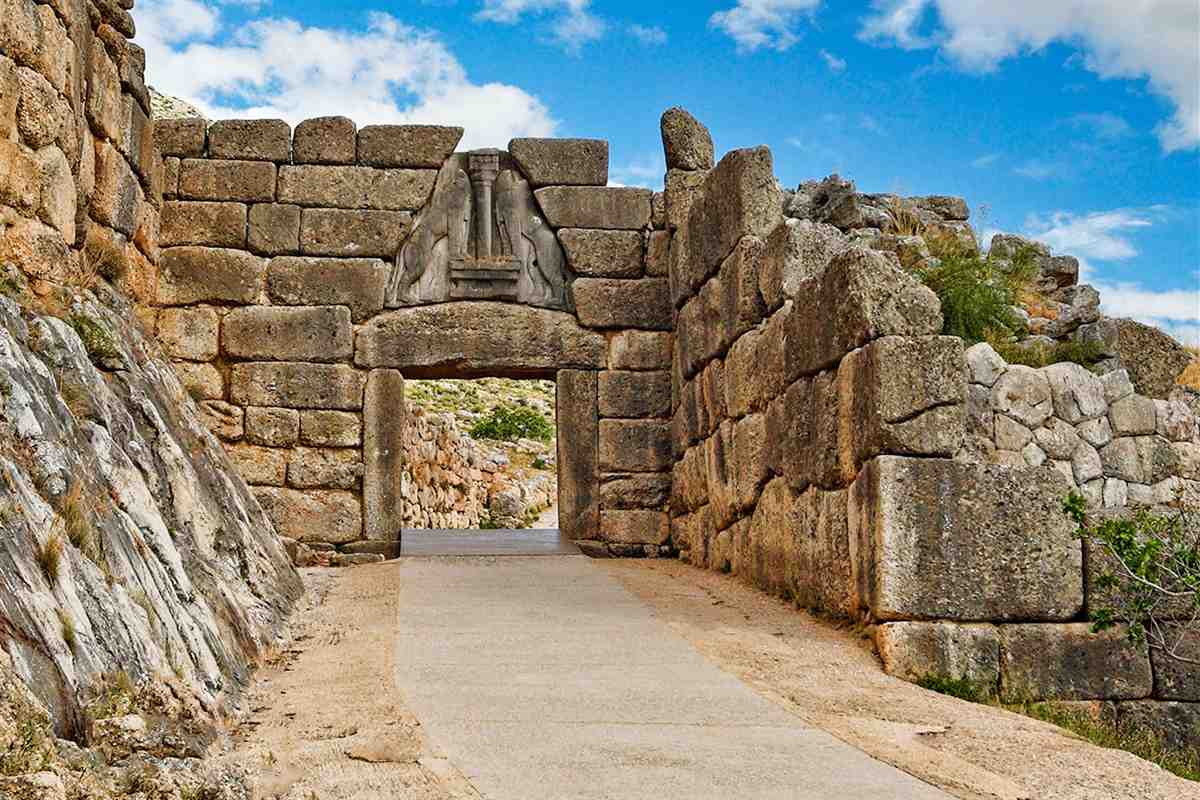
The Lion Gate is the main entrance of the Bronze Age citadel of Mycenae. It stands on the north-western side of the acropolis and was built in the thirteenth century BC. The Mycenae Epidaurus tour from Nafplio lists it as the monumental palace entrance.
On the Mycenae Epidaurus tour from Nafplio, the gate is the first sight the listing names at Mycenae. Two great monoliths stand upright, and a huge lintel rests on them. The lintel measures 4.5 by 2.0 by 0.8 metres. A double door once closed the opening. It was fitted to a vertical beam and turned around it like a pivot.
Look above the lintel on the Mycenae Epidaurus tour from Nafplio. The stone courses form a corbelled arch. It leaves an opening that lightens the weight on the lintel. The relieving triangle is a great limestone slab, and two lionesses are carved on it in high relief. They stand on either side of a central pillar.
The pillar is a Minoan-type column on an altar-like platform, and the lionesses rest their front feet on it. Their heads were made as separate pieces and are missing, but the necks remain. The relief was an emblem of the Mycenaean kings and a symbol of their power to subjects and foreigners.
One view reads the lions as a symbol of the goddess Hera. The design was not new. Minoan seals of the fifteenth century BC and a gem found at Mycenae show a similar image. The Mycenae Epidaurus tour from Nafplio shows the only monumental piece of Mycenaean sculpture that survives.
What are the Cyclopean walls around the citadel?
Cyclopean walls are fortification walls built of huge limestone boulders, roughly fitted together with very little gap between the stones. The Mycenae Epidaurus tour from Nafplio lists these walls around the acropolis as one of its sights.
The walls on the Mycenae Epidaurus tour from Nafplio show how the builders worked. They used huge, unworked limestone boulders, with clay mortar or none at all. Smaller chunks of limestone fill the gaps between the big boulders, and the boulders are never carefully cut blocks. Tiryns has walls in the same style.
The word Cyclopean comes from the Cyclopes, the giants of Greek myth. Classical Greeks assumed that only the Cyclopes had the strength to move such boulders. Pliny’s Natural History reports a tradition, credited to Aristotle, that the Cyclopes invented masonry towers.
The ancient geographer Pausanias also paired the gate and the walls. He wrote that parts of the city wall remained, including the gate with the lions. They were said to be the work of the Cyclopes.
Modern archaeologists use the word in a narrower sense. Only parts of the Mycenae walls are Cyclopean. Cut stone appears only in and around gateways, and at Mycenae it is conglomerate. At the Lion Gate, the Mycenae Epidaurus tour from Nafplio shows both styles: rough boulders and ashlar blocks.
The Mycenae Epidaurus tour from Nafplio lists the gate and the walls together. The gate and the greater part of the Cyclopean wall rose together. That was the second extension of the citadel, in the thirteenth century BC.
A ramp, partly natural and partly built, led up to the gate. West of the approach stands a rectangular bastion, 14.80 metres long and 7.23 metres wide. It let defenders strike the right-hand side of attackers, who carried their shields on their left arms.
What is Grave Circle A at Mycenae?
Grave Circle A is a royal burial ground from the sixteenth century BC. It lies near the Lion Gate, inside the walls of Mycenae. The Mycenae Epidaurus tour from Nafplio goes to this citadel, home of the shaft graves.
Each of the six shaft graves is between one and four metres deep. Two to five bodies lay in each, except in Grave II, which held one burial. The finds include gold death masks, full sets of weapons, ornate staffs, gold jewellery and cups of gold and silver. One estimate counts about 15 kilos of gold in all.
Travellers who join the Mycenae Epidaurus tour from Nafplio learn about the Mycenaean civilisation. These graves show its early phase. Men were buried with weapons and women with jewellery. The decorated daggers were art objects, not working weapons. Bulls’ heads with a double axe show Minoan style, from Crete. Fighting and hunting scenes on other objects are in Mycenaean style.
The circle began outside the walls. A mound seems to have covered each grave. The citadel on the Mycenae Epidaurus tour from Nafplio grew in the thirteenth century BC. The new wall took the circle in. Builders put a double-ring wall around the graves and set up the carved grave markers, called stelae, again. Three of them show chariot scenes.
Grave Circle B lies outside the walls of the citadel that the Mycenae Epidaurus tour from Nafplio visits. It is the older circle, with graves from the seventeenth and sixteenth centuries BC, and it holds less wealth. The richer gifts in Circle A point to powerful rulers. The site also seems to have become a sacred precinct for ceremonies.
What is the Mask of Agamemnon, and where is it today?
The Mask of Agamemnon is a gold funeral mask from the Bronze Age site of Mycenae. It is shown today in the National Archaeological Museum of Athens. The Mycenae Epidaurus tour from Nafplio reaches the site of the find, and its listing names no museum stop.
The mask was made from a single thick sheet of gold. It was heated and hammered against wood, and the details were chased on later with a sharp tool. Three of the other masks are flat, but this one is three-dimensional. Its eyes show open and closed lids together. Its face has a full pointed beard and a handlebar moustache.
Heinrich Schliemann named the mask after Agamemnon, the king in Homer’s Iliad. The listing for the Mycenae Epidaurus tour from Nafplio also speaks of the Kingdom of Agamemnon. Yet modern research dates the mask to around the sixteenth century BC. That is 300 to 400 years before the time of the mythical Trojan War.
Historian Cathy Gere called the mask the “Mona Lisa of prehistory”. In recent decades, William Calder III and David Traill formally questioned whether it is real. They point to Schliemann’s reputation for adding finds from elsewhere to his digs. The Greek Archaeological Society had sent Panagiotis Stamatakis to supervise the dig. Modern research suggests the mask is genuine.
Schliemann found the mask in Grave V of Grave Circle A. Five masks came from Graves IV and V. Those who defend it say the beard closely matches the mane of a gold lion-head vessel from Shaft Grave IV. To see the original, travellers from the Mycenae Epidaurus tour from Nafplio must visit the museum in Athens.
What is the Treasury of Atreus?
The Treasury of Atreus is a large beehive tomb outside the citadel of Mycenae, built between 1,300 and 1,250 BC. The listing for the Mycenae Epidaurus tour from Nafplio names the tombs of Atreus and Clytemnestra. It is also called the Tomb of Agamemnon.
This kind of grave is called a tholos tomb and has three parts. A narrow passage, the dromos, joins a deep doorway, the stomion. The doorway opens into a round burial chamber, the thalamos, which has a corbelled dome. The dome was covered with earth to make it higher. Green marble columns with zigzag patterns once flanked the door.
The Mycenae Epidaurus tour from Nafplio lists the largest tholos tomb known from the Aegean Bronze Age. Its dome was the world’s largest until the Roman period and remains the largest corbelled dome. The passage is 36 metres long and 6 metres wide. Its walls rise from half a metre at the entrance to 10 metres at the front.
The front wall stands 10.5 metres high. The inner of its two lintel blocks is 8 metres long and weighs about 120 tons. It is the heaviest single piece of masonry known from Greek architecture. It stands in the tomb that the Mycenae Epidaurus tour from Nafplio names. One estimate says it took up to 1,000 people to move it.
The ancient writer Pausanias placed the graves of Atreus and Agamemnon inside the walls of Mycenae. We know little about who lay in this tomb, and its name seems to date from the eighteenth century. The Tomb of Clytemnestra, which the Mycenae Epidaurus tour from Nafplio also names, was named by association with the Treasury.
What can you see of the palace on top of the Mycenae hill?
Remains of the last palace are visible on the acropolis, the high city of Mycenae. The Mycenae Epidaurus tour from Nafplio names the acropolis in its listing. Palaces were built there one after another. Earlier ones were cleared away or built over.
Palaces of that age across southern Greece shared a similar design. Each had a megaron, or throne room, with a raised hearth under an opening in the roof. Four columns in a square held up that roof. The throne stood against a wall beside the hearth, in clear view from the entrance. Frescoes decorated the plaster walls and floor.
A stepped ramp led from the gate up to the palace. A grand staircase led from a terrace below to a courtyard. The hall was entered from this courtyard, which had a columned portico. The Mycenae Epidaurus tour from Nafplio reaches a site with a palace of this design. Remains older than the palace lie beneath its floors.
The site on the Mycenae Epidaurus tour from Nafplio also has a secret passage that leads below ground. It runs under the north-east wall, an extension added around 1,200 BC. About 99 steps lead down to a cistern, or water tank, carved from the rock 15 metres down. A tunnel brought spring water to it from higher ground.
A temple inside the citadel had a Room of the Idols. A scarab of Queen Tiye of Egypt was placed there. Later, in the Archaic period, a temple of Hera was built on the summit. The hill that the Mycenae Epidaurus tour from Nafplio visits holds a Bronze Age palace and a later temple.
Who was Agamemnon in myth and in Homer?
Agamemnon was the legendary king of Mycenae who commanded the Greek army in the Trojan War. The listing for the Mycenae Epidaurus tour from Nafplio calls the site the mythical Kingdom of Agamemnon. The myth is part of the day.
Homer’s Iliad and Odyssey call him the son of King Atreus and the older brother of Menelaus. He marries Clytemnestra, and Menelaus marries Helen; both are daughters of Tyndareus, king of Sparta. The old tales call the family cursed, with murder, incest and treachery across successive generations.
At Aulis, a port in Boeotia, a plague and a lack of wind keep the army from sailing. The prophet Calchas declares that only the sacrifice of Agamemnon’s daughter Iphigenia can end the anger of the goddess Artemis. The plays differ on how willing father and daughter are, but he does sacrifice her.
Agamemnon enters the Iliad in Book One, a good start before the Mycenae Epidaurus tour from Nafplio. The poem tells of his quarrel with Achilles in the final year of the war. He seizes Briseis, the prize of Achilles, and Achilles then refuses to fight.
After Troy, in one telling, Agamemnon lands in Argolis with Cassandra, a daughter of King Priam of Troy. Mycenae lies in the same region, and the Mycenae Epidaurus tour from Nafplio goes there. Ancient writers tell his death in two ways.
- In the Odyssey, Aegisthus ambushes him in a feasting hall, under the pretence of a feast for his return.
- In the Oresteia, Clytemnestra kills him alone, in a bath, after a net or blanket is thrown over him.
- Her motive is anger at the sacrifice of Iphigenia in the Oresteia, and jealousy of Cassandra in the Odyssey.
His son Orestes avenges him by killing Aegisthus and his own mother. In the Oresteia, the misfortune of the House of Atreus ends when Orestes atones in a court of justice. The king belongs to the poets, while the stones on the Mycenae Epidaurus tour from Nafplio are Bronze Age.


How did Heinrich Schliemann dig at Mycenae?
Heinrich Schliemann, a German businessman turned amateur archaeologist, began digging at Mycenae in eighteen seventy-six. A Greek archaeologist watched his work, and he found the Shaft Graves. The Mycenae Epidaurus tour from Nafplio reaches the hill he opened.
Schliemann made his money in trade and was rich enough to retire at 36. In his memoirs he said he then wanted to find ancient Troy. He took the places in Homer’s poems to be real. His Troy dig came first, and Mycenae, where the Mycenae Epidaurus tour from Nafplio stops, came next.
He did not dig alone. Panagiotis Stamatakis, a Greek archaeologist, was attached to the dig as a condition of Schliemann’s permit. Under that watch Schliemann found the Shaft Graves, with skeletons and more royal gold. He published the work in a book called Mycenae two years later.
Schliemann believed he had found the body of King Agamemnon. His telegram to King George I is said to read: “I have gazed upon the face of Agamemnon”. He later named his own son Agamemnon. Near the end of his life he accepted doubts and is quoted as saying, “All right, let’s call him Schulze”.
Modern research dates the finds to around the 16th century BC, 300 to 400 years before the mythical Trojan War. So the hill on the Mycenae Epidaurus tour from Nafplio holds graves of men who lived long before Homer’s Agamemnon.
Critics call his methods rough: he ploughed through layers of soil without proper record keeping. The archaeologist Carl Blegen replied that no science of archaeological investigation existed yet. Schliemann dug up rich graves and read them through Homer. The Mycenae Epidaurus tour from Nafplio lets you see the same hill without that reading.
What is Epidaurus, the second stop of the tour?
Epidaurus was a small city (polis) of ancient Greece, on the Argolid Peninsula by the Saronic Gulf. The Mycenae Epidaurus tour from Nafplio reaches it as the second stop, so you can see its sanctuary of Asclepius.
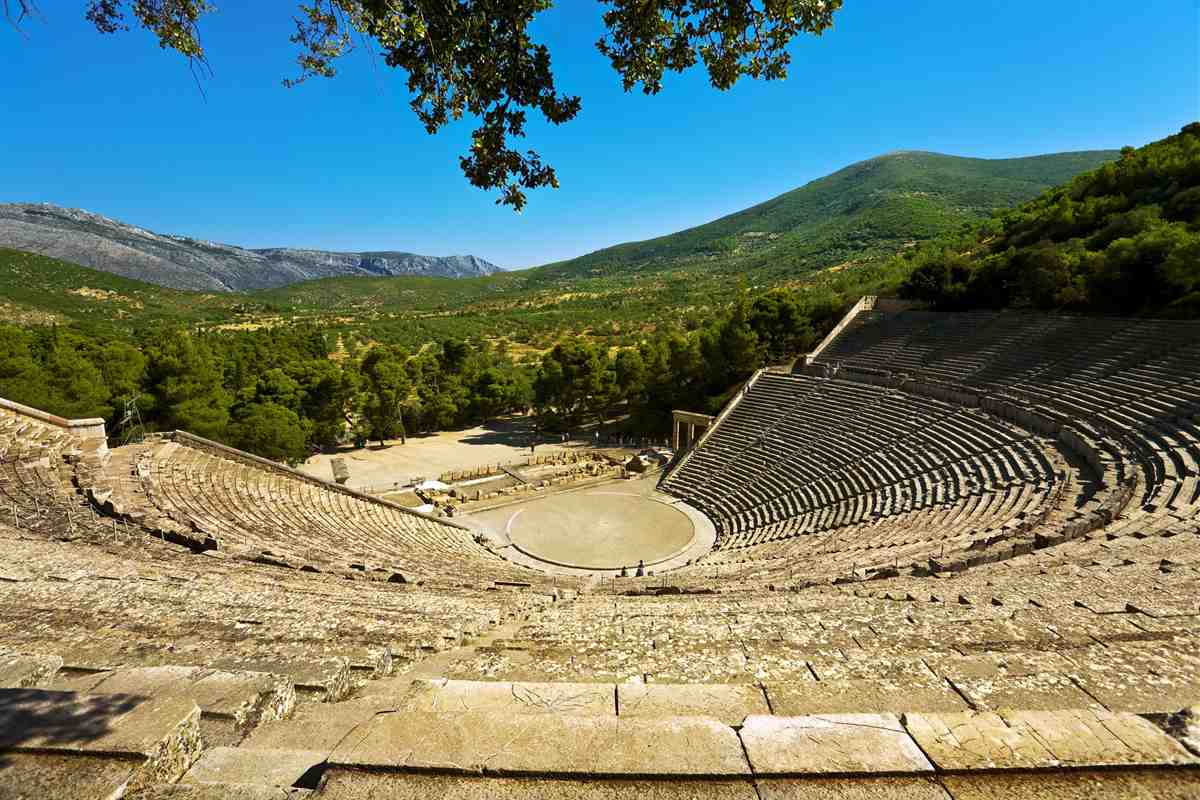
The tour listing says the Epidaurus visit takes in a sanctuary of Apollo, founded around 800 BC. Then comes the Asclepieion. The ancient theatre follows within the same archaeological site. The Mycenae Epidaurus tour from Nafplio reaches this ground after the Mycenae stop.
The city took its name from the hero Epidauros, a son of Apollo. It was independent of Argos and was not part of Argolis until Roman times. With its land, it formed a small territory called Epidauria.
Two modern towns carry the name, Palaia Epidavros and Nea Epidavros. They belong to one municipality in the regional unit of Argolis, with its seat in the town of Lygourio. The sanctuary on the Mycenae Epidaurus tour from Nafplio lies about five miles (8 km) from the town.
The ancient town had a theatre of its own, built in the 4th century BC, with about 2,000 seats. It was found well preserved, has been renovated and is open to the public. It is not the large theatre inside the sanctuary.
UNESCO lists the sanctuary and that large theatre for their exemplary architecture. It also names their part in the spread of healing sanctuaries and cults across the ancient Greek and Roman worlds. The Mycenae Epidaurus tour from Nafplio enters a World Heritage Site.
Who was Asclepius, and why did the sick travel to Epidaurus?
Asclepius was the Greek hero and god of medicine, a son of Apollo. The sick travelled to Epidaurus because its sanctuary was the leading healing centre of the Classical world. The Mycenae Epidaurus tour from Nafplio stops there.
In myth, Asclepius was the son of Apollo and Coronis, or of Arsinoe, or of Apollo alone. One version says Coronis bore him in Epidaurus and left him on Mount Tittheion, where a goat gave him milk. Strabo named Tricca in Thessaly as his birthplace instead.
The centaur Chiron taught him medicine. His rod, a staff with a snake wound round it, remains a symbol of medicine today. The original Hippocratic Oath began by calling on him: “I swear by Apollo the Physician and by Asclepius.”
The myth ends in a death. Asclepius began to bring dead people back to life, so Hades complained to Zeus. Zeus killed him, and at Apollo’s request he became a star.
From the fifth century BC, the cult of Asclepius grew popular. Pilgrims flocked to his healing temples hoping to be cured of their ills. At Epidaurus the cult is attested in the 6th century BC. The older hill-top sanctuary of Apollo Maleatas had become too small. The Mycenae Epidaurus tour from Nafplio visits one of these healing temples.
The tour listing calls the Asclepieion the healing temple of serious diseases in ancient Greece. Ill people went there in the hope of a cure. On the Mycenae Epidaurus tour from Nafplio you stand where that hope drew them.
Asclepius, the foremost healer god of antiquity, brought prosperity to the sanctuary that the Mycenae Epidaurus tour from Nafplio visits. It flourished until the first half of the first century BC. Then Sulla sacked it during the First Mithridatic War. A visit by Hadrian in AD 124 revived it.
The Goths raided the sanctuary in AD 395. Even so, it was still known as a Christian healing centre in the mid 5th century. Athens also held a festival for the god, called the Epidauria.
What was the Asclepieion of Epidaurus like as an ancient healing centre?
The Asclepieion of Epidaurus was the main holy site of the healing god Asclepius. Ill people spent a night in a big sleeping hall. There the god was said to advise them in dreams. The Mycenae Epidaurus tour from Nafplio names it as a visit.
The temple of Asclepius went up in the early 4th century BC. It was Doric and about 80 feet long. Builders carved sculpture for both gables. An inscription found nearby records the work and names Theodotus as the architect. The job took nearly five years. Only foundations survive, as you see on the Mycenae Epidaurus tour from Nafplio.
The cult statue of the god was made of ivory and gold. The geographer Pausanias described it in the 2nd century AD. He says an inscription names Thrasymedes of Paros as the sculptor. The god sat on a seat holding a staff, with his other hand above a serpent’s head. A dog lay by his side.
Pausanias describes slabs that name the men and women healed, their diseases and the cures. Panagiotis Kavvadias began digging in the 19th century and found two such slabs in his first season. They name at least twenty people, healed mainly through dreams or visions. The Mycenae Epidaurus tour from Nafplio visits the sanctuary where the slabs were found.
Kavvadias dug out the abaton in his third season. The next year he rebuilt a row of columns in its western stoa. Beyond the sacred grove, on Kynortion hill, stood the secondary sanctuary of Apollo Maleatas. The listing for the Mycenae Epidaurus tour from Nafplio also names an Apollo sanctuary.
What else stands in the sanctuary of Epidaurus, from the tholos to the stadium?
Besides the temple, the sanctuary held a round marble tholos, a stadium and a guest house of 160 rooms. The listing for the Mycenae Epidaurus tour from Nafplio does not name these buildings. They are facts about the site, not tour stops.
Pausanias describes the tholos as a circular building of white marble. Kavvadias uncovered it, and the temple of Asclepius, in his second season. In his fourth he excavated the temple of Artemis and the Great Propylaia. Pausanias also lists a sanctuary of Aphrodite and Themis. He praises a fountain for its roof and general splendour.
Archaeologists found the stadium in the 19th century. It lies in the same sanctuary as the theatre of the Mycenae Epidaurus tour from Nafplio. Kavvadias found a building beside the stadium, joined to it by an entrance tunnel. Stephen Miller has suggested that it was a changing room for athletes. He also found an elaborate building north of the stadium.
In the 2nd century AD, the Roman senator Pythodorus gave generously to the sanctuary. His gifts included a bathhouse of Asclepius, and he restored the guest house. The Library of Rufus and a small odeon in the gymnasium come from the same period. A visit on the Mycenae Epidaurus tour from Nafplio takes in centuries of building.
Fragments of the temple’s upper parts are kept in the museum on the site. The sculptures from its gables and roof are the work of master sculptors of the period. They fill a prominent room in the National Archaeological Museum in Athens. The Mycenae Epidaurus tour from Nafplio shows the setting, while those sculptures are in Athens.
What makes the ancient Theatre of Epidaurus special?
Size, age and design set the theatre apart. It was built at the end of the fourth century BC and holds 13,000 to 14,000 spectators. The Mycenae Epidaurus tour from Nafplio names it among the highlights of its listing. It stands at the southeast end of the sanctuary of Asclepius.
Polykleitos the Younger designed the theatre you reach on the Mycenae Epidaurus tour from Nafplio. A sculptor of athletes and the son of Polykleitos the Elder, he made his greatest achievements in architecture. The tour listing dates the theatre to 330 BC, at the end of the classical era. Reference works give a range from 340 to 300 BC.
The Mycenae Epidaurus tour from Nafplio reaches a theatre with three classic parts. The theatron holds the seats. The orchestra is the circular floor at the centre, and the skene is the stage building. A corridor 1.82 metres wide divides the seats into 12 lower and 22 upper sections. The lowest rows in each part were for important people.
Only part of the stage building survives. It had two storeys and a proscenium in front. Two ramps led to the roof of the proscenium, where the actors later played. Its first phase dates to the end of the fourth century BC, its second to the middle of the second. The theatre also has two gates, which are restored.
Panagiotis Kavvadias led the first systematic dig. Thanks to the restorations that followed, the Mycenae Epidaurus tour from Nafplio shows an auditorium in almost its original form. As in other Greek theatres, the lush landscape behind the stage is part of the design. UNESCO lists the theatre with the Temple of Asclepius for its exceptional architecture and aesthetics.
How do the acoustics of the Epidaurus theatre work?
The acoustics come from two causes: the shape of the seating and the limestone of the rows. Together they shape how sound from the stage reaches the audience. The Mycenae Epidaurus tour from Nafplio includes the theatre in its description, so both causes can be seen on site.
The theatre on the Mycenae Epidaurus tour from Nafplio has a long reputation for exceptional acoustics. It hosted music, singing and dramatic games in the worship of Asclepius, so clear sound mattered. The story says that a word spoken from the stage, with no amplification, was almost fully clear. This held for all 14,000 spectators, wherever they sat.
Measurements taken on the spot soften the story. Researchers took large-scale sound measurements in the Odeon of Herodes Atticus and the theatres of Epidaurus and Argos. Sounds can indeed be noticed throughout the theatre. Clear speech, however, is not guaranteed. A voice needs good projection, and ancient Greek actors had a reputation as experts at it.
The stone is the first cause. The limestone rows filter out low-pitched noise, such as the murmur of a crowd. They also strengthen the high-pitched sounds from the stage. Together, the two effects favour the stage over the crowd. On the Mycenae Epidaurus tour from Nafplio, the seat rows in front of you are this filter.
The shape is the second cause. The seating design is unique and rests on three marking centres. Because of this design, the architects won strong acoustics and a better view in one plan. The listing of the Mycenae Epidaurus tour from Nafplio calls the theatre elegant and praises its acoustics and design.
What is the Epidaurus Festival, and which plays are staged today?
The Epidaurus Festival is a yearly summer arts festival held in the ancient theatre of Epidaurus. It stages ancient tragedies and comedies in the same theatre that the Mycenae Epidaurus tour from Nafplio visits.
The theatre that the Mycenae Epidaurus tour from Nafplio visits saw its first modern performance in nineteen thirty-eight. It was Electra by Sophocles, directed by Dimitris Rontiris. The festival opened in nineteen fifty-five with Hecuba by Euripides. Alexis Minotis directed it, and Katina Paxinou played the title role.
Today the programme holds tragedies by Aeschylus, Sophocles and Euripides, and the surviving comedies of Aristophanes. Other productions revive ancient myths. A third group are contemporary plays written on the basis of ancient dramas.
The festival takes place in Athens and Epidaurus from late spring to October. It is held in the summer months, on Fridays and Saturdays in July and August. The listing of the Mycenae Epidaurus tour from Nafplio does not mention the festival. Check the festival calendar for a play date.
The stage has held more than drama. Maria Callas performed Norma there in nineteen sixty and Medea in nineteen sixty-one. In nineteen eighty-two Peter Hall staged the Oresteia, the first foreign director at the festival. Anyone on the Mycenae Epidaurus tour from Nafplio stands in a theatre that has also heard opera and orchestral music.
A smaller venue, the Theatre of Palaia Epidavros, also hosts festival shows. They began in nineteen ninety-five as an experimental music series called Musical July, and plays were added later.
What is Nafplio, the town where the tour starts and ends?
Nafplio is a coastal city on the Argolic Gulf in the northeast Peloponnese, and the capital of Argolis. The Mycenae Epidaurus tour from Nafplio begins and ends in this town.
The listing for the Mycenae Epidaurus tour from Nafplio spells the town Nafplion. English also uses Nauplia and Navplion. Its oldest mention appears to be the Aegean List, from the mortuary temple of Amenhotep III. That Egyptian list dates to the 14th century BC.
The old town stands largely on a peninsula that juts into the gulf. The peninsula forms a naturally protected bay, and human-made moles add to it. Landfill, mainly since the nineteen-seventies, has nearly doubled its land area.
Ancient Nauplia was the port of Argos. The town that begins the Mycenae Epidaurus tour from Nafplio later changed rulers. French Crusaders took it in the early 13th century, and Venice acquired the lordship that held it. The city surrendered to the Ottomans in the 16th century.
The Venetians retook the city in the late 17th century. They made it the capital of their Kingdom of the Morea.
In the Greek War of Independence, Nafplio was an Ottoman stronghold and was besieged for more than a year. After its capture it became the seat of the provisional government.
Ioannis Kapodistrias, the first head of state, then made it the capital. It held that role until King Otto moved the capital to Athens. So the Mycenae Epidaurus tour from Nafplio starts in a former national capital.
Colourful houses in the old town show Venetian influence, and to a much lower degree Ottoman influence. The city also holds the only example of Mycenaean Revival architecture, a National Bank of Greece branch.
The Archaeological Museum on Syntagma Square shows a bronze armour suit of the 13th century BC. A Mycenaean soldier once wore it. That armour links the town to the sites on the Mycenae Epidaurus tour from Nafplio.
What are Palamidi and Bourtzi in Nafplio?
Palamidi is a Venetian fortress on a 216-metre hill in Nafplio. Bourtzi is a Venetian water castle in the middle of its harbour. Both stand in the town where the Mycenae Epidaurus tour from Nafplio begins and ends.
The Venetians built Palamidi during their second period of rule in the area. The work ended in a relatively short time. The Ottomans captured the fortress the year after it was finished. They held it until the Greeks took it at the Siege of Nauplia. It is far younger than the ruins on the Mycenae Epidaurus tour from Nafplio.
Palamidi has eight bastions, and they changed names with each ruler. The Ottomans gave them Turkish names. The Greeks chose Epaminondas, Miltiades, Leonidas, Phocion, Achilles and Themistocles for six, and St. Andrew and the French philhellene Robert for the other two. The Miltiades bastion became a prison, and Theodoros Kolokotronis, a hero of the Greek Revolution, was held there.
The name Bourtzi comes from the Ottoman Turkish word burc, which means tower. The Italian architect Antonio Gambello of Bergamo built the castle in the fifteenth century. The engineer Brancaleone completed it. After the Treaty of Karlowitz, the Venetians added a sturdy tower and bastions with cannons on the islet. That fortress dominates the entrance to the port today.
In the Greek Revolution, 200 armed soldiers captured the castle, and it was used to bombard Nafplio. The Greek government twice took refuge in it during the civil war. By order of King George I, the castle was later disarmed. It became the home of the city’s executioner and a place of executions by guillotine.
In the twentieth century the castle was restored with the Greek National Tourism Organisation. It became a hotel with 12 rooms and a restaurant, one of the first tourist centres in Greece. The Greek junta later closed both. The itinerary of the Mycenae Epidaurus tour from Nafplio names only Mycenae and Epidaurus as stops. Both forts are town sights.
What do you wear and bring for a day among the ruins, and who can join?
Wear comfortable walking shoes and bring a hat, sunscreen, water and a camera for the Mycenae Epidaurus tour from Nafplio. The tour is not suitable for wheelchair users or people with mobility impairments, because the walking is on uneven surfaces.
The listing for the Mycenae Epidaurus tour from Nafplio asks for comfortable walking shoes. It describes a moderate amount of walking and says the tour crosses uneven surfaces. The walking covers two archaeological sites, Mycenae and Epidaurus, in the same day. Comfortable shoes head the listing’s short list of things to bring.
The listing also tells you to check the weather forecast and dress appropriately. Bring a hat and sunscreen for protection against the sun on the Mycenae Epidaurus tour from Nafplio. Water is on the list of things to bring, and the listing recommends snacks as well.
A camera is on the packing list, and photography is allowed on the Mycenae Epidaurus tour from Nafplio. The use of flash is prohibited inside the tombs. Smoking is not allowed on the tour either.
The listing names two groups the tour does not suit: people with mobility impairments and wheelchair users. Its not-suitable list stops at those two. Anyone who can walk over uneven ground can join the Mycenae Epidaurus tour from Nafplio, according to the listing.
What else do travellers ask about the Mycenae Epidaurus tour from Nafplio?
Is the Corinth Canal visited within the Mycenae Epidaurus tour from Nafplio?
No. The itinerary lists the pickup in Nafplion, Mycenae, Epidaurus and the return, and it names no canal stop. Other sellers add the canal to routes longer than a Mycenae Epidaurus tour from Nafplio. One bus day from Athens makes a 20-minute stop there. A day that begins in Loutraki pauses at the canal for photos.
Does the tour run in rain or in heat?
The operator’s listing for a Mycenae Epidaurus tour from Nafplio states no rain rule and no heat rule. Another seller of a day from Nafplio says weather does not affect its excursion. If it cancels because of unfavourable weather, you pick another date or take a full refund.
That seller also needs at least two participants for its tour to run. Those terms belong to that seller alone. Ask the operator about this day before you pay.
Does the tour visit a museum?
The itinerary of this Mycenae Epidaurus tour from Nafplio lists two site visits and no museum. A bus day from Athens at another seller lists the Archaeological Museum of Mycenae as an optional visit.
Epidaurus has its own Archaeological Museum, noted for its temple reconstructions, columns and inscriptions. It opened in the early twentieth century to show finds from the ancient site. At Mycenae itself, a scientific committee has worked on visitor access with walkways and information stations.
Which language does the tour use?
The listing names English only, spoken by the driver. It names no audio set and no second language.
A coach day from a seller based in Loutraki adds a whisper audio system for clear commentary at every stop. A Mycenae Epidaurus tour from Nafplio by van names no such system here. Ask the operator first if you need another language.
Is Argos, the large town near Mycenae, part of the tour?
No. The itinerary names only Mycenae and Epidaurus as sites. Argos is the largest city in Argolis, with nearly twice the population of the capital, Nafplio. In Mycenaean times it was a major stronghold, alongside Mycenae and Tiryns.
Its ancient theatre went up in the third century BC with a capacity of 20,000 spectators. In the nineteenth century the Fourth National Assembly of the new Greek state met there under Ioannis Kapodistrias. Larissa castle stands on the highest point of the city, 289 metres up. The Argos museum holds a great number of finds from prehistoric times.
How can I fit Nafplio’s old town around the Mycenae Epidaurus tour from Nafplio?
A travel wiki says the major sights of Nafplio stand in the old town, easy to cover on foot. The town’s Archaeological Museum shows finds from the Neolithic to the Roman periods, all from southern Argolis. Its Early Helladic exhibits come from Tiryns, Asine, Berbati and Palaia Epidavros.
South of Syntagma Square stands the Vouleftikon, the first parliament of the Greek nation. It was earlier an Ottoman mosque.
Frangokklisia, the oldest church in the town, stands at the foot of the Akronafplia castle, south-east of the old town. These places are not tour stops, so they fill the hours around a Mycenae Epidaurus tour from Nafplio.