
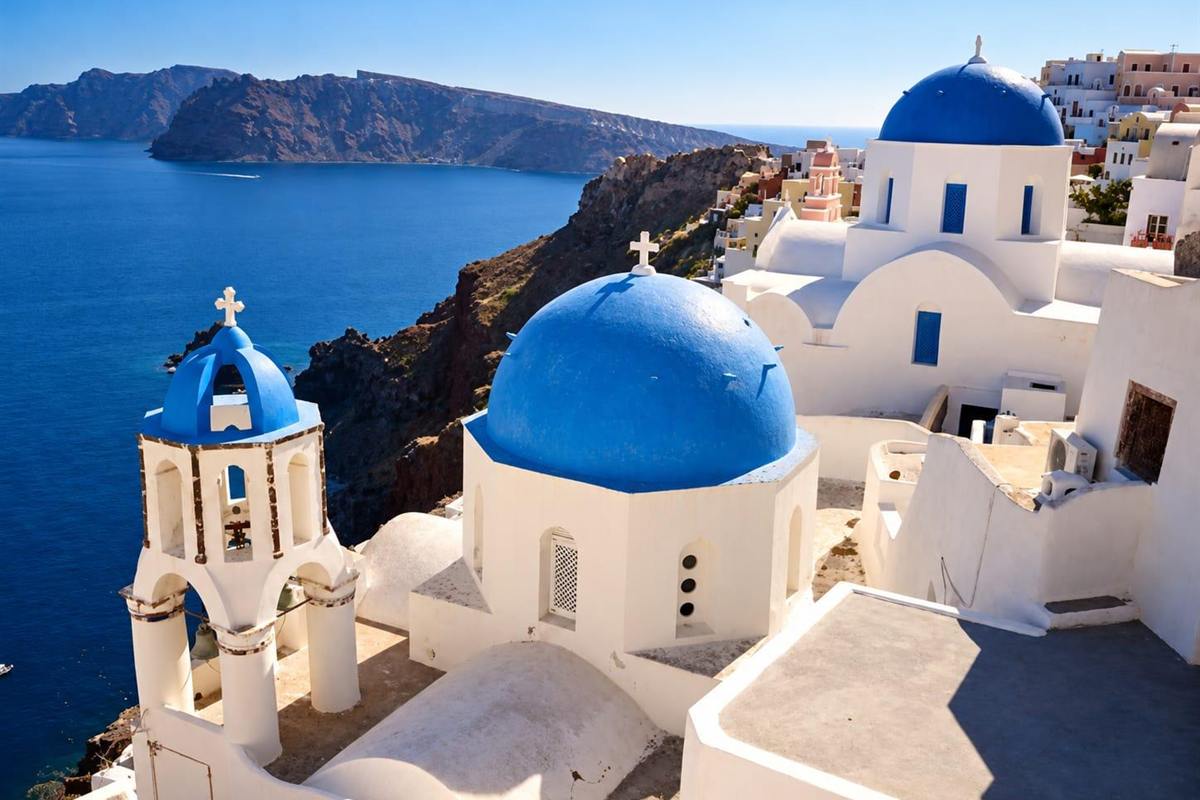
A Santorini private tour gives you one car and one local driver for the day, with the stops, the pace and the lunch break set around your group. Find the other islands and day trips on our page of tours in Greece.
The sections below cover the inclusions, the pickup points, the car and the drinks on board, how the island formed, each stop from Oia to Perissa, lunch, extra stops, other private tours and what to wear.
What does the Santorini private tour include?
The Santorini private tour includes private transport, pick-up and drop-off, and a local English-speaking driver. Fuel, all transport costs and entrance fees, where they apply, are included too. Tips are optional and not included.
The operator’s listing names the activity provider as MARJO GOLDEN MEMORIES MIKE. Its own text calls the company Golden Memories Tours. The title presents the Santorini private tour as a luxury island tour with a local driver. The short blurb says the company runs private tours with knowledgeable local drivers.
The text describes a flexible island tour for travellers who want the island’s highlights and its quieter, more authentic places. It promises a relaxed, personalized way to see the island. The highlights list adds visits to iconic Santorini sites and authentic local areas. The driver is a local Santorinian who speaks English and shares real island stories.
The listing gives English and Greek as the languages of the live host. The Santorini private tour is for your group only, up to 15 people. All scheduled sightseeing stops in the itinerary are covered at no extra cost. The listing lets you cancel a day before the start and get all your money back.
The listing’s included list has five lines: transport, pick-up and drop-off, the driver, fuel and transport costs, and entrance fees. A sixth line, tips and gratuities, is marked optional. A drink or meal by the water at Perissa Beach is optional too. The listing says it is not included in the Santorini private tour.
How long is the Santorini private tour, and how flexible is the plan?
The Santorini private tour lasts 3 to 8 hours, depending on your preferences. The plan is fully flexible: you can change the time at each stop, skip places, or ask for extra stops.
The listing shows the length of the Santorini private tour as 3 to 8 hours. Its text speaks of 4-, 5-, 6- and 8-hour tours. The 3-hour end of the range appears only in the duration line. It gives no start time and asks you to check availability to see the starting times.
The listing calls its route a proposed itinerary. The listing starts the tour in Oia and ends it at Perissa Beach. Lunch comes as a seventh item on the longer packages. Each of the seven items carries an approximate time, which the listing marks as approx.
- Oia village: about 60 minutes
- Fira and the Three Bells of Fira: about 45 minutes
- Imerovigli: about 30 minutes
- Prophet Elias Monastery: about 30 minutes
- Red Beach, Akrotiri: about 30 minutes
- Perissa Black Beach: about 45 minutes
- Lunch stop, on the 6- and 8-hour packages: about 60 minutes
Added up, the six sightseeing stops come to 240 minutes, which is 4 hours. The lunch stop adds 60 minutes more. The first three stops come to 135 minutes, and the last three come to 105. The shortest day is 3 hours, so a short Santorini private tour needs shorter stops or fewer places.
The listing says the itinerary is fully flexible. You can adjust the time at each stop, skip locations, or request additional stops that match your interests. Drop Imerovigli, for example, and you free about 30 minutes for a longer stop elsewhere. The highlights list also promises itineraries adapted to your pace and interests.
Where does the driver pick you up for a Santorini private tour?
The driver collects you from your hotel, the cruise port, the airport or another place you prefer. The listing for this Santorini private tour covers the whole island, and it names Athinios port as one meeting place.
The listing keeps the start simple. A Santorini private tour begins with a pick-up from your hotel, cruise port, airport or preferred location. The words “preferred location” add one more choice to that short list. If your address is not a hotel, a port or the airport, ask the seller before you book.
A second note in the listing repeats the point. The seller can pick you up from all over the island, from your hotel, Athinios port or the airport. Wikivoyage adds that almost all accommodation and tourist infrastructure stand on Thira, the largest island of the archipelago.
Wikivoyage names Athinios as the port where ferries dock. The listing names the same port as a pick-up place, so travellers who arrive by ferry are covered. It also names the airport, so travellers who arrive by plane are covered too.
The drop-off follows the same pattern. The listing counts hotel, port and airport pick-up and drop-off as part of the Santorini private tour. The ride back is therefore part of the same plan. The listing gives no pick-up time and tells you to check availability for the starting times.
How do cruise passengers meet the driver when cars cannot reach the Old Port?
On a Santorini private tour the car cannot enter the Old Port of Fira, because no road gives vehicles access. Cruise passengers ride the cable car up to the driver, or ask the seller for a private boat transfer.
The listing states the rule in plain words. The seller is unable to access the Old Port of Fira directly. There is no road access for vehicles, so a Santorini private tour cannot start there by car. To reach the driver, you can use the cable car service. The listing names that option first and the boat second.
Wikivoyage explains the setting. The Old Port sits at the bottom of the steep caldera cliffs. The cable car connects the port to the town centre. The same wiki says a cruise ship too big for Athinios anchors in the caldera, west of Fira. That spot lies 3 kilometres north of Athinios.
That is why the listing treats the two ports differently on a Santorini private tour. Wikivoyage says vehicles leave Athinios by a steep, winding road. The Old Port has no such road, so the cable car does the climb that the car cannot do.
A traveller on a forum described a similar start on a Santorini private tour with another seller. Staff met them at the top of the cable car in Fira and walked them to the car. The listing for this tour does not name a meeting spot at the top. Ask the seller to confirm it.
Wikipedia adds two notes about the ride. It advises riding early or late to avoid crowds. It also says the cable car is not always suitable for strollers or pets. Wikivoyage names a paved stairway as another way up. The listing mentions only the cable car and the boat.
The second option for a Santorini private tour is a private boat transfer. The seller can arrange it upon request. The listing names no landing point and gives no boat time, so ask early. For further information and assistance, the listing asks you to contact the seller through WhatsApp.
What is the car like, and what drinks wait on board?
A Santorini private tour runs in a modern, air-conditioned Mercedes-Benz with a local English-speaking driver. On the 4, 5, 6 and 8-hour tours, guests also get champagne, refreshing drinks and chilled water on board.
The operator’s listing says the tour includes private transport in a comfortable, modern Mercedes-Benz. Its short description calls the vehicles new, modern and customised. The listing names a local driver who speaks English and knows the island very well. On a Santorini private tour, the pick-up itself already happens in the air-conditioned vehicle.
On the 4, 5, 6 and 8-hour tours, guests are treated to a complimentary bottle of champagne. Refreshing beverages and chilled bottled water come with it. The listing sums this up as a relaxing and luxurious experience on board. It names no drinks for other lengths, so ask before you book a 3-hour Santorini private tour.
Water matters on this island. Wikivoyage says Santorini has no rivers or lakes and gets little rain, so fresh water is scarce. The tap water is safe to drink but rather salty. Health concerns exist about long-term use, so almost everyone drinks bottled water while visiting.
Wikivoyage also names dehydration, together with sunburn, as the commonest health issue on the island. Chilled water in the car of a Santorini private tour is more than a small extra.
Why choose a private car over a bus or a group tour on Santorini?
A Santorini private tour is built around your pace. The listing promises comfort, flexibility and local insight, with no crowds or strict schedules. It keeps you out of large groups and off the public bus network.
The public bus works differently. Wikivoyage says there are no route numbers, and not all buses show where they are going. You buy a ticket on the bus, and it takes cash only. It calls the buses comfy and air-conditioned, so the gap is the timetable. A Santorini private tour follows your plan instead.
In low season, services end by 7 in the evening. In peak season, buses run up to every 15 minutes from Oia, Kamari and Perissa. They fill up at their starting points and skip the stops in between. A full bus means standing in the corridor. Return times can drift far from the published ones.
Taxis come with limits too. Wikivoyage passes on a hotel tip to book a taxi in advance. There are not enough taxis in high season. As is the rule in the Cyclades, fares are shared between passengers. A cabbie can pick up more people on your trip. On a Santorini private tour, the car carries only your group.
Driving yourself has its own limits. Wikivoyage calls the road conditions unsafe, as drivers follow the habits of nearly every country in the world. It takes about an hour to drive from Exomytis to Oia, the length of the island. It recommends an international driving permit for a rental car.
Quad bikes share the same roads with other drivers. You need a driver’s licence for one, and Wikivoyage recommends a helmet. A driver on a Santorini private tour handles the road for you.
A group tour has its own trade-off. The listing promises an island day without stress, strict schedules or large groups, tailored just for you. It also describes local Santorinian drivers who share real island stories. That is the pitch of this Santorini private tour.
What is Santorini, the island the tour loops around?
Santorini is a group of five volcanic islands in the Cyclades, in the southern Aegean Sea. A Santorini private tour visits towns and beaches on the biggest of them, Thira, which covers about 73 square kilometres.
A travel wiki says the group used to be a single island. Thira is by far the largest and has about 15,500 people. Therasia, the next largest inhabited island, covers 9 square kilometres and has less than 500 inhabitants.
The Santorini private tour listing names Oia, Fira, Imerovigli, Akrotiri and Perissa. The same travel wiki lists all five among 13 towns and villages on Thira. The list also holds Vlychada, a fishing village on the southern shore with a large marina. Finikia is a traditional village with two volcanic cones in its backyard.
Aspronisi is the smallest island, only 650 metres long and uninhabited. Thira, Therasia and Aspronisi form the outer ring around the crater. Nea Kameni and Palea Kameni stand near its centre. A Santorini private tour looks over this ring from Oia, where the listing promises caldera views. At Fira it promises views of the volcano.
Wikipedia gives the official name as Thira, also written Thera. It says the name Santorini comes from the island’s patron saint, Saint Irene of Thessalonica. A travel wiki adds that Greek and Brazilian TV series were shot on the island. So were Hollywood films such as Tomb Raider II.
How did the volcano give Santorini its cliffs and coloured beaches?
Repeated cycles of volcano building and collapse shaped Santorini and left a sheer cliff wall around the crater. A Santorini private tour also visits a red beach and a black beach, both coloured by volcanic rock.
The volcano behind a Santorini private tour exists because of the Hellenic subduction zone south-west of Crete, says Wikipedia. There, the African plate moves under the Aegean plate by up to 5 centimetres a year. Santorini has seen at least twelve large explosive eruptions, and at least four of them formed a crater.
The crater you see today is the newest of at least four overlapping ones. The oldest, in the south, formed about 180,000 years ago. The next two followed about 70,000 and 21,000 years ago. The Minoan eruption formed the current crater about 3,600 years ago.
Cliffs 300 metres high enclose the crater on three sides, and the crater reaches a maximum depth of 385 metres. The cliff face shows layers of solidified lava, stacked one on another. The main towns stand along the top edge. The first two stops of a Santorini private tour, Oia and Fira, are cliff-top towns.
Away from the crater, the ground slopes down and outward, and the outer beaches are smooth and shallow. Sand colour depends on which rock layer lies bare. Wikipedia names a Red Beach, a Black Beach and a White Beach, all made of solidified lava.
This Santorini private tour’s listing names red volcanic cliffs at Red Beach and black volcanic sand at Perissa. The white shade has a match in the island group’s own names. Aspronisi means white island, after the colour of the volcanic pumice above its waterline. The island’s pumice quarries are closed, to preserve the caldera.
The volcano that a Santorini private tour looks out on is dormant but still active, says Wikipedia. Later eruptions built the dark lava islands of Nea Kameni and Palea Kameni inside the crater. Steam and carbon dioxide still escape from the current active crater.
What do you see in Oia on the first stop of the Santorini private tour?
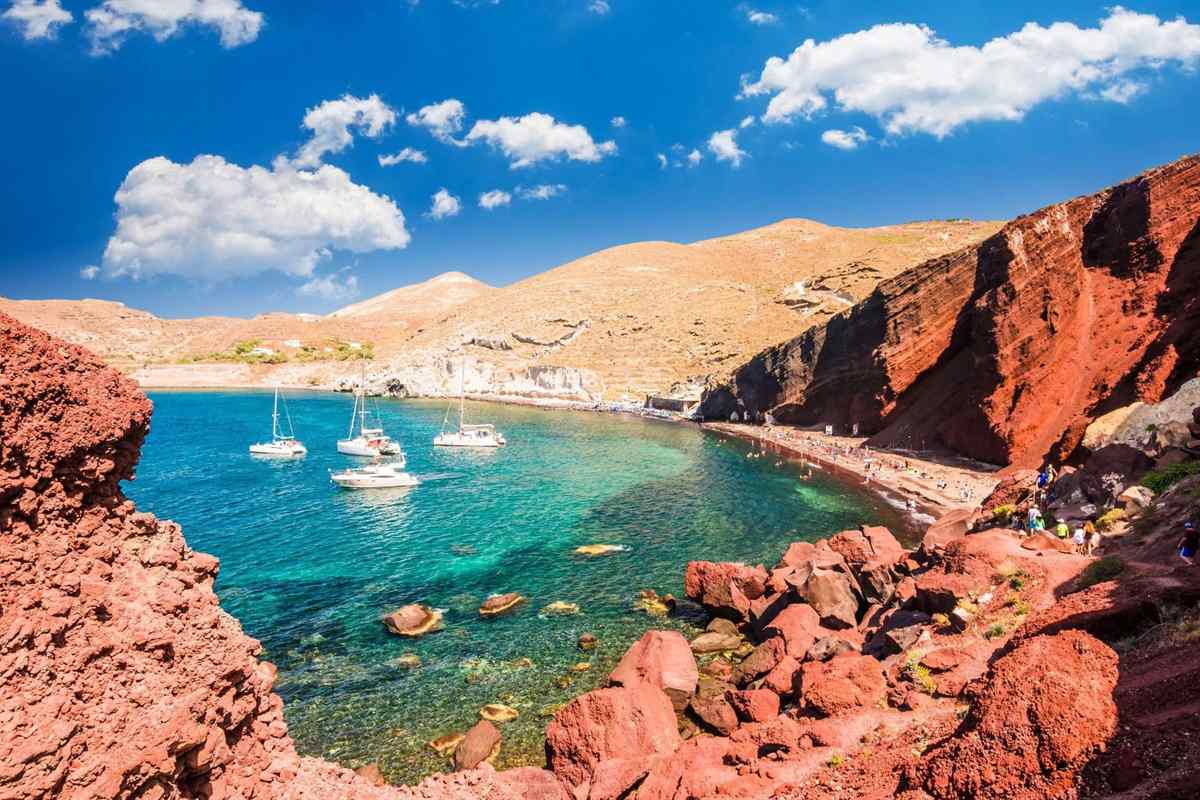
Oia is the first stop of the Santorini private tour, and you see it on foot. The operator’s listing names narrow streets, whitewashed houses, blue-domed churches and caldera views. It also gives free time for photos and exploring.
Wikivoyage calls Oia the northernmost town on Thira, the main island of the Santorini archipelago. So the Santorini private tour opens at the northern end of Thira. That page sums up the village in four things: steep volcanic cliffs, white houses, deep blue church roofs and windmills.
Wikivoyage says motorised vehicles are banned from the town, so the only way around is on foot. Even the rubbish is carried away by donkeys. It adds that Oia is small, and that crossing the whole town on foot takes only 20 to 30 minutes. Its narrow streets draw over 2 million tourists every year.
Wikipedia says the village was previously known as Apano Meria, which means upper side. The name changed to Oia in the second half of the nineteenth century. Wikivoyage adds that Oia was rebuilt from the ground up after a magnitude 7.8 earthquake, with its cables laid underground. Ask your driver about the old name on the Santorini private tour.
The Santorini private tour leaves free time for photos, and the white walls come with a story. One explanation on Wikipedia says that Greeks under Ottoman rule were not allowed to fly a white flag. In defiance, Oia painted its whole housing complex white, with domes. The page adds that Oia has much longer sunlight hours than Fira.
What is Fira, the capital and second stop?
Fira is the modern capital of Santorini, a town of whitewashed houses on the western edge of the semi-circular island. It is the second stop of the Santorini private tour, right after Oia. The listing says you learn about the island’s history and architecture there.
On the Santorini private tour, the listing pairs Fira with the Three Bells viewpoint, which has its own section. It says you enjoy views of the volcano and the Aegean Sea from the town. Wikipedia says the view from Fira takes in the caldera and Nea Kameni, the volcanic island at its centre.
The Santorini private tour listing names a viewpoint, not a museum, yet Fira has museums on the island’s past. Wikivoyage describes a Folklore Museum about how people lived on the islands. Its displays show a cobbler, a blacksmith, a distillery, a winery and even a mine underground. It covers homes from cave houses to the white houses of today.
Fira and Oia are joined by a trail along the crater rim. Wikivoyage says it is well marked, with signs to Oia before you leave town. Walking from Fira to Oia is more uphill, with a climb of over 300 m. The Santorini private tour links the same two towns by car, from Oia to Fira.
Wikipedia lists 1,516 residents for Fira in a recent census. The town is also the seat of the municipality of Santorini. Wikivoyage names the Archaeological Museum of Thera, which holds objects from the Proto-Cycladic culture of the third millennium BC. Wikipedia adds that caldera boat cruises are available from either Oia or Fira.
What is the Three Bells of Fira viewpoint?
The Three Bells of Fira is a blue-domed church with three bells, officially the Catholic Church of the Dormition. It stands directly above the cliffs of western Santorini, and the Santorini private tour lists it as a viewpoint.
The operator’s listing sets the Three Bells of Fira viewpoint inside the Fira stop of the Santorini private tour. It promises a view of the volcano and the sea. It also says you learn about the history and architecture of the island while you are there.
A travel wiki says the churches of Santorini are mainly Greek Orthodox. The Three Bells is different. Wikipedia calls it an Eastern Catholic Greek Byzantine church. It stands in the Southern Aegean region of Greece. Its Greek name, Τρεις καμπάνες των Φηρών, simply means the Three Bells of Fira.
The church that the Santorini private tour names as a viewpoint was built in the 18th century. It has been refurbished and expanded multiple times since. The Amorgos earthquake damaged it heavily, and the building was restored afterwards. The land was given to the Diocese of Santorini.
The wiki says island church bells come, as a rule, in odd-numbered groups, such as three or five. Other churches on Thira have a similar setup. The wiki guesses that the ridge of the caldera has something to do with the popularity of this one. A Santorini private tour brings you to the viewpoint with a local driver.
- Feast day of the church: 15 August
- Opening hours: open at all hours, says the wiki
- Hikers on the coastal path from Fira to Oia pass the church on the way
Why is Imerovigli called the balcony of the caldera?
The listing for the Santorini private tour calls Imerovigli the “balcony of the caldera”. The village is built on the rim of the Santorini caldera. Its viewpoints are among the highest on the island.
The listing calls Imerovigli a peaceful village and names no sight there except the high viewpoints. On a Santorini private tour, this stop is about the view. Wikipedia places the village north of Fira, which is the stop before it in the listing’s route.
Skaros Rock rises near the village. Wikipedia calls it a large rock promontory. Volcanic activity of the nearby caldera formed it, and erosion and earthquakes have shaped it since. A travel wiki says it towers high above the water. The listing does not name it, so ask your driver on the Santorini private tour whether it fits your plan.
- Other names: Fortress Skaros, Castle Skaros
- In nautical use: Cape Skaros
In its day, Skaros was the largest settlement on the island. Its fortress became the de facto capital of Venetian Santorini. The first fortress, called La Roka, was finished in the early 13th century. When Venice took over, the settlement held over 200 homes and hundreds of inhabitants.
- The Chapel of Panagia Theoskepasti stood at the base of the rock, beside a small harbor
- 17th century: an eruption set off earthquakes that dropped part of the town into the sea
- 18th century: eruptions drove the majority of residents to Fira or Imerovigli
- Early 19th century: only weathered ruins remained
Hikers and photographers visit the ruins today, and the chapel remains in use on the cliffs below the rock. You reach the promontory through Imerovigli, the village where a Santorini private tour stops.
What is the Prophet Elias Monastery at the highest point of Santorini?
The Prophet Elias Monastery stands at the highest point of Santorini, near the village of Pyrgos. The Santorini private tour includes it as a stop with a 360-degree view of the whole island.
Profitis Ilias is the Greek name for the Prophet Elijah, and the monastery is dedicated to him. A Greek monastery directory places it on top of the mountain, 3 km from Pyrgos. On a Santorini private tour, the listing sells the stop for photos and a quiet break away from the crowds.
A travel wiki says the monastery is rarely open to visitors. It adds that the view makes the climb worth it. Walkers reach the hilltop on the Pyrgos to Kamari trail, which starts just south of Pyrgos. The Santorini private tour visits the same hilltop. On the way down, walkers pass the Zoodochos Pigis cave and then reach Kamari.
The monastery on the Santorini private tour has a long record. In the 19th century it ran a school where Greek language and literature were taught. In earlier times it held considerable wealth and owned its own ship. During the Greek War of Independence, sixteen monks declared in writing their support for the revolt. Abbot Gerasimos Mavrommatis led them.
The directory adds a local custom. In dry spells, the icon of the Prophet is taken out of its usual place, so that he sends rain. A Santorini web portal says the monastery also has a museum of church items, books and material on local life. It sits in Agia Triada, first a Catholic church of a small convent.
Which villages lie on the road south, from Pyrgos to Megalochori?
A Santorini web portal names the villages on the main road. From Fira, they run Karterados, Messaria, Pyrgos and Megalochori, then Emporio, Perissa and Perivolos to the south east. The Santorini private tour listing names none of them as a stop.
Pyrgos Kallistis means Beauty Tower in Greek. The portal says its panorama reaches all the way to Oia, and the hillside village was declared a protected settlement. Wikipedia lists Pyrgos among the island’s five fortified settlements. The monastery stop of the Santorini private tour lies 3 km from this village.
At Easter, the portal says, the whole hillside of Pyrgos is lit up with burning brands on Good Friday. On Easter Sunday, the square has fireworks, lamb on the spit and wine. The village also hosts the Vanishing Santorini exhibition, a look into the island’s past.
Megalochori sits in vineyard country on the south-western plains. Merchants and land barons there exported Vinsanto wine. Their mansions have high walls, inner courtyards and solid wooden doors, built for privacy and for safety against pirates. The Lost Atlantis Experience, a private museum there, links the Atlantis myth to the island’s volcanic landscape.
Two caldera beaches, Plaka and Thermi, are named after churches. The portal says neither is accessible by car, so a Santorini private tour cannot drive you to them. A travel wiki adds the Heart of Santorini. This rock formation near the village is a popular spot for photographers.
Distances from Fira, from Wikipedia and the portal, if a Santorini private tour adds these villages:
- Pyrgos: about 7 km
- Megalochori: 9 km
- Emporio, also called Nimborios: 12 km, near the Profitis Ilias mountains, with the old Goulas Castle
What makes the Red Beach near Akrotiri red?
Wikipedia links the red of this beach to oxidised iron. It says the sand is crushed black and red volcanic rock from the Santorini caldera. The Santorini private tour lists the Red Beach as its fifth stop, in the south near Akrotiri.
The beach is small. A travel site gives its length as about 300 metres. It describes red rock, black volcanic sand and deep blue sea side by side. Other travel pages call it Kokkini Beach, its Greek name.
The operator’s listing for this Santorini private tour sends you south to admire the red volcanic cliffs and landscape. It says admire, not swim. One travel site tells visitors to go for the view and not to expect a normal beach day. Another says that on certain days visitors skip the walk down and admire the rocks from the headland.
Check the rules before your Santorini private tour arrives. Wikipedia says the area is prone to landslides, and parts of the beach have been inaccessible for over ten years. The first site also quotes a Municipality of Thira notice that bars visitor access because of rockfall danger. The notice asks tour operators to respect the warning signs.
A news report on one tremor said rocks tumbled down the cliffs and the beach closed to the public. At that time it was reachable only by boat. Boats also leave from Akrotiri port, a travel page says. Ask the driver of your Santorini private tour what the signs allow on the day.
What is Akrotiri, the Bronze Age town you can add as a stop?
Akrotiri is a Bronze Age town in the southwest of Santorini. Volcanic ash buried it, and diggers have been uncovering it for over half a century. It is not in the proposed itinerary, but a Santorini private tour lets you request added stops.
The town you can add to a Santorini private tour has a long past. People lived there as early as the fifth millennium BCE. Fragments of foreign pottery show trade with other Aegean cultures. Paved streets, an extensive drainage system and fine pottery point to a sophisticated settlement. Its wealth lasted about 500 more years.
The ash also records a warning. The first ash layer is thin and shows no wear from winter rain before the next layer fell. Wikipedia reads this as months of warning from the volcano before the main eruption.
Only the southern tip of the large town has been uncovered. Wikipedia lists multi-level buildings, streets, squares and walls up to eight metres high, with stone staircases still intact. The houses held huge storage jars called pithoi, mills and pottery. A loom workshop suggests weaving for export, and a wall painting shows two antelopes.
Spyridon Marinatos began the modern dig. He tried tunnelling into the pumice, a method later dropped. Christos Doumas led the work after Marinatos died. Wikivoyage also lists a lighthouse and a Venetian castle under Akrotiri.
The listing for the Santorini private tour lets you change the time at each stop. You can skip locations or request added stops, such as cultural sites. It does not name Akrotiri. It lists entrance fees only as included where they apply, so ask the operator first.
Red Beach lies near Akrotiri, so adding the site keeps your Santorini private tour on the same southern leg. To make room, shorten or skip another stop. A traveller on a forum wrote that you can hire a certified tour leader at the site entrance.
What is Perissa Black Beach, the last stop of the Santorini private tour?
Perissa Black Beach is the final stop on the Santorini private tour. The listing gives it about 45 minutes to relax by the sea and walk on black volcanic sand. A drink or meal by the water is optional.
Perissa is a village of 725 permanent residents, according to a recent census. It belongs to the community of Emporio. The remains of an early Christian church, Saint Irene, lie in the village. The name Santorini is a shortened form of Saint Irene. A travel wiki adds that Perissa has churches from all eras of civilisation.
The Santorini private tour ends on a long beach. Perissa, Perivolos and Agios Georgios form one continuous beach. The colours and sizes of sand and pebbles change along the way. Beach bars and restaurants give it the feel of a beach day club. Kamari Beach, a black sand beach in Kamari, continues south into Perissa.
Right next to the beach stands Timiou Stafrou, a traditional Greek Orthodox church with blue domes. A travel wiki calls it one of the largest churches on Santorini. The same wiki lists good Greek fish restaurants in the village. It also names a dive shop in Perissa and lists Perissa Rock as a snorkelling site.
Perissa closes the Santorini private tour after the Red Beach stop near Akrotiri, with its red volcanic cliffs. A trail from the Basilica ruins of Perissa follows the beach for 3 km to Agios Georgios. Walkers can go on to Exomytis, 5 km in total, past the necropolis of Ancient Eleusis, a burial ground.
What is Ancient Thera on the ridge above Perissa?
Ancient Thera is an archaeological site from classical antiquity on top of Mesa Vouno, a limestone hill near Perissa. It is open to the public, and it lies close to the last stop of the Santorini private tour.
Settlers from Sparta founded the city for the strategic value of its rocky ridge. Evidence of the city dates from the ninth century BCE. Ancient Thera had two seaports, at present-day Kamari and Perissa, and the one at Perissa was called Elefsina. So the village where the Santorini private tour ends was once a port of the city.
In the second half of the third century BCE, the Ptolemaic war fleet was based in its harbour. The city was rebuilt for the officers on a regular street grid. At first the garrison had three officers and about 300 soldiers. The main street ran almost 800 metres and was between 2 and 4 metres wide, wide for its time.
The Basilike Stoa, a portico of 46 by 10 metres, marked the centre of public life. The theatre had seating for about 1,500 people, more than the city needed. Builders used the limestone of the mountain, and wood was rare there. In the eighth century a small eruption covered the city in pumice, and soon after people gave it up.
A travel wiki advises visiting the ruins in the morning. It says the view is as good a reason to go as the history. From the officers’ houses on the eastern slope, the sea lay more than 300 metres below. The listed route of the Santorini private tour does not include the site.
Where do you stop for lunch on the six- and eight-hour tours?
The six- and eight-hour Santorini private tour packages include a one-hour lunch stop at a place you choose. The operator’s listing also recommends places to eat, so you have options.
The listing names no restaurant, so you decide where the group sits down. It also says a drink or a meal by the water at Perissa Black Beach is optional and not included. Tell the driver what food you like, and plan the meal around your Santorini private tour.
Wikivoyage lists fava among the island’s specialities. Lunch on a Santorini private tour is a fair moment to try it. Fava is a split-pea puree topped with olive oil and lemon. It is served as a side dish or a main dish with bread. Locals treat it as a healthy comfort food.
Wikivoyage also gives a rule of thumb for menus. Check the board outside, and if it lists moussaka but no fava, you are probably better off looking elsewhere.
Bakeries are another option. Wikivoyage says every town and village has one, selling bread and pastries such as saganaki and spanakopita. Saganaki is fried cheese in filo pastry covered in honey, and spanakopita is a spinach pie. Wikivoyage calls them hearty options for hikers.
Fish is the other choice. Wikivoyage says seafood is very popular, in particular grilled octopus and deep-fried fish. It points to Vlychada for traditional fish restaurants. Ask for a family-run fish tavern on your Santorini private tour, and ask for the catch of the day.
Which extra stops can you request, such as wineries or villages?
Wineries, local villages and cultural sites are the extra stops the listing names. Ask the driver for any of them, and the Santorini private tour adds it to the route.
A winery stop adds a tasting to your Santorini private tour. Wikipedia describes Mezzo, a sweet wine from the island’s white or red grapes. Its name literally means “less sweet”. Makers dry the grapes in the sun, then add dry grape must to the run-off juice before fermenting. Mezzo sits outside the Greek classification system but is commonly produced.
Local villages are easy to add. Wikivoyage describes Finikia as a traditional village with houses and notable churches carved into the volcanic rock. It calls Emporio the second largest town on Thira. The 15th-century castle forms its centre, with narrow streets and fewer gift shops than Fira or Oia.
The Museum of Prehistoric Thera in Fira stands where the old Ypapanti Church stood before an earthquake destroyed it. Its collections run in time order from the Late Neolithic period. They include ceramics, sculptures, jewellery, wall paintings and ritual objects. Ask for this stop to add history to your Santorini private tour.
Wikivoyage also names the marble Temple of Agios Nikolaos Marmaritis near Emporio. The square temple dates to the 3rd century and is only 4 metres long and wide. It is still in use for services today.
Kamari is a coastal village in the southeast, about 8 kilometres from Fira. Residents of Episkopi Gonias built it after an earthquake nearly flattened their village. Its black pebble beach is the longest on the island. The name comes from a small arch left from an old customs house. Add Kamari for a shoreline stop on your Santorini private tour.
How does this tour compare with other Santorini private tours?
A Santorini private tour comes as a flexible plan or as a named tour with a stated length. This one lets you shape the stops with the driver. Santorini Day Tours lists named tours of 4 hours, 5 hours and a full day.
Santorini Day Tours says it is based in Santorini. Its page groups the 4-hour, 5-hour and full-day tours under a heading for cruise passengers. It also lists a 5-hour private tour with a winery tour and tasting, plus catamaran cruises and helicopter flights. Kallisti Tours lists half-day and full-day private custom island tours and a private shore excursion.
Experience of Santorini says it specialises in customised private tours at your own pace, with an experienced private driver. Each Santorini private tour at Touring with Kostas is listed for up to 4 guests. Its list includes an Akrotiri tour and a tour of the south. Its page says the host has 17 years of leading private tours.
A listing page for Santorini private tours shows how far the lengths spread. One private car and driver listing runs 3 to 7 hours, and a customised tour runs 3 to 8 hours. A flexible tour runs 3 to 10 hours for a group of up to 7. A tour around the island runs 4 hours.
Ask who speaks at each stop. A forum post says the driver only drove, so the couple explored the Akrotiri site alone. The listing for this Santorini private tour names a local English-speaking driver and host. Then compare the hours, the group limit and the host across every seller.


What do you wear and bring, and when is the island busiest?
For a Santorini private tour, wear comfortable walking shoes and bring SPF 50 sunscreen. The UV index stays at 9 or 10 all year. Summer is the busiest season, when cruise ships and beach-goers overcrowd the island. April to June and September to October are the shoulder seasons.
Wikivoyage says Santorini has cobblestone paths and steps at the cliff side. Heels and uncomfortable shoes are a poor choice there. A pair of sneakers or comfy walking shoes is its pick for strolls around the island. It adds that beaches are generally pebbles of different sizes, and proper footwear is required on them.
Pack for the sun on a Santorini private tour. Wikivoyage puts the UV index at 9 or 10 throughout the year and calls that extreme. It says SPF 50 sunscreen is an absolute necessity, even under T-shirts. The cool sea breeze lowers the temperature, but the sun burns regardless. Shade is rare, with hardly any trees.
The Wikipedia weather box lists a January average high of 14.3 degrees Celsius. The June average high is 27.9 degrees, and in July the record high is 39.4. Wikivoyage advises staying out of the sun from noon to 3 in the afternoon. It calls December through March the off-season, with cooler temperatures and occasional rain and winds.
Wikivoyage names April to June and September to October as the shoulder seasons, with milder weather and fewer crowds. Plan a Santorini private tour for those months if you want a quieter island. Seasonal businesses start closing toward the end of October. Another forum post says the driver went to Oia first, before the tour buses came.
What else do travellers ask about a Santorini private tour?
Can a Santorini private tour add Akrotiri on any day of the week?
Wikivoyage lists Ancient Akrotiri as open daily from 8:30 in the morning to 3:30 in the afternoon. It is closed on Tuesdays. Keep that in mind when you plan your Santorini private tour. Confirm the hours with your driver before the day.
A giant canopy covers the whole site, says Wikivoyage, so a visit stays comfortable even in the hot summer months. The ruins lie about 2 kilometres from the centre of the modern town of Akrotiri. That town sits about 15 kilometres south of Fira.
Which beaches lie outside the Santorini private tour plan?
Wikivoyage describes two beaches that the listed plan does not name. Baxedes is the main beach on the north side of Thira. The page calls it a peaceful place with black sand, more like the island before mass tourism arrived.
Caldera Beach is a small beach close to the town of Akrotiri. It has relatively deep, clear water. The page calls it an excellent spot for snorkelling and diving, and a diving school there rents out equipment.
Kampia Beach, also in the Akrotiri area, is a small pebble beach with a restaurant. Ask whether your Santorini private tour has room for any of these beaches.
Is the island easy for children and for older visitors?
The listing’s notes name no age limit and no mobility rule. Confirm both with the seller if you plan a Santorini private tour for a family. Wikivoyage warns that cliffs and low walls above large drops pose a danger to children. It adds that older travellers can find the steps hard.
Cave exploring is possible, but Wikivoyage says to stay on the paths because the tufa rock is unstable. It also says not to linger under cliffs, which are prone to rockslides. There are no hospitals on the island. Fira has a clinic, and smaller clinics stand in Emporio, Kamari, Oia, Pyrgos and Therasia.
How safe is Santorini for visitors?
Wikivoyage calls Santorini relatively crime-free and says you are quite unlikely to be pick-pocketed. The same page names a different worry. A restaurant or bar bill can leave visitors feeling ripped off.
The page gives one rule: do not shop at stores or order at restaurants without a clear list of what each item costs. Apply it wherever your Santorini private tour stops for a meal or a purchase.
Wikivoyage adds that there are no dangerous animals to worry about on the island. The two snake species and the two scorpion species are harmless to humans. The scorpions hide in cracks in stone walls.
Will your phone and the internet work on the island?
Wikivoyage says free Wi-Fi is available in cafes, beach bars and hotels. Cell coverage exists on Thira and Therasia only, not on the uninhabited islands. Messages to your driver on a Santorini private tour need a signal or a Wi-Fi spot.
Visitors with an EU SIM card get EU roaming free of charge, because Santorini is part of Greece. A booth in the airport arrivals hall sells prepaid SIM cards for 3, 7 or 10 days.