
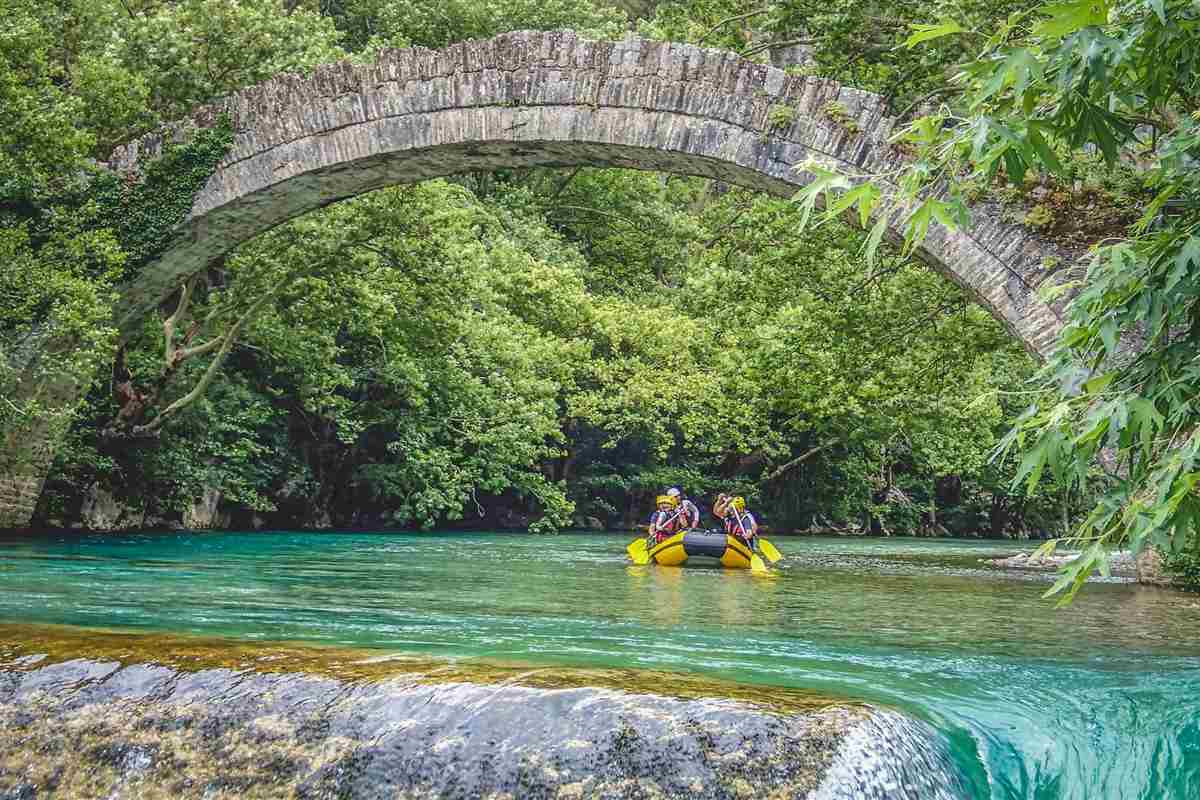
Voidomatis rafting runs down a turquoise river in Epirus, from the stone bridge of Aristi to the arched bridge at Klidonia. Compare it with more tours in Greece before you pick a date.
This page covers what the trip includes, the timing, the river and its clear water, the national park and the stone bridges, difficulty, what to wear, what happens on the water, the road from Ioannina, the other teams and common questions.
What does Voidomatis rafting with the Trekking Hellas team include?
Voidomatis rafting with the Trekking Hellas Ioannina team includes certified river leaders and all the rafting equipment. You also get a local transfer from the base to the start point, changing rooms and complimentary photos.
Every Voidomatis rafting trip here is led by river rafting leaders certified by the International Rafting Federation. The local team speaks English, and the instructors speak Greek as well. You can follow every instruction on the water without a language problem.
The gear for Voidomatis rafting is all provided. You receive a neoprene suit and boots, a waterproof jacket, a helmet, a lifejacket and a paddle. The operator lists this equipment as part of the package.
At the base you also have access to changing rooms, lockers, a WC and WiFi. The operator adds complimentary photos of the rafting, and all legal taxes are part of the package.
Three items are not part of this Voidomatis rafting package. Hotel pickup and drop-off, transport to the rafting base and food are not included. You drive to the base yourself, so plan your own way there and your own meal afterwards.
The operator’s listing offers free cancellation for Voidomatis rafting. A cancellation made a full day ahead is refunded in full. Check that cut-off against your own plans.
How long is Voidomatis rafting, and where does it start and finish?
Voidomatis rafting takes approximately 3 hours in total, including preparation and transfer. About 1.5 hours of that time are spent on the raft. The team welcomes you at 10:00, and the descent ends at about 13:00.
The meeting point is the Trekking Hellas Ioannina Rafting Base at Kato Voidomatis, Klidonia 440 16. It stands on the main road from Aristi village to Papingo village. This base is both the place where you meet the team and the place where the trip ends.
Your Voidomatis rafting morning begins at the base. The rafting team welcomes you at 10:00 and hands out the safety equipment. When you are ready, a minibus takes you to the starting point, the bridge of Aristi-Papigo. The itinerary gives the ride as 20 minutes.
At the start, a safety briefing of 15 minutes follows. Then you do a little river practice, and the descent begins. The finish comes shortly after the stone bridge of Klidonia, just below the rafting base. You finish below the same base where the trip began.
- 10:00: welcome and safety equipment at the base
- 20 minutes: minibus ride to the bridge of Aristi-Papigo
- 15 minutes: safety briefing at the start
- 1.5 hours: time on the raft
- About 13:00: the descent ends below the base
The description gives 10:00 as the welcome time. The listing asks you to look up the departure times for your chosen day, and it adds that the itinerary can change. Book your morning with that in mind, and plan nothing tight right after the finish.
What is the Voidomatis River, and where does it flow?
The Voidomatis is a river in the Ioannina regional unit of northwestern Greece, and Voidomatis rafting takes place on it. The river is 15 kilometres long and flows into the Aoos river.
Anyone planning Voidomatis rafting can learn where the water starts. The main sources lie in the village of Vikos, and the national tourism site says the river rises beneath it. From there the water runs through the green Vikos Gorge. Along the way it meets other streams that come down from Tymfi or from the gorge.
The gorge itself lies in the Pindus Mountains, on the southern slopes of Mount Tymphe. An online encyclopedia gives it a length of about 32 kilometres. The Voidomatis is shorter, at 15 kilometres, yet it flows through this gorge. Voidomatis rafting sits in that wild setting.
The river ends close to Konitsa. The national tourism site says it meets the Aoos river and finishes in the Konitsa valley. The Aoos is far longer, at about 272 kilometres. Its first 80 kilometres lie in Greece, and the rest crosses Albania before it empties into the Adriatic Sea. The Voidomatis is one of its main tributaries.
The name Voidomatis means “the eye of the ox”. The encyclopedia explains that oxen have clear blue eyes, like the water of this river. It adds that the river is known for water sports, and Voidomatis rafting sits next to kayaking on that list.
People lived beside the river long ago. A British team dug at Kleidi Cave, just above the Voidomatis. The team found stone tools, animal remains and other fossils. They date from 20,000 to 12,000 years ago, in the Palaeolithic.
Why is the Voidomatis water so clear?
The national tourism site says rocks and stones filter the Voidomatis water as it flows, which leaves it impossibly clear. That clean, filtered water is the setting for Voidomatis rafting.
Voidomatis rafting happens on one of the cleanest rivers in Europe, according to an online encyclopedia. The same entry says the river faces no environmental issues. Nothing in the entry points to pollution, so the clear water comes from the river itself and its mountain home.
The Aoos, which the Voidomatis joins, has a similar reputation. The encyclopedia calls it generally wild and unpolluted. The national tourism site speaks of virgin nature around the Voidomatis. Clean rivers and wild country go together here, and Voidomatis rafting takes place in both.
Clear does not mean warm. A Greek travel site calls the water transparent and icy, even in summer. The national tourism site agrees and says the river starts high in the Pindos Mountains. Voidomatis rafting is therefore a cold-water trip, even on a hot day.
Streams feed the river, too. The same Greek travel site says the Voidomatis is fed by small streams that tumble down from the mountains. The encyclopedia says the main current sources sit in Vikos village. Spring water, mountain streams and a rock filter together make the river you see during Voidomatis rafting.
What is the Vikos-Aoos National Park around the Voidomatis rafting route?
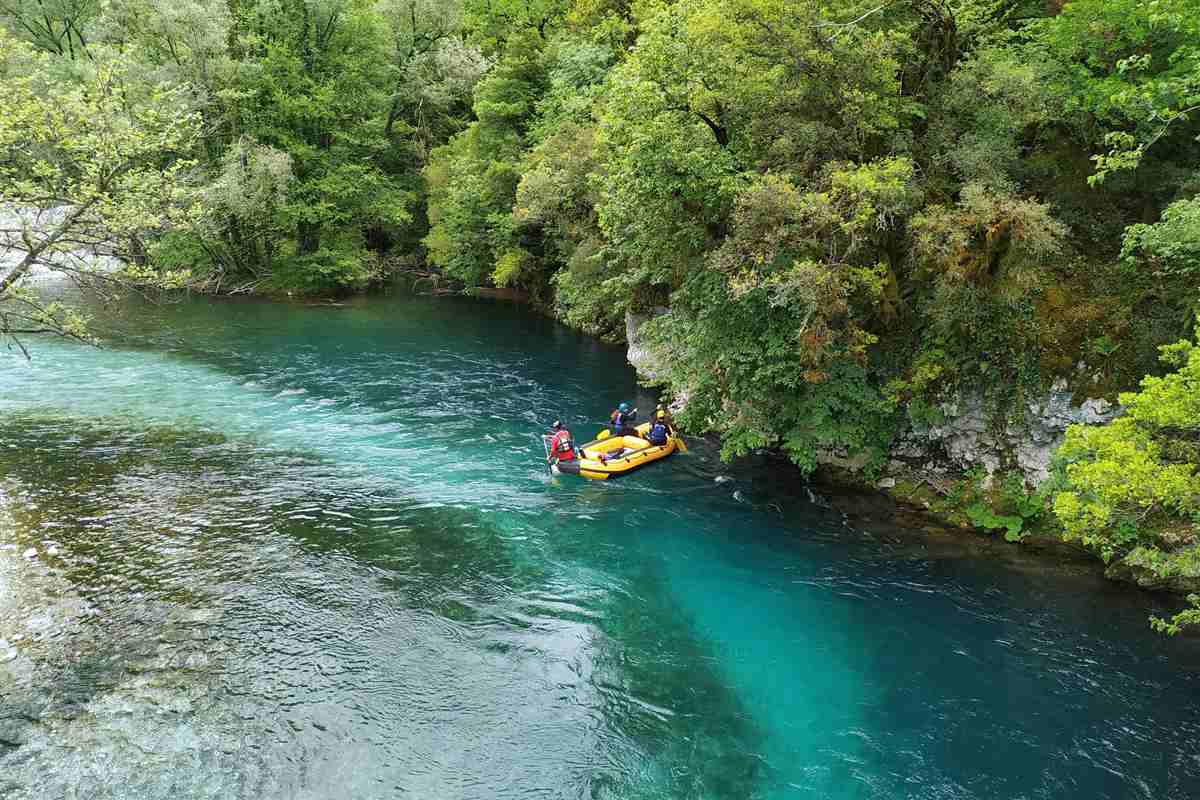
The Vikos-Aoos National Park is a protected mountain area in Epirus, in northwestern Greece. The Voidomatis rafting route runs through its heart. The park covers 12,600 hectares and holds the Vikos Gorge, which the Voidomatis River carved.
The tour listing puts the rafting in the heart of the park, and its highlights name the Voidomatis gorge. So a Voidomatis rafting trip runs inside a protected area, not beside one. The same tourism site places the river in the Vikos Gorge, inside the park.
Wikipedia gives the size of the two gorges. The main part of the Vikos Gorge is 12 km long and reaches a depth of 1,000 metres. The Aoos Gorge, in the northern part of the park near Konitsa, is 10 km long. Between the two gorges lies the Tymphe mountain range. Its highest peak, Gamila, stands at 2,497 metres.
The same article says the Guinness Book of Records lists the Vikos Gorge as the deepest canyon for its width. The Voidomatis flows through that gorge, so Voidomatis rafting happens inside a record-holder.
The park also shelters wildlife. Wikipedia calls it one of the last European strongholds of the brown bear. It names wolves, foxes, wild horses and roe deer among the large mammals. A total of 121 bird species have been seen in the park, and the area hosts fifteen raptor species.
The plants are just as rich. The article puts the park’s flora at 1,800 species. In the valley of the Vikos Gorge, plane trees form a gallery forest along the banks of the Voidomatis.
Wikipedia also lists the park as one of the UNESCO geoparks. Voidomatis rafting therefore takes place in a protected landscape.


What are the stone bridges of Aristi and Klidonia?
The Aristi Bridge and the Klidonia Bridge are two single-arch stone bridges over the Voidomatis. The national tourism site says organised Voidomatis rafting trips mostly start at the Aristi Bridge and end at Klidonia.
The same site adds that the Aristi Bridge is on the road between Aristi and Vikos. It says both bridges deserve their place among the stone bridges of Epirus. The tour listing describes the Klidonia crossing as the arched stone bridge of Klidonia. The closest Zagori villages to the starting point are Aristi, Vikos, Megalo Papingo and Mikro Papingo.
Wikipedia calls stone bridges one of the characteristic features of the national park. It adds that sixteen of these bridges and seven churches in the region are listed as protected historical monuments. Stone bridges are part of the scenery around the Voidomatis rafting route.
The Klidonia Bridge has a dark story behind it. The national tourism site says it was built in the nineteenth century, on the site of an older Byzantine bridge. Two feuding families were involved in an incident linked to that older bridge. It ended in a tragic meeting on the bridge.
After that meeting, the village where the families lived was eventually abandoned. The bridge you see today is the newer stone arch. A Voidomatis rafting trip that ends at Klidonia therefore finishes beside a place with real local history.
How hard is Voidomatis rafting, and who can join?
Voidomatis rafting on this tour has a low level of difficulty. The listing says people aged over 6 years old with basic swimming capability can join. It also calls the trip relaxing and kid-friendly.
The river itself backs up that low rating. A Greek travel site describes the route from the Aristi bridge to the Klidonia bridge. It calls the setting good for beginners and for experienced river explorers alike. It mentions quiet moments, gentle bends and small passages where the current runs stronger.
The national tourism site agrees that the journey is mostly serene. It adds that rafters have time to take in the park around them. That calm picture fits the low difficulty level in the listing, so Voidomatis rafting reads as an easy trip.
Swimming is the one skill the listing asks for, and it words the rule as basic swimming capability. The national tourism site makes the same point for rafting trips along the river. All participants must be able to swim. Check this before you book for children or for friends who avoid water.
The listing names three groups the trip does not suit. They are children under 6, pregnant women and people with mobility limitations. If one of these applies to someone in your group, pick another activity for that person. Everyone else with basic swimming skills can take part in Voidomatis rafting.
What do you bring and wear for Voidomatis rafting?
For Voidomatis rafting the listing asks you to bring three things: swimwear, a change of clothes and a towel. It also bans two things on the trip: plastic bottles and littering.
The listing says the rafting team supplies the equipment, so these three items are all it asks you to carry. Swimwear is the only piece of clothing it names for the water. Keep the change of clothes and the towel dry for the end of the descent.
The national tourism site gives a longer list for trips along the river. It names a hat, sunscreen and sunglasses. It adds dry clothes for changing, a long-sleeve or UV-protection top, and a waterproof camera or case for your phone. That list covers rafting and hiking together, so read it as extras, not as rules of this tour.
The same site says the experiences depend on weather conditions. A sunny day makes the hat and sunscreen useful, while a cooler day makes the dry top layer useful. Pack for Voidomatis rafting the evening before, so nothing is missing at the base.
The ban on plastic bottles and littering protects the river for every group that books Voidomatis rafting after you. The national tourism site calls the Voidomatis an unspoilt environment and asks every visitor to help keep it that way. Take your own rubbish with you, and leave the riverbank as you found it.
A small bag keeps packing simple. Swimwear, a change of clothes and a towel fit in it easily, and nothing in it is a plastic bottle. Voidomatis rafting needs no other gear from you, because the team hands it out at the base.
What happens on the water during Voidomatis rafting?
Voidomatis rafting begins with a safety briefing and a river practice. After that you paddle downstream. You stop for optional dives in the crystal-clear water. Near the end, you pass under the Klidonia stone bridge.
The briefing follows the minibus ride to the start. A river practice comes next, and only then does the Voidomatis rafting descent begin. The order is fixed in the operator’s listing: first the briefing, then the practice, then the river.
During the descent, the raft stops for optional dives. The word optional matters, because nobody has to jump in. Anyone who wants a swim takes a refreshing dive in the clear water of the Voidomatis. The others stay on board. These dives are part of Voidomatis rafting for those who choose them.
On the last stretch of Voidomatis rafting you paddle under the artificial waterfalls of the Klidonia stone bridge. The descent ends shortly after that bridge, just below the rafting base. The listing calls this the final part of the experience.
The national tourism site adds a detail about Voidomatis rafting. It names a small manmade waterfall just before the end point. The real adrenaline rush for rafters, it says, comes from plunging down it. Otherwise, it says, the journey is serene, with time to enjoy the sights and sounds of the national park.
What do you see from the minibus on the way to the start?
From the minibus, the operator’s listing promises impressive views of Mount Tymphi, the Astraka towers and the Papigo villages. The ride runs from the rafting base to the bridge of Aristi-Papigo, where Voidomatis rafting starts.
Those views come during the transfer, before the safety briefing. So on a Voidomatis rafting trip, the mountain scenery comes before the briefing and before the river.
Wikipedia explains where the Papigo villages sit. Papingo is made up of two villages, Megalo Papingo and Mikro Papingo, meaning greater and lesser Papingo. Both lie in the Vikos-Aoos National Park, at the base of Mount Radovoli, which is part of the Tymphe massif.
The same page says the snowcapped Astraka peak of Mount Tymphe towers over Papingo. It adds that the village lies very near the northern end of the Vikos Gorge, with deciduous forests around it. It says the village attracts hikers and mountaineers from around the world. It also has tavernas serving traditional food, coffee and spirits.
A footpath leads up from the village to Drakolimni, a glacial lake at 2,000 metres. It crosses the sub-alpine plateaus of Mount Tymphe. Wikipedia says the trek takes about five hours. It is a separate trip from Voidomatis rafting.
Wikipedia also lists a series of rock pools called the Kolymbethres, Greek for baptismal fonts. The Rogovos stream, which runs down Mount Tymphe, formed them in the limestone.
Wikipedia describes the climate of the region as Mediterranean turning to Continental, with heavy snowfalls in winter. The same page says a mountain refuge stands on that footpath at 1,950 metres. It is called the Mountain Hut of Tymphe or of Astraka.
Papingo became the capital of Zagori after the region came under Ottoman control, the page says. Its population has grown again in recent decades, largely because the villages attract visitors.
How do you reach the Voidomatis rafting base from Ioannina?
You drive. The tour listing says you can reach the Voidomatis rafting base by car in 30 to 50 minutes from Ioannina. It gives the same time from the West Zagorohoria villages. The national tourism site also recommends the car.
Ioannina is the closest city to the Voidomatis River, according to the national tourism site. It measures the road from Ioannina to the Aristi Bridge at 51.7 km, or about 1 hour. That bridge is the starting point of the rafting trips. It stands on the road that links the villages of Aristi and Vikos.
Four Zagori villages sit closest to the start of Voidomatis rafting. The same site lists them from the Aristi Bridge. Aristi is 3.4 km (7 minutes), and Vikos is 8.4 km (7 minutes). Megalo Papingo is 7.5 km (13 minutes), and Mikro Papingo is 9.8 km (20 minutes).
Ioannina has a domestic airport with flights to Athens. By road, Athens to Ioannina is 411 km, or 4.5 hours, along the Olympia Odos and Ionia Odos. A daily bus also runs from Athens. Once in Ioannina, you drive on to Voidomatis rafting.
From Thessaloniki, flights link the city to Ioannina. The Egnatia Odos covers 260 km in 3 hours. A daily bus runs from Thessaloniki too.
Which other teams run Voidomatis rafting?
Three other teams describe their own Voidomatis rafting trips: Xtreme Greece, Zagori Outdoor and Extreme Rafting. Each team gives its own times, route and equipment, so read what each one states before you choose.
Xtreme Greece lists a 10:00 start for Voidomatis rafting and a total time of 3 hours or more. It offers trips in Greek and English. Its page names difficulty class II, ages 3 and up, and no experience needed. The descent begins at the Aristi Bridge, and the base stands only metres from it.
At the end, Xtreme Greece offers a traditional snack and water. It includes a neoprene suit, a windproof jacket, a helmet, a life jacket and rafting shoes. Changing rooms wait at the base. The meeting point and time are set once your booking is confirmed, and they depend on where you stay.
Zagori Outdoor runs Voidomatis rafting from the Voidomatis bridge between Aristi and Papigo, inside the Vikos-Aoos National Park. It ends at the old bridge of Kleidonia. Its page describes a 6 km route with no special technical demands. It rates the river 2 on a scale that tops out at 6.
The route passes natural springs, small waterfalls and stone bridges. That team supplies a wetsuit, booties, a life jacket and a helmet. It asks you to bring a swimsuit or a second change of clothes. The crew takes photos and gives you a copy at the end.
Extreme Rafting runs Voidomatis rafting and calls the river one of the coldest and cleanest in Europe. It says the springs are inside the Vikos Gorge. The team states more than 5,000 visitors a year and more than 15 years of experience.
Its Voidomatis rafting kit is a neoprene suit, neoprene socks, a waterproof jacket, a life jacket and a helmet. A head camera records the trip, and the team sends you the photos and video. Basic safety instructions come before each activity.
What else do travellers ask about Voidomatis rafting?
When is the season for Voidomatis rafting?
The national tourism site says organised rafting and hiking trips run along the river all year round. It lists spring to October as the months to go.
Spring and autumn give the finest rafting conditions, while summer is the time to swim. The same page says the water level stays high until late spring. Plan your Voidomatis rafting date around those seasons.
Is the craft a raft or a kayak?
The national tourism site names two inflatable craft for the river. One is a raft for 8 to 10 people, and the other is a kayak for 2 people.
A Greek travel site describes its own trip on a raft. The instructor first explains the basic paddling strokes and how to use the paddle to avoid obstacles. The instructor also stresses the value of paddling in time as a team. That teamwork is the heart of Voidomatis rafting.
What plants and animals line the river?
The national tourism site mentions age-old plane trees and other plants native to Epirus along the banks. A Greek travel site sums up the scene as plane trees, fresh air and green slopes.
The same travel site adds a bird, the dipper. This small river bird has a white chest, flies low over the water and dives with ease. Voidomatis rafting drifts through that quiet setting.
Can you hike beside the river instead of rafting?
Yes. The national tourism site describes a riverside path and calls hiking along the Voidomatis safe and easy. Organised group hikes take about 2 to 3.5 hours.
Hikers explore shallow caves, which people believe were lived in during prehistoric times. They also see a seventeenth-century monastery called Agii Anargyri. Hikers and rafters share one river, so you can pick hiking or Voidomatis rafting.
What is Zagori, the region around the Voidomatis?
Wikipedia calls Zagori a region in the Pindus mountains of Epirus and a UNESCO World Heritage Site. It holds 46 villages across about 1,000 square kilometres, and about 3,400 people live there. That is 3.4 people per square kilometre, which Wikipedia calls very sparse next to the Greek average of 73.8.
Mountain roads and arched stone bridges linked the villages until modern roads opened in the nineteen-fifties. Merchants living abroad paid for those bridges in the eighteenth century, and the bridges replaced older wooden ones.
Wikipedia says the name Zagori probably comes from a Slavic word meaning “beyond the mountains”. It also lists a monastery of the Transfiguration near Kleidonia. The Byzantine emperor Constantine IV founded it in the seventh century.
Zagori has the shape of an upturned triangle. Ioannina sits at its southern point, and the Aoos river forms its northern edge. Wikipedia says the ancient Molossians, a tribe of Epirus, ruled from a town near Konitsa. The Voidomatis, Aoos and Sarantaporos rivers meet there. Voidomatis rafting takes place inside this region.
Where do travellers stay near Voidomatis rafting?
The national tourism site says the Zagori villages offer traditional guest houses and boutique hotels. For something livelier, it points to Ioannina.
It calls Ioannina a lakeside city with historical sites, restaurants, shopping and nightlife. Pick a village or the city for the night before your Voidomatis rafting morning.