
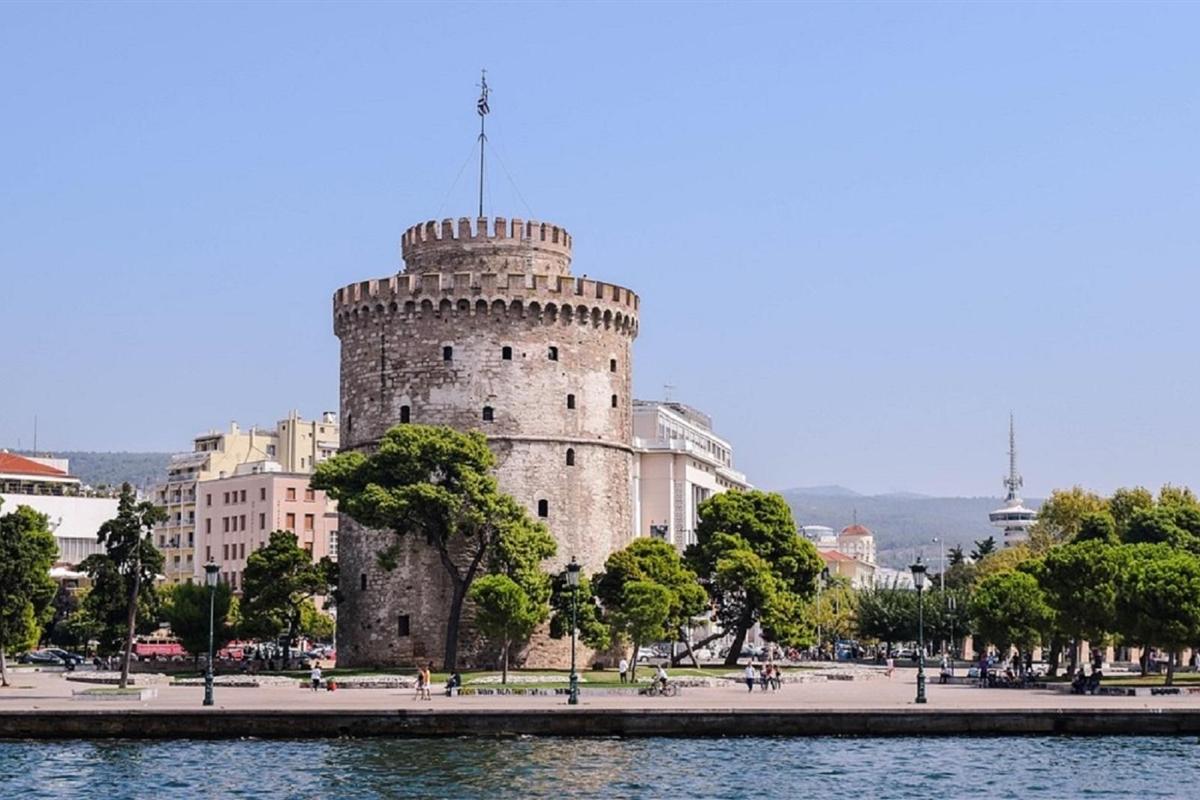
A Thessaloniki cooking class happens in a real family home in the Evosmos district, where you cook moussaka and a village salad and then eat them together. Pair the class with another day out from the tours in Greece listed on our homepage.
Read on for what the class includes, the meeting point and timing, the menu from welcome treats to dessert, moussaka, tzatziki, dakos and bougatsa, the drinks, the Evosmos district, the dance steps and the shared meal, Thessaloniki as a city of gastronomy, other classes in the city and the questions travellers ask.
What does the Thessaloniki cooking class with a local family include?
The Thessaloniki cooking class takes place in a real Greek family home. You cook family recipes from scratch and taste local tapas. You learn a traditional dance, then sit down to eat what you made. The operator is Thessaloniki Signature Journeys.
The home is the heart of this class. The operator’s listing invites you into a real Greek family home in Thessaloniki. There you see the lifestyle and the cooking habits of a typical Greek household. You are not in a studio or a restaurant kitchen.
The family says it has welcomed travellers from around the world for nearly 10 years. It treats you as a guest of the family, not only as someone who attends a cooking class.
The operator’s listing names these items as included in the Thessaloniki cooking class:
- Local tapas: dakos salad, tzatziki, cheese pie and boujiourdi
- Cooking in a local house
- The recipes in digital form
- Dessert halva
- One lesson of a Greek traditional dance
- Dinner of moussaka, and a Greek salad
- Greek wines, tsipouro, ouzo, juice and soft drinks
So the cooking, the meal, the drinks, the recipes and the dance lesson all sit on one list. The list names one dance lesson and one dinner, and it ends with the drinks. You do not need to plan any of them on your own.
The instructor of the Thessaloniki cooking class speaks English. The group is limited to 7 participants, and the listing marks the class as wheelchair accessible. If you need access details, ask the operator before you book.
Plans change, and the booking allows for it. Free cancellation is open until 24 hours before the class begins.
How long is the Thessaloniki cooking class, and where do you meet the family?
The Thessaloniki cooking class lasts 2.5 hours. You meet the family in Evosmos, at a children’s play venue called AS TO PLAY. Pick a date on the listing to see which starting times are open.
The operator’s listing gives the length as 2.5 hours. For the start, it tells you to check availability to see the starting times. So choose your date first, then the time that fits your day. Plan your day around the full 2.5 hours of the Thessaloniki cooking class.
The meeting point on the listing is AS TO PLAY, a children’s play venue. The address is Akadimou 81, Evosmos 562 24, Greece. Type the venue name and the street into your map app before you set out.
The listing does not say whether the meeting point is also the family home. Ask the operator about that too, so you know where the cooking starts.
The listing also names pickup and drop-off among the included items. It gives no more detail on that line. The meeting point is the one place the listing prints. Ask the operator how pickup works for your hotel and your date before the day of the Thessaloniki cooking class.
Which dishes do you cook in the Thessaloniki cooking class?
The Thessaloniki cooking class runs in a clear order. You start with homemade treats. Then you cook a village salad, tzatziki, potatoes, eggplants and baked feta. After that comes the family moussaka, one of the listed highlights.
The family begins the Thessaloniki cooking class with homemade Greek treats, such as its cheese pie and bougatsa. The listing also names a starter plate that mixes a dakos salad with tzatziki, a pie and boujiourdi. Its highlights add moussaka, tzatziki, salad and dessert to the dishes you prepare.
Then the family rolls up its sleeves, and everyone cooks together. You prepare a traditional Greek village salad and tzatziki. After that you cook potatoes and eggplants and make baked feta with tomato, peppers and kasseri.
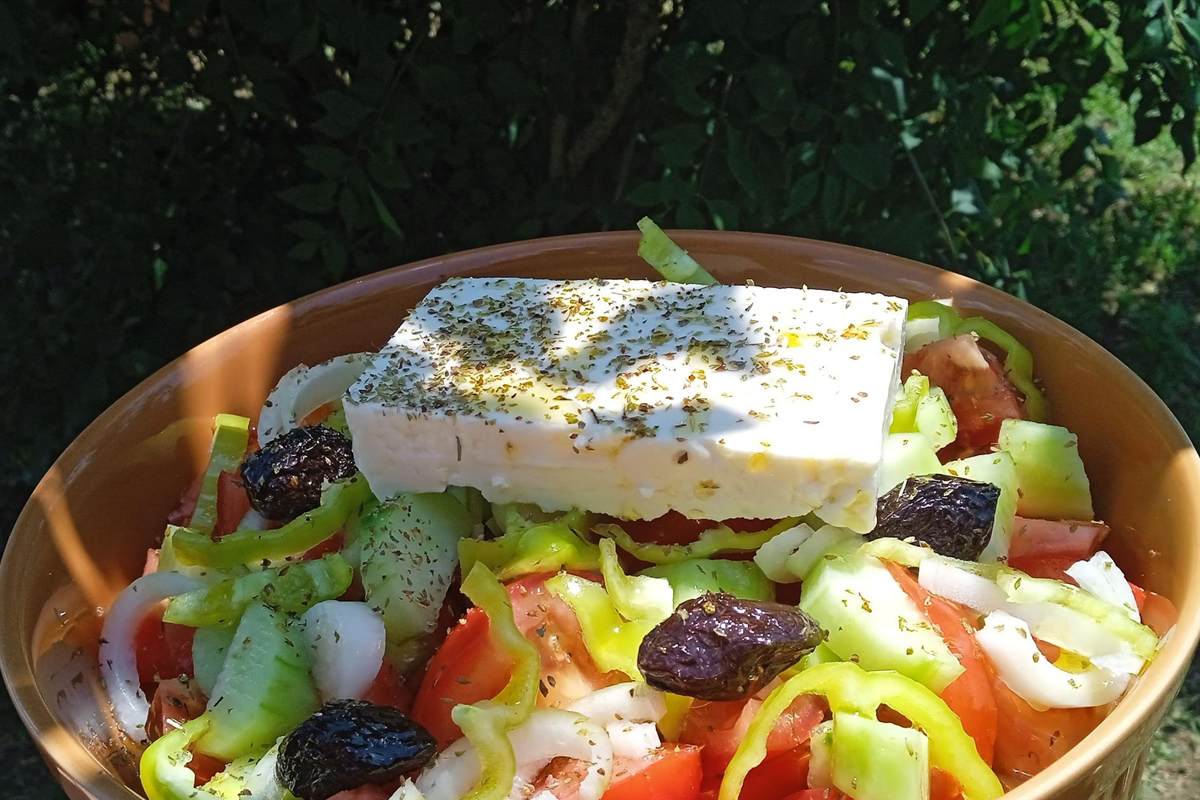
The village salad you prepare in the Thessaloniki cooking class is called horiatiki in Greek. Wikipedia says it is made with tomatoes, cucumbers, onion, feta and olives, dressed with salt, Greek oregano and olive oil. The Greek original has no lettuce.
Wikipedia also says people imagine this salad as a farmer’s breakfast or lunch. Its ingredients match what a Greek farmer can have at hand. Mint or parsley decorates it, mainly in Northern Greece. Thessaloniki is the largest city of that region.
What is moussaka, and how does the family make it?
Moussaka is a baked Greek dish with layers of eggplant and meat under a white béchamel sauce. In the Thessaloniki cooking class, you take part in the whole process, including the ingredients, the meat and the béchamel.
Wikipedia says moussaka is an eggplant- or potato-based dish, common in the Balkans and the Middle East. The modern Greek version was created in the nineteen twenties by Nikolaos Tselementes, a French-trained Greek chef. His recipe has three layers, and each layer is cooked on its own before the final baking.
The bottom layer is sliced eggplant sautéed in olive oil. The middle layer is ground lamb lightly cooked with tomatoes, onion, garlic, cinnamon, allspice and black pepper. The top layer is béchamel sauce or a savoury custard. That is the classic recipe on Wikipedia. The listing for the Thessaloniki cooking class names only the meat and the béchamel.
At the Thessaloniki cooking class, the family says its moussaka recipe is well over a century old. It says the family passed the recipe down through generations. It also says fresh ingredients come from the family garden in its village outside Thessaloniki. Trusted local producers supply other products.
Similar eggplant dishes appear in a 13th-century Arabic cookbook, kitab al-Tabikh. Its recipe calls for alternating slices of eggplant and spiced minced meat and onions, layered in a shallow pan. The English name comes from Greek mousakás, which came from Ottoman Turkish and, before that, Arabic.
There are variations on the basic recipe. Wikipedia lists sautéed zucchini slices, part-fried potato slices and sautéed mushrooms, added to the eggplant slices. Tselementes’ cookbook also has a vegan fast-day version with neither meat nor dairy. It uses ground eggplant instead of ground meat, plus tomato sauce and bread crumbs.
What are tzatziki, dakos and bougatsa on the Thessaloniki cooking class menu?
Tzatziki is a cold dip of strained yogurt and cucumber. Dakos is a salad built on a barley rusk. Bougatsa is a filled phyllo pastry. The tour listing for this Thessaloniki cooking class names all three.
Tzatziki mixes salted strained yogurt with cucumber, garlic, olive oil and red wine vinegar. It is served as a cold appetiser and as a sauce for souvlaki and gyros. The earliest known recipe appears in a Baghdad cookbook of the tenth century. The listing says guests prepare tzatziki next to a village salad.
Dakos is a Cretan salad. A slice of paximadi, a barley rusk, is soaked in water or olive oil. It is topped with chopped tomatoes, crumbled feta or mizithra cheese and olive oil, then seasoned with dried oregano. In the Thessaloniki cooking class, the listing places dakos salad among the local tapas.
Bougatsa is a Greek breakfast food or snack, sweet or savoury. Phyllo dough wraps a filling of semolina custard, cheese, spinach or minced meat. The modern version began in northern Greece, in particular in Serres and Thessaloniki. On the Thessaloniki cooking class, the family opens with bougatsa and a cheese pie that it bakes itself.
The listing also names kasseri and dolmadakia. Kasseri is a pale yellow cheese made from sheep milk with up to 20 percent goat’s milk. Dolma is a family of stuffed dishes, and the word is Turkish for “something stuffed”.
Which drinks go with the meal: wine, ouzo, tsipouro and mastiha?
At the Thessaloniki cooking class, the listing says guests taste Greek cheeses and local products with Greek wine. Traditional drinks such as ouzo, tsipouro and mastiha are also available, and the includes list names juice and soft drinks.
Tsipouro is an un-aged brandy from Greece, in particular Thessaly, Epirus and Macedonia. It is a strong spirit with 40 to 45 percent alcohol by volume. It is traditionally made from grape pomace, the residue of the winepress. It is served in shot glasses with meze, small side dishes such as nuts, cheese or olives.
Ouzo is a dry aperitif flavoured with anise. Ouzo has its roots in tsipouro, said to be the work of monks on Mount Athos in the fourteenth century. A version flavoured with anise eventually took the name ouzo. Water or ice turns clear ouzo milky white, because the oil of anise does not dissolve in water.
The minimum allowed strength of ouzo is 40.5 percent alcohol by volume. Anise tsipouro and ouzo taste almost the same. Ouzo starts from highly purified alcohol at 96 percent. Tsipouro is distilled less, so it keeps the aroma of the pomace. The Thessaloniki cooking class listing puts ouzo and tsipouro on its includes list, beside Greek wines.
The listing names mastiha as a third traditional drink at the Thessaloniki cooking class, next to ouzo and tsipouro. Mastiha is a sweet liqueur seasoned with mastic, a resin from the mastic tree. It is traditionally served cold. Chios Mastiha is flavoured with mastic from the island of Chios.
What is Evosmos, the district of the Thessaloniki cooking class?
Evosmos is a suburb of the Thessaloniki Urban Area, and its name means a place that smells nice. The listing for the Thessaloniki cooking class sets the meeting point at an address in Evosmos.
Evosmos lies in the regional unit of Thessaloniki, in Macedonia, Greece. Since a local government reform, it has been part of the municipality of Kordelio-Evosmos. It is the seat of that municipality. Its land area is 9.927 square kilometres, and the census counts 79,221 people.
Rapid development has made the population grow fast. New development is taking place in the northern district of the municipality, called Nea Politeia, which means New Town. For the Thessaloniki cooking class, that makes Evosmos a suburb with its own square, shops and churches.
The place began as a small village called Harmanköy. Refugees from Asia Minor settled there in the early 20th century, and the population first rose sharply at that time. The village later became an independent community named Neos Koukloutzas. Two years after that, it was renamed Evosmos.
Much of the cultural life in the district of the Thessaloniki cooking class takes place around the main square. Cafes, bars, the city hall and the main church surround it. The main shopping street, Megalou Alexandrou, lies just north of the square. The cultural centre and the cinema are on that street.
The municipality has three Orthodox churches. Agios Athanasios is the oldest, and Evagelismos is the largest and stands by the square. The Municipal Athletic Center of Evosmos, in Nea Politeia, has indoor basketball and volleyball courts. The local football club is Agrotikos Asteras.
What happens after the cooking: the dance steps and the shared meal?
In the Thessaloniki cooking class, the family says, Dora teaches simple steps of a traditional Greek dance after the cooking. Then everyone sits down together and eats what they prepared.
The talking starts before the dance. The family says they talk about Greek family life, Thessaloniki, their traditions and the stories behind the recipes. They do this around the kitchen and later around the table. So the talk starts with the cooking and carries on during the meal.
The Thessaloniki cooking class lists a dance lesson in the Greek tradition among what is included. The listing does not say which dance the family teaches, so this text names none. Dora leads the lesson, and the steps are simple.
Greek dance itself is an old tradition, and authors such as Plato, Aristotle, Plutarch and Lucian referred to it. Each region formed its own choreography and style. Traditional Greek dancing brings the community together at key points of the year, such as Easter or the grape harvest.
In the Thessaloniki cooking class, the family says, the hosts and the guests sit down together after the dance lesson. They enjoy everything they have prepared. The meal is the food the group cooked earlier in the kitchen. So the table holds the work of the whole group.
Why is Thessaloniki a city of gastronomy?
A Thessaloniki cooking class sits in a city that one local cooking school calls a City of Gastronomy. The page says the title came from the city, the Ministry of Tourism and the Greek UNESCO commission working together.
The school’s page also calls the city a crossroads of flavors and cultures. Another tour seller says the recipes of Dimitra’s Thessaloniki cooking class reflect the city’s layered food culture. Byzantine, Ottoman, Jewish and Macedonian influences make up those layers, it says.
The history is layered too. Wikivoyage describes a continuous 3,000-year history. The city preserves relics of its Roman, Byzantine and Ottoman past and of its formerly dominant Jewish population. Wikivoyage adds that Muslims, Jews and Christians lived together in Thessaloniki for over 400 years.
Wikipedia says Thessaloniki stayed under Ottoman rule about 100 years longer than southern Greece. It kept much of its Eastern character, including its culinary tastes. Spices play an important role in its cuisine, and the Ladadika area has tavernas serving traditional meze.
Wikipedia also names Kapani as the oldest central market in the city. Its shops sell fish, meat, vegetables, fruits, olives, sweets, nuts and spices.


Which other cooking classes run in Thessaloniki?
Four other kitchens run a Thessaloniki cooking class: Cooking classes for Foodies, Erna’s home, Dimitra’s home and Ammilos. Lessons last from 1-2 hours up to 4 hours. Each plan below comes from that kitchen’s own page.
Cooking classes for Foodies holds its Thessaloniki cooking class in the heart of the city, taught by local chefs. The class is named 7 Greek Meze Plates, and guests cook 7 recipes with the chef. The page says it runs in English and Greek.
The page lists 6 people for a group and 20 as the maximum. Guests get a printed copy of the recipes. Cancellation is free until 7 days before the start.
Erna lives in Epanomi, a seaside village outside Thessaloniki. A travel site calls her lesson a Thessaloniki cooking class and says it lasts about 1-2 hours. Guests make side dishes such as fried aubergines stuffed with herbs and fresh cheese, then eat together at the table. Her recipes are traditional Greek ones with an Austrian twist.
Dimitra, a native of Northern Greece, teaches a 4-hour hands-on organic Thessaloniki cooking class. It runs in her home in Ampelokipi, a suburb just minutes from the center. Guests cook northern Greek recipes, then eat a family recipe dinner with local wine. Her page says the home is near the train station and the intercity bus terminal.
Ammilos is Maria Kaivetzi’s kitchen, just outside Thessaloniki. A travel blog says she was born in the city and has lived there over 40 years. It calls her a cook and a cooking instructor who leads all the classes.
Her Thessaloniki cooking class lasts four hours in a professional-level kitchen. Guests cook 5 dishes, including fried feta with honey and sesame, and take home a recipe booklet.
What else do travellers ask about a Thessaloniki cooking class?
The family says this Thessaloniki cooking class welcomes vegetarian, gluten-free and lactose-free guests. It says it can adapt the meal to dietary needs. It also says it will contact you before your visit to ask about allergies or special requirements.
Is the Thessaloniki cooking class a good stop on a cruise?
The family says the Thessaloniki cooking class suits cruise visitors who have limited time in the city. The meeting point is a short taxi ride from the port. You step away from the usual sightseeing. Wikivoyage calls Thessaloniki the second largest city in Greece and once the biggest port of the Balkans.
How do you get around Thessaloniki by taxi, metro and bus?
Wikivoyage says licensed taxis are dark blue with a taxi light. You can hail them in the street or at taxi ranks. Ride-hailing services are also an option. The city has a single metro line with 13 stations, and the bus company OASTH runs 85 bus lines. Bus drivers occasionally go on strike.
How is the city centre of Thessaloniki laid out?
Wikivoyage says the centre follows a grid of streets parallel and perpendicular to the coastline. A street that goes downhill leads to the waterfront. Aristotelous Square is the focal point of the city. The Aristotelous Promenade runs uphill from it to the Roman Forum. Tsimiski and Egnatia are big streets parallel to the sea.
What is the weather like in Thessaloniki through the year?
Wikivoyage’s climate chart puts the average high at 11.5 degrees Celsius in January and 32.7 in July. So the season of your Thessaloniki cooking class decides the weather. Wikivoyage also says the sun can be strong at noon and in the early afternoon, even in autumn and spring. Use sunscreen, a hat and sunglasses.
Why is kasseri a protected cheese, and where is it made?
Kasseri has a protected designation of origin. Wikipedia says it must be made in Thessaly, Macedonia, Lesbos or Xanthi. It is aged for at least three months. It is smooth rather than crumbly, and chewy. Thessaloniki is the capital of Macedonia, so the Thessaloniki cooking class sits in one of those four areas.
What is halva, the dessert named in the listing, made of?
For the Thessaloniki cooking class, the listing names dessert halva but not its type. Wikipedia says halva in Greece is mainly made of sesame or semolina. One version from the Thessaly town of Farsala uses cornflour. Greeks also eat halva as a fasting food, and serve it as a dessert and at village festivals.