
An Argostoli boat trip puts you on a traditional Greek boat for a full day on the Ionian Sea, with swim stops, a Kefalonian lunch and the red sand of Xi Beach. Our list of tours in Greece has more ways to fill the rest of a Kefalonia stay.
This page covers what the day includes, the harbour departure and the schedule, White Rocks Beach, Vardiani, the lunch menu, Xi Beach and its clay, the sea animals and the other boat days from Argostoli.
What does a full-day Argostoli boat trip include?
A full-day Argostoli boat trip on a traditional Greek boat lasts 7 hours. The ticket covers local wine and water through the day, snorkelling gear, inflatables and a paddle board. A live host speaks English and Greek.
The operator is Dreamy Cruises Kefalonia. On its own website, the company describes its boats as traditional Greek wooden boats, named Christina and Konstantinos. The listing for this day calls it a full-day cruise from Argostoli, with swimming, snorkelling, beach visits and a lunch. The title of the listing names the lunch as part of the cruise.
On this Argostoli boat trip you swim and snorkel to observe marine life. The listing names snorkelling gear, inflatables and a paddle board as included. The equipment for the water is part of the day.
The listing gives the duration as 7 hours. It shows the starting times once you check availability for a date. The standard group is up to 48 people, so you share the boat with other travellers from around the world.
Free cancellation applies up to 24 hours in advance, with a full refund. That makes the Argostoli boat trip easy to drop if your plans change the day before.
Where does the Argostoli boat trip leave from, and how does the day run?
The Argostoli boat trip starts from Argostoli Harbour on Kefalonia. The meeting point is on Leof. Antoni Tritsi, Argostoli 281 00. Captain Vagelis runs the cruise with his seafarer, Thanasis, and the day follows four blocks.
The operator’s website groups its daily cruise under the heading Daily Cruises from Argostoli. The listing breaks the day into four blocks, and it lists them in this order.
- Boat cruise: 1 hour.
- Photo stop, free time, swimming and snorkelling: 1 hour.
- Photo stop, visit, lunch, swimming and snorkelling: 105 minutes.
- Photo stop and swimming: 1 hour.
Three of the four blocks include a photo stop, and each of those three includes swimming. Snorkelling is listed in the second and third blocks. Free time sits in the second block, and the visit sits in the third block together with lunch.
The day opens with the 1-hour boat cruise. The lunch block is the longest of the four, at 105 minutes. The four blocks add up to 4 hours and 45 minutes. The listing does not split the rest of the 7 hours.
The listing marks this plan as for reference only and says itineraries are subject to change. So treat the Argostoli boat trip as a set of blocks, not a fixed clock.
The listing describes crystal clear water and a rugged coastline along the way. It says the boats are designed for a smooth and enjoyable cruise. The boat for this Argostoli boat trip carries a dinghy. It makes transfers to the shore and back for guests who do not feel comfortable swimming.
On board you find well-organised bars. The bartenders, Makis or Vaso, make cocktails and other drinks for the guests on board.
Poor weather can change the schedule or cancel the Argostoli boat trip. The listing says so in its notes for travellers. The plan above is the intended route, not a promise.
What is White Rocks Beach, the first swim stop?
White Rocks Beach is the first stop of the Argostoli boat trip run by Dreamy Cruises Kefalonia. The operator’s listing says guests can swim, use the snorkelling gear, or relax on the beach in the sun.
On its own website, Dreamy Cruises calls it the fairytale beach of White Rocks and describes blue-green, crystal clear water. The full-day listing talks of shimmering white sands that meet azure water. It also calls the beach a secluded oasis and invites guests to dip into the crystal clear water.
Another listing from the same operator tells you where the first stop of the Argostoli boat trip lies. It says White Rocks Beach is just south of the beaches of Platys and Makris Gialos. The page describes turquoise water and pristine white sand, and it says the crew provides snorkelling masks.
A family travel writer gives a third description of the beach where the Argostoli boat trip stops. She sees a gleaming pale beach with round white pebbles dotted with sea glass, lapped by turquoise water. She says water shoes are a good option on the pebbly beach.
The same writer says the majority of day tours follow one route. They stop at White Rocks beach, Nisida Vardianoi and Xi beach, though the order sometimes differs. The Dreamy Cruises daily cruise page names White Rocks beach first, which fits its listing for the Argostoli boat trip.


What is Vardiani, the small island of the lunch stop?
Vardiani is a remote small island, also called Rabbit Island. It is the lunch stop of the Argostoli boat trip run by Dreamy Cruises Kefalonia. The listing says the crew prepares lunch while guests visit the island.
Dreamy Cruises runs the Argostoli boat trip. Its website places Vardiani at the south of the Paliki peninsula, at the entrance of the bay of Livadi. Wikipedia’s Lixouri page lists Vardianoi, the island, in the Katogi community of Paliki. Another Dreamy listing says the island has a quaint lighthouse and the remnants of a Russian shipwreck.
The listing for the Argostoli boat trip uses the name Rabbit Island too. A family travel writer says the little isle has a series of names, though you no longer spot any rabbits. She adds that occupying Italian forces used the island to defend Kefalonia in the Second World War. Guns were mounted there, and they are long gone.
Today the island has the remains of a lighthouse and a tiny monastery, where the bell still chimes. A Hellenic lighthouse list says the British made the lighthouse in eighteen twenty-four, on the south-east end of Vardianoi. It gives the tower height as 8.5 metres and says only certain ruins are saved today.
Another Dreamy listing adds that guests have time for another swim or to explore the island. The writer describes a couple of paths to the monastery and the lighthouse, passing butterflies and an abandoned bathtub. Wildflowers and thistles grow there, so she advises walking with care. She says the lighthouse is not safe to go inside or to climb.
What is served for lunch on the Argostoli boat trip?
The operator’s listing says lunch on the Argostoli boat trip is a traditional Kefalonian meat pie. It comes with Greek salad and traditional tzatziki, served on board and paired with local wine and water.
The listing says the crew prepares the lunch while guests visit the island of the lunch stop. It names the cook as Helen, the sister of Captain Vagelis.
The listing’s short list of highlights adds fruit to the table. It reads: homemade traditional Greek cuisine with fresh salad, fruit and wine. Put together, the Argostoli boat trip lunch is a meat pie, salad, tzatziki and fruit. Local wine and water come with it.
The operator’s own website uses bigger words for the same food. It says guests on its boats indulge in a feast of traditional Greek delicacies. It adds that they savour the flavours of the region.
Food needs are covered on the Argostoli boat trip too. The listing says vegetarian, vegan and allergy lunch options are available on request. It places this note in its know-before-you-go section. Travellers with a food need can ask the operator before the day.
What is the red clay of Xi Beach, and why do swimmers use it?
The operator’s listing for the Argostoli boat trip calls Xi Beach the highlight of the cruise. It is known for its unique red sand and the special clay that lines its shores. Guests use that clay for a natural spa treatment, the listing says.
The listing says the clay “is said to have miraculous properties”. It describes soft clay between your fingers in a rejuvenating spa treatment by the sea. These are the listing’s words, not a tested health claim. The clay spa is one of five highlights on its short list.
The operator’s website calls Xi a unique place in Kefalonia. It says the strange colour of the sand will amaze visitors.
A family travel blog describes the clay in more detail. Its writer took a different Argostoli boat trip, on another operator’s boat. She says the clay comes from the cliff face and the shoreline. She calls it blackish grey, and she calls the sand red.
That blog says the clay is “supposed to” leave you looking 20 years younger. You mix it with water and rub it on. Its writer was not quite convinced she had found the fountain of youth.
She also read warnings that the clay and the red sand can stain swimwear, especially anything pale. Her own swimwear escaped. Anyone on an Argostoli boat trip who packs a pale swimsuit can note that warning.
Wikipedia calls Lixouri the main town on the Paliki peninsula and the second largest town on Kefalonia after Argostoli. It names Xi, Fteri and Petani among the beaches of the region. It calls those beaches celebrated for natural beauty and crystal-clear waters.
Wikipedia says Argostoli and Lixouri lie about 40 kilometres apart on the same bay. Lixouri’s small port has a ferry to Argostoli for vehicles under 5 tons. It runs every hour or half-hour in peak season.
Wikipedia adds that certain hotels in Lixouri run bus services, including one to Xi Beach. That gives a land route to the same sand that the Argostoli boat trip reaches by sea.
Which sea animals can you spot, from loggerhead turtles to monk seals?
The Dreamy Cruises listing for the full-day Argostoli boat trip names dolphins, sea turtles (caretta caretta) and monk seals. The listing treats each one as a chance to spot, tied to luck, so none is promised.
The operator’s own website lists the same three animals: dolphins, monk seals and caretta caretta turtles. The listing pictures dolphins leaping, monk seals basking in the sun and sea turtles gliding by. It adds the words “if luck is on your side”.
Caretta caretta is the scientific name of the loggerhead sea turtle. Wikipedia calls it a marine reptile found in the Mediterranean Sea and in the Atlantic, Pacific and Indian Oceans. A fully grown adult measures around 90 cm in shell length. It feeds mainly on bottom-dwelling invertebrates.
Wikipedia names the Koutavos Lagoon, east of Argostoli, as a feeding ground for loggerhead turtles. The lagoon sits at the end of the bay and is now a nature reserve. The full-day listing does not name it as a stop on the Argostoli boat trip.
The Mediterranean monk seal is believed to be the world’s rarest pinniped, the group that includes seals. Wikipedia estimates that 800 to 1,000 survive in isolated groups. Greece is one of the countries where it lives, with Croatia, Cyprus, Albania and Turkey. Adults average 2.4 m long.
Wikipedia calls the species shy. It now uses sea caves, which people cannot always reach, to give birth and take shelter. With numbers that low, a monk seal on an Argostoli boat trip is a bonus, never a plan.
Which other Argostoli boat trips can you book, and who is each one for?
Four other kinds of Argostoli boat trip leave the port. They are day cruises on other boats, four-hour sailings, sunset or night cruises and private charters. Each operator’s own page states its times and inclusions.
Queen Bee Cruises offers a full-day Argostoli boat trip that leaves Argostoli Port at 09:00 and returns at 17:00. Its two family-owned wooden boats are Queen Bee I and Queen Bee II. The free bar covers coffee, water, wine and soft drinks.
Artemis, a traditional wooden boat, sails to White Rocks, Kounello island and Xi Beach from 10:00 to 17:00. Its page speaks of adults and children on board. A family travel blog lists a three-hour trip from Argostoli to White Rocks Beach among its boat trips with kids.
Utopia Cruises offers a shorter Argostoli boat trip: four-hour morning and evening cruises, and a night cruise. Its page says everything is included, with a free bar, light meals and snacks. One listing for an Argostoli Bay cruise with swim stops runs 3.5 hours.
The Queen Bee sunset cruise leaves at 18:30 and returns at 23:00, and its page mentions cocktails. Dreamy Cruises also lists a sunset cruise, which its site describes as a sail through the Kefalonian sunset. Both suit travellers who prefer evening light to a swim-and-lunch day.
A private Argostoli boat trip suits groups who want no other guests. Queen Bee takes 1 to 25 people on Queen Bee and 1 to 56 on Queen Bee II. Dreamy Cruises hires out its boat for an all-day exclusive cruise.
What else do travellers ask about an Argostoli boat trip?
How do I reach Argostoli for an Argostoli boat trip?
Kefalonia Airport has scheduled flights to Athens and Zakynthos, plus charter flights in summer. A bus runs between the airport and Argostoli, but only in the summer season. The bus stop stands in front of the terminal, and you buy the ticket from the driver.
The main ferry port links Argostoli with the mainland, through Kyllini, and with Zakynthos. Taxis run from Plateia Valianos and the seafront. You can also hire a car or a scooter in town.
How big is Argostoli, and what is its climate?
The Argostoli boat trip begins in a municipality of 377 square kilometres. A recent census recorded 23,574 people living in it. Lassi, a holiday resort with small beaches, lies on the Ionian Sea coast southwest of the town centre.
Argostoli has a hot-summer Mediterranean climate, with hot, dry summers and cool, rainy winters.
What is the De Bosset Bridge in Argostoli?
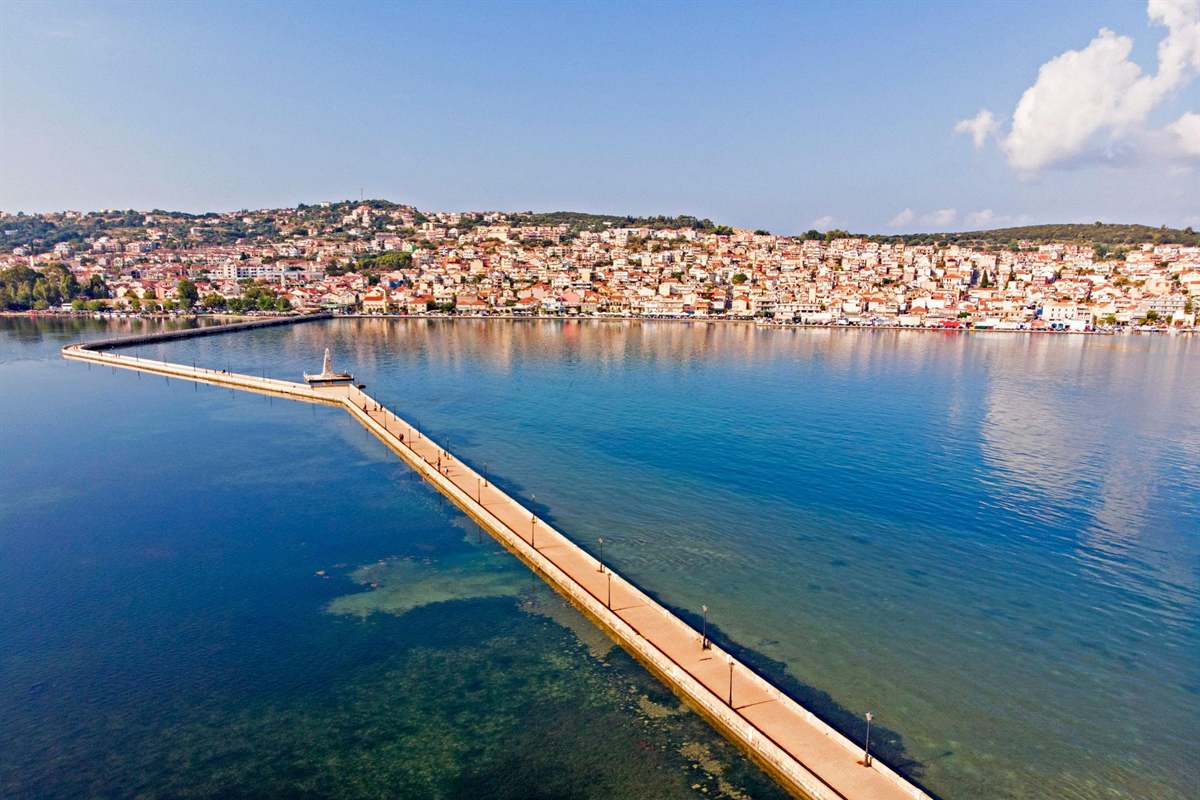
Your Argostoli boat trip begins in a town with a narrow stone bridge across the Koutavos Lagoon. In eighteen thirteen, Colonel Charles Philip de Bosset built the first bridge from wood. He was a Swiss engineer working for the British army. Four years later, stone arches were added.
After about 26 years, the whole bridge was rebuilt in stone. It stayed in continuous use until two thousand five and is now closed to traffic. Almost halfway along stands a stone column that the British built to celebrate their presence.
What stands on the Piccolo Gyro, the coastal road west of Argostoli?
Two sights line the coastal road out of the town where the Argostoli boat trip starts. In the Vlikha area, the Katavothres swallow holes are a geological phenomenon. Sea water disappears underground there and re-emerges about fourteen days later in the Karavomylos area of Sami. In eighteen thirty-five, its power ran a water mill.
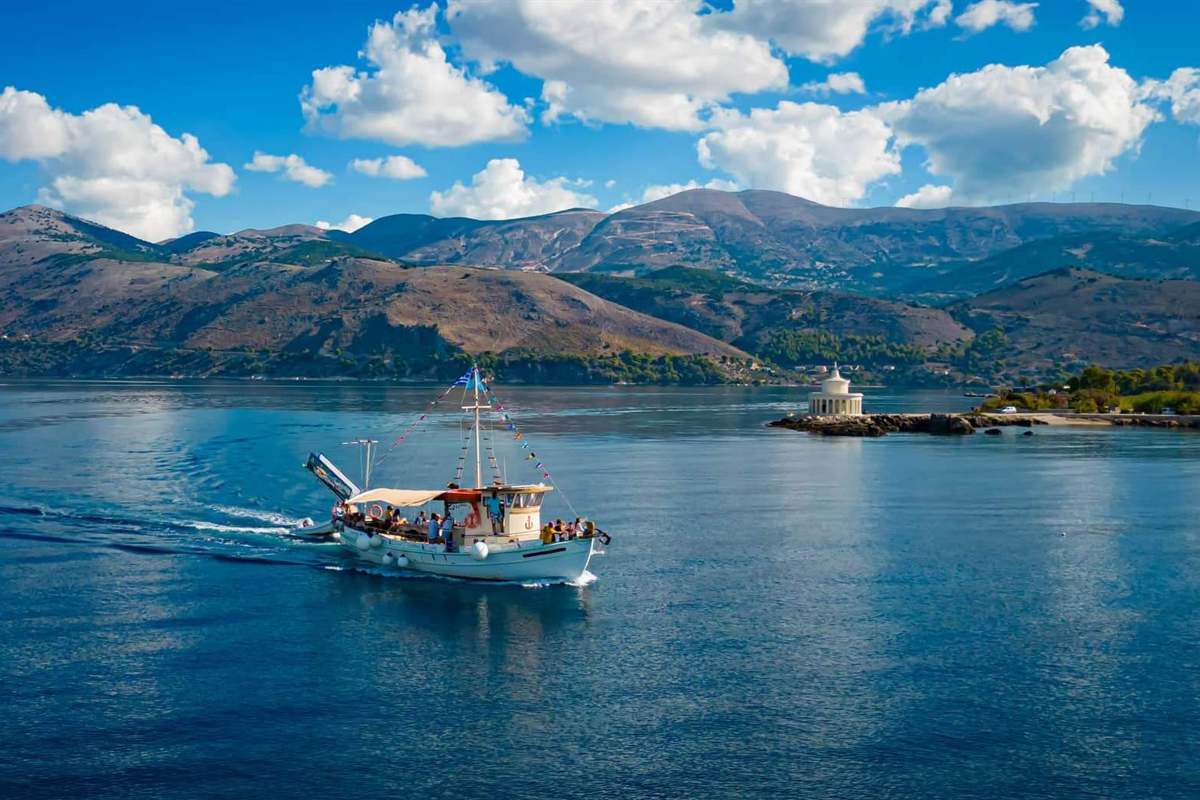
Further along stands the Lighthouse of Saint Theodore, named after the small church beside it. People more commonly call it the Fanari lighthouse. The British built it in eighteen twenty-nine. The earthquake of nineteen fifty-three destroyed the original. The present lighthouse was rebuilt from the original plans, with Doric-style columns.
What else is there to see in Argostoli besides an Argostoli boat trip?
The Bell Tower was rebuilt in nineteen eighty-five to house the original clock mechanism. The British built the law courts with stone from the Cyclopean site at nearby Krani.
On Lithostroto, next to the Catholic Church, a tiny museum honours the soldiers of the Acqui Division. German bombing in nineteen forty-three shattered buildings in the town, and the earthquake of nineteen fifty-three destroyed the rest.