
A Kyrenia and Nicosia day trip from Ayia Napa is a full day by coach in which you cross the Green Line on foot at Ledra Street and spend the rest of the day in the north of Cyprus. Set it beside other tours in Greece when you plan the days of your holiday.
This page covers what the trip includes and how the day is timed, the pickup in Ayia Napa and Protaras, the drive to Nicosia, the border documents and who cannot cross, Ledra Street and the Green Line, Nicosia and its Venetian walls, Buyuk Han, Kyrenia and its harbour, Kyrenia Castle and the Kyrenia ship, Bellapais Abbey, Lawrence Durrell and the questions travellers ask.
What does the Kyrenia and Nicosia day trip from Ayia Napa include?
The Kyrenia and Nicosia day trip from Ayia Napa is a full-day coach trip to the north of Cyprus. The listing includes pickup, drop-off and a live tour leader who speaks Polish. The activity provider is MTS Globe Cyprus Ltd.
The Kyrenia and Nicosia day trip from Ayia Napa has four main stops. They are Ledra Street, Buyuk Han, Kyrenia Castle and Bellapais Abbey. A coach links the four stops. The listing also describes a walk along Ledra Street in Nicosia and a border crossing.
The inclusion list is short: pickup and drop-off, and a qualified and licensed tour leader. The listing says pickup is included and tells you to check availability for details. It lists Polish as the language of the live tour leader and no other.
Not everything is covered on the Kyrenia and Nicosia day trip from Ayia Napa. Lunch is not included, so plan to buy your own. Food and drinks are not included either. Tips for the driver and the tour leader are listed as optional. The bring list names comfortable shoes, sunglasses, a sun hat and sunscreen.
The castle visit is optional. The listing marks the castle stop with an extra fee, even though it also says entrance fees are included. Check the operator’s booking page to see how the castle is handled. Cancelling is free until 24 hours before the start, and the refund is in full.
How long is the Kyrenia and Nicosia day trip from Ayia Napa, and how is the day timed?
The Kyrenia and Nicosia day trip from Ayia Napa lasts 8 hours, according to the listing. The day holds four coach rides and four stops, and the listed legs add up to exactly 480 minutes.
On the Kyrenia and Nicosia day trip from Ayia Napa, the first coach ride to Nicosia takes 1 hour. Ledra Street comes next as a walk of 1 hour, and the listing says the walk leads to the checkpoint. Buyuk Han follows for 30 minutes, and the listing tags it as a visit.
A second coach ride of 50 minutes brings you to Kyrenia. Kyrenia Castle is the longest stop of the day, at 2 hours. A 30-minute coach ride then leads to Bellapais Abbey, where the listing sets aside 40 minutes. The last ride, back to the drop-off stops, takes 1.5 hours. It is the longest ride of the day.
The day starts on the coach and ends on the coach. Count from the first ride, with the legs back to back. Ledra Street begins after 1 hour and Kyrenia after 3 hours and 20 minutes. Bellapais Abbey begins after 5 hours and 50 minutes. The rides total 230 minutes and the stops total 250 minutes.
Treat the times as a plan. The listing says the itinerary is for reference only and subject to change. It gives no clock times and no border queue time. It tells you to check availability to see starting times. Ask the operator for the start of your Kyrenia and Nicosia day trip from Ayia Napa.
Where does the pickup happen in Ayia Napa and Protaras?
The Kyrenia and Nicosia day trip from Ayia Napa includes pickup. The listing offers 35 stops in Ayia Napa, Protaras, Paralimni and Konnou. It shows starting times only when you check availability for a date.
Find the stop nearest your bed before you book the Kyrenia and Nicosia day trip from Ayia Napa. Seven stops name a hotel: Tsokkos Gardens, Grecian Park, Lordos Beach, Marina, Amethyst Napa, Princess Beach and Limanaki Beach. Crown Resorts Elamaris is on the list as well.
Not every stop is a hotel. The list names Primemart, Plus Discount Market, Village supermarket, Rossos Supermarket and Adams Superstore. It also names Caprees Gift & Souvenir Shop, Bliss Bar and McDonald’s. Plus Discount Market appears twice, so read your stop name with care. The drop-off list repeats the same 35 names.
Protaras has six stops: Sunrise Beach, Fig Tree Bay and four on Kavo Gkreko Avenue. Three stops use the Nissi Avenue name, one of them numbered 44. Konnou has two, Grecian Park Hotel and Iras, and Paralimni Port has one. Makronissos Beach is a stop on the Kyrenia and Nicosia day trip from Ayia Napa too.
Wikipedia calls Ayia Napa a tourist resort at the far eastern end of the island’s southern coast. Its name comes from a Venetian-era monastery in the town centre. Protaras, another resort, comes under the Municipality of Paralimni. Paralimni is the commuter town for both. The Kyrenia and Nicosia day trip from Ayia Napa picks up in all three.
What is the drive from Ayia Napa to Nicosia like?
An Ayia Napa tour agency lists Nicosia 88 km away and says the drive takes just over an hour. The Kyrenia and Nicosia day trip from Ayia Napa makes this run first, then crosses the border at Nicosia.
Wikipedia gives a second figure. It places Paralimni, a town near both resorts, 110 km east of Nicosia. The two numbers start from different towns, so they differ. Treat both as rough measures. The day plan for the Kyrenia and Nicosia day trip from Ayia Napa shows no stop before Nicosia.
Wikipedia also describes the land around the pickup towns. Paralimni stands at the southeast end of the Mesaoria, the island’s central plateau, about 80 m above sea level. The plain runs around the town to the north, and coastal hills rise to the south. The town sits on the shore of a shallow lake that dries up outside winter.
Ayia Napa belongs to Kokkinochoria, the Red Villages, named for the red colour of the soil. Around Paralimni the red soil is rich in zinc and grows very nutritious potatoes. Windmills there draw water from aquifers; electric or diesel pumps replaced the derelict ones. That farmland lies around the start of the Kyrenia and Nicosia day trip from Ayia Napa.
The east of the island has its own border crossing. A Cyprus travel site lists Pergamos, near Larnaca and Ayia Napa, as the east-side vehicle crossing, closest to Famagusta. The Kyrenia and Nicosia day trip from Ayia Napa does not use it. The listing crosses at Nicosia, so the drive goes there first.
Which documents do you need for the Kyrenia and Nicosia day trip from Ayia Napa?
Travellers on the Kyrenia and Nicosia day trip from Ayia Napa must carry a passport or a national ID card. The listing lets only citizens of European Union countries cross with a national ID card. All other nationalities need a passport.
Six rules sit in the Know before you go section of the tour listing. This part tells all six as the listing words them. The tour text also calls documents obligatory at the border crossing in Nicosia. It names personal ID or passport as the two choices. The what-to-bring list opens with a passport or ID card.
In plain terms, the Kyrenia and Nicosia day trip from Ayia Napa has two groups of travellers. An EU citizen crosses with a passport or a national ID card. Every other traveller crosses with a passport. The ID card is therefore an option for EU citizens only.
The Kyrenia and Nicosia day trip from Ayia Napa takes original documents only. The listing names four items that are not valid for crossing:
- photocopies
- scanned copies
- driving licences
- temporary residence permits
The listing adds that any other form of identification is not valid either. Only the original document counts at the crossing. A Cyprus travel site gives the same core rule: a valid passport or an EU national ID card is sufficient. Its summary box calls the rule non-negotiable.
Who cannot cross the border, and why does the passport date matter?
The listing keeps seven nationalities off the Kyrenia and Nicosia day trip from Ayia Napa without a special visa. Citizens of India, Armenia, Syria, Nigeria, Turkmenistan, Bangladesh and Nepal must obtain that visa in advance. Without it, there is no place on the tour.
The passport date is a separate check. The listing says a passport that expires less than six months after the trip can mean denied boarding or entry. The six months are counted from the day of the trip. A passport that runs out five months after the day of travel falls under this rule.
The Kyrenia and Nicosia day trip from Ayia Napa is closed to Ukrainian citizens living in Cyprus under refugee status. The listing gives one reason: they are not permitted to re-enter. The rule names both the citizenship and the refugee status.
Greek citizens have their own rule. An old-style handwritten ID card does not let the holder cross. The listing says the holder must carry either the new ID card or a valid passport. In total, the listing names four cases:
- seven nationalities that need a special visa in advance
- Ukrainian citizens living in Cyprus under refugee status
- Greek citizens with an old-style handwritten ID card
- any passport that expires less than six months after the trip
These four cases are the listing’s rules, told as written. They sit in the same section as the document rules above. Check your nationality, your residence status, your ID card and your passport date against them. Read the full wording on the operator’s listing before you book the Kyrenia and Nicosia day trip from Ayia Napa.
What is Ledra Street, and how does the crossing on foot work?
Ledra Street is a shopping street in central Nicosia that links Nicosia with North Nicosia. The Kyrenia and Nicosia day trip from Ayia Napa walks it to the checkpoint, then crosses the border on foot.
Wikipedia calls Ledra Street a major shopping thoroughfare, about 1 km long. It leads off Eleftheria Square and runs from south to north. The street lies mainly in the area the Republic of Cyprus controls. A short stretch at the northern end, past the buffer zone, lies in the Turkish part of Nicosia. The Greek name is Odos Lidras.
A barricade once stood here across the United Nations buffer zone. Wikipedia says it symbolised the division of Nicosia between the Greek south and the Turkish north. The crossing reopened on 3 April, after 34 years. The Kyrenia and Nicosia day trip from Ayia Napa now walks to the crossing at that site.
Wikipedia describes the Ledra Street crossing that the Kyrenia and Nicosia day trip from Ayia Napa uses. The authorities on the northern side run an immigration checkpoint there. All pedestrians entering or leaving the north go through it. Entry and exit stamps go on separate visa slips, not in passports. The Republic of Cyprus keeps no immigration checkpoint there.
A Cyprus travel site calls Ledra Street a pedestrian-only crossing in the city centre, convenient for Nicosia day visitors. It adds that you receive a paper entry document from the northern authorities, and you need it when you return. The listing for the Kyrenia and Nicosia day trip from Ayia Napa gives no details of the checks.
What is the Green Line that divides Nicosia?
The Green Line is the United Nations buffer zone that cuts through the centre of Nicosia. It splits the city into southern and northern sections. On the Kyrenia and Nicosia day trip from Ayia Napa, you cross it at Ledra Street.
Wikipedia gives the Greek name Prasini Grammi and the Turkish name Yeşil Hat. It says the first buffer zone was set up in the last days of nineteen sixty-three. This followed the violence of that Christmas. The line is also called the Attila Line, after Turkey’s military operation of nineteen seventy-four, codenamed Operation Attila.
Wikipedia says the winding buffer zone marks the southernmost points that Turkish troops reached in August nineteen seventy-four. It runs between the ceasefire lines of the Cypriot National Guard and the Turkish army. Nicosia remains the last divided capital in Europe, it adds. On the Kyrenia and Nicosia day trip from Ayia Napa, you cross that line on foot.
The zone that the Kyrenia and Nicosia day trip from Ayia Napa crosses spans 346 square kilometres. Its width varies from less than 20 metres to more than 7 kilometres. About 10,000 people live in villages inside the zone and work on farms. Parts of the zone are untouched by people and shelter plants and animals.
Wikipedia describes Northern Cyprus as a de facto state on the northern third of the island, recognised only by Turkey. The international community, it says, considers the area territory of the Republic of Cyprus under Turkish military occupation. The day continues in the area north of the Green Line, which a Turkish Cypriot administration runs.
What is Nicosia, the capital that the day starts in?
The Kyrenia and Nicosia day trip from Ayia Napa starts in Nicosia, also called Lefkosia, the capital of Cyprus. Wikipedia says people have lived there for over 5,500 years without a break. It has been the capital since the 10th century.
The Kyrenia and Nicosia day trip from Ayia Napa reaches a city with two local names. The Greek name is Lefkosia and the Turkish name is Lefkoşa. Both grew out of Leucosia, a form that became common in the Byzantine period. The English name Nicosia came later, in the medieval Lusignan period. Greek speakers also use the nickname Chora.
Around 965 the Byzantine Empire chose Nicosia as the capital of the island. Wikipedia says the reason was mainly security, since raids hit the coastal towns. The first settlers made their homes on the fertile Mesaoria plain. The city sits in the rain shadow of the Troodos Mountains.
Visitors on the Kyrenia and Nicosia day trip from Ayia Napa enter a city that changed rulers again and again. The Lusignan kings made it the capital of their medieval Kingdom of Cyprus. Venice took the island in the 15th century. The Ottomans took Nicosia in the 16th, and British rule began in the 19th.
The Ottoman conquest hit the city hard. Wikipedia estimates that Nicosia had 21,000 people before it. Ottoman census data from soon after counted between 1,100 and 1,200. Today the Kyrenia and Nicosia day trip from Ayia Napa begins in the financial and business heart of Cyprus. The city hosts the headquarters of all Cypriot banks.
What are the Venetian walls of Nicosia?
Nicosia, where the Kyrenia and Nicosia day trip from Ayia Napa begins, is ringed by the Venetian walls. The Republic of Venice rebuilt them in the mid-16th century. Wikipedia says they are still largely intact and a major tourist attraction.
The walls form a circle with a circumference of about 5 km, or 3 miles. They hold eleven pentagonal bastions. The bastions are named after eleven families of the town’s Italian aristocracy, who gave money towards the building. The designers placed the gates beside the bastions to make them easier to protect during a siege.
The walls have three gates: the Paphos Gate, the Famagusta Gate and the Kyrenia Gate. Wikipedia says the Kyrenia Gate gave access to the north, and particularly to Kyrenia. The Kyrenia and Nicosia day trip from Ayia Napa reaches that town later in the day. The Famagusta Gate serves as a venue for art exhibitions and concerts.
Venice hired the Italian engineers Giulio Savorgnan and Francesco Barbaro to design the new defences. The old medieval defences came down to make way for them. The river Pedieos was moved outside the city to stop floods and to fill the moat round the walls. Experts call the walls a prime example of 16th century military architecture.
The walls were still unfinished when the Ottomans attacked. The city held out for 40 days, and the Ottomans broke through at the Podocattaro Bastion. The Ottomans repaired the walls after the siege. Half of the walls lie in North Nicosia, which the Kyrenia and Nicosia day trip from Ayia Napa also visits.
What is Buyuk Han in North Nicosia?
Buyuk Han, the Great Inn, is the largest caravanserai in Cyprus. The Ottomans built it in the year after they took the island from the Venetians. The Kyrenia and Nicosia day trip from Ayia Napa stops there in Northern Nicosia.
Historical records link the inn to Muzaffer Pasha, the first Ottoman governor of Cyprus. They say it was modelled on Koza Han in Bursa. The archaeologist Tuncer Bagiskan credits his successor, Sinan Pasha, instead. So the builder of this stop on the Kyrenia and Nicosia day trip from Ayia Napa is debated.
Reports say the inn stands on the remains of an older building. It began as Yeni Han, the New Inn. Merchants from Alanya frequented it, so it was also called the Inn of those from Alanya. In the 17th century it became Büyük Han, once the smaller Kumarcilar Han was built opposite Asmaalti Square. The Greek name is Megalo Pandocheio.
The Kyrenia and Nicosia day trip from Ayia Napa visits a building that once held prisoners. After the British took over, the inn was restored for use as a prison. It was the first city prison under British rule. Later it served as an inn again, then as a refuge for poor families, who rented rooms there.
The inn spent a long stretch of the last decade of the twentieth century being restored. Today it is an arts centre with galleries, workshops and courtyard cafes. Visitors on the Kyrenia and Nicosia day trip from Ayia Napa find souvenir shops that sell traditional Cypriot handicrafts. The Evkaf Administration requires tenants to sell only what they make.
What does an Ottoman caravanserai look like inside and outside?
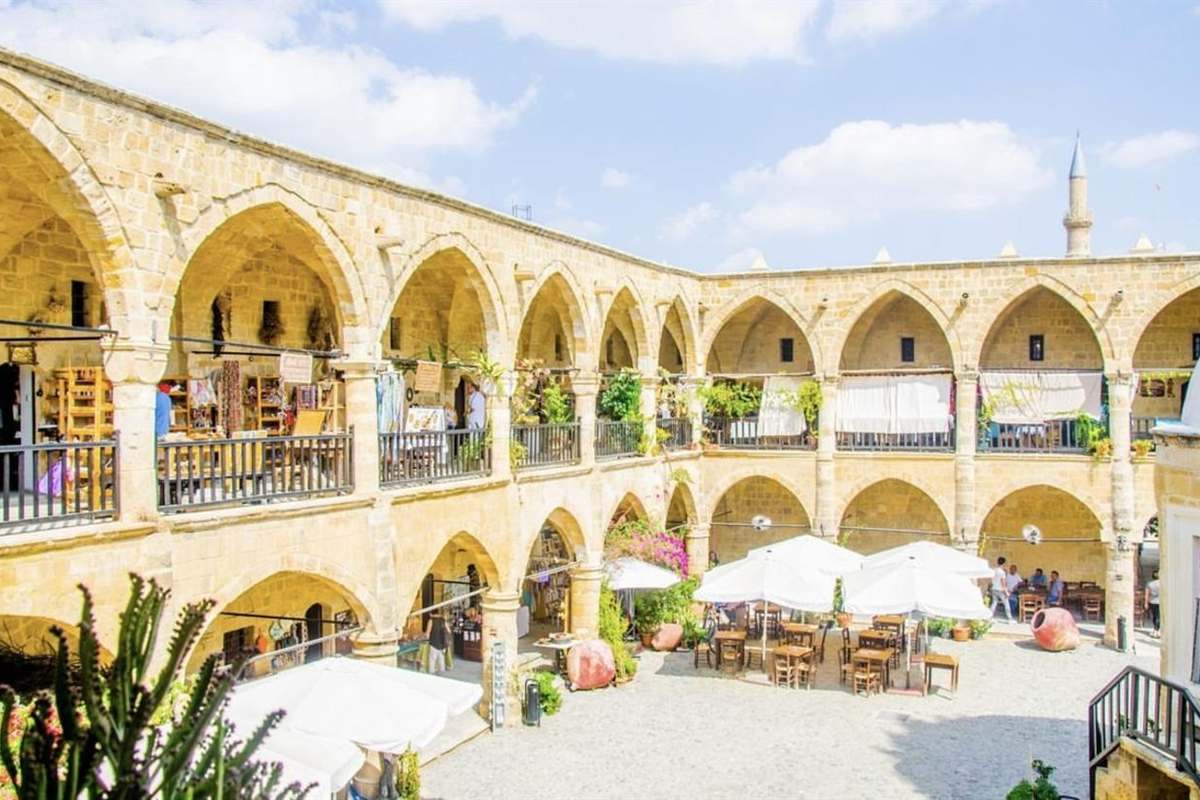
Buyuk Han is a roughly square building with two floors and 68 rooms around a large courtyard. A mosque stands in the middle of the yard. You see this layout on the Kyrenia and Nicosia day trip from Ayia Napa.
The building measures 50.67 metres by 45.25 metres. Two doors lead in, one on the east side and one on the west. The main door, on the east side, opens onto Asmaalti Square. Ten one-storey shops sit behind the colonnade at the eastern entrance.
The rooms around the courtyard have colonnades with cross vaults in front of them. The ground-floor rooms were historically used for trade, and the first-floor rooms for lodging. On the Kyrenia and Nicosia day trip from Ayia Napa, you see an inn that mixed trade and lodging.
On the Kyrenia and Nicosia day trip from Ayia Napa, you find a special masjid in the courtyard. In Turkish it is a köşk mescidi, which means mansion masjid. Its fountain is for washing before prayer. Tuncer Bagiskan believes the stones for the masjid came from other buildings. Koza Han in Bursa has a similar masjid.
Each room has a fireplace under a hexagonal or octagonal stone chimney, and Rupert Gunnis found these chimneys unusual. A grave lies southwest of the masjid. Tradition says it belongs to Muzaffer Pasha or to a high-standing person who died at prayer. Bagiskan calls the Muzaffer story a myth. George Jeffery noted that the masjid was used as a hayloft.
What is Kyrenia, also called Girne?
Kyrenia is a city on the northern coast of Cyprus, and Girne is its Turkish name. The Kyrenia and Nicosia day trip from Ayia Napa reaches it after Nicosia. Wikipedia says the city is noted for its historic harbour and castle.
Keryneia is the Greek name. Wikivoyage says tourist writing always calls the town Kyrenia. Over the centuries, maps spelled the name Ceraunia, Cerenis, Keronean, Kernia and Kerini, says Wikipedia. The tour listing itself uses Kyrenia, Kerynia and Kyreneia.
Wikipedia tells a myth about its start. In it, the Achaeans Cepheus and Praxandrus founded Kyrenia after the Trojan War. They named it after their hometown Kyrenia in Achaea, Greece. Wikivoyage says Hellenistic people founded the city over 3,000 years ago. The Kyrenia and Nicosia day trip from Ayia Napa visits a port town with a very long past.
Wikivoyage says Kyrenia was the chief port on this coast, so it controlled trade and needed defending. Today Wikipedia calls it the tourism capital of the north of Cyprus, with hotels, nightlife and a port. It also holds an annual culture and arts festival with hundreds of artists and performers. Wikivoyage counts 45,881 people in the city.
Wikipedia says the Kyrenia Mountains run about 160 km along the northern coast. Their highest peak, Mount Selvili, is 1,024 m high. Kyrenia is the capital of the smallest of the six districts of Cyprus. The Kyrenia and Nicosia day trip from Ayia Napa moves from the Nicosia District into the Kyrenia District.
What is Kyrenia harbour, and how do you spend the free time there?
Kyrenia harbour is the historic port of the town. Wikipedia says it is lined with cafés, bars and restaurants that locals and tourists use. The Kyrenia and Nicosia day trip from Ayia Napa leaves free time there.
The listing for the Kyrenia and Nicosia day trip from Ayia Napa calls Kyrenia a port in the Venetian style. It says a monumental Byzantine fortress dominates the port. Wikipedia notes a small tower in the harbour for slinging a defensive chain to close it to enemies. Wikipedia also lists the ruins of a small Christian church behind the harbour.
The harbour was a working port first. Wikipedia says that before British rule began, local boats traded from there and exported wheat, olives, donkeys and goats. Larger boats came in late autumn and early winter to take in the carob crop. Two-storey buildings slowly rose around the harbour, with warehouses on the lower floor and homes above.
Free time is part of the Kyrenia and Nicosia day trip from Ayia Napa. The listing names a walk around the harbour, lunch or shopping. Wikivoyage says the town is walkable. The castle visit is optional and sits in the same stop. The listing gives no separate length for the free time.
On the Kyrenia and Nicosia day trip from Ayia Napa, the listing says lunch is not included. You choose your own table at the harbour. A Cyprus travel site lists a harbour lunch at one of the seafront restaurants on its Kyrenia route. Wikipedia also names a second port, the Kyrenia Touristic Port, besides the historical harbour.
What is Kyrenia Castle, and why is the visit optional?
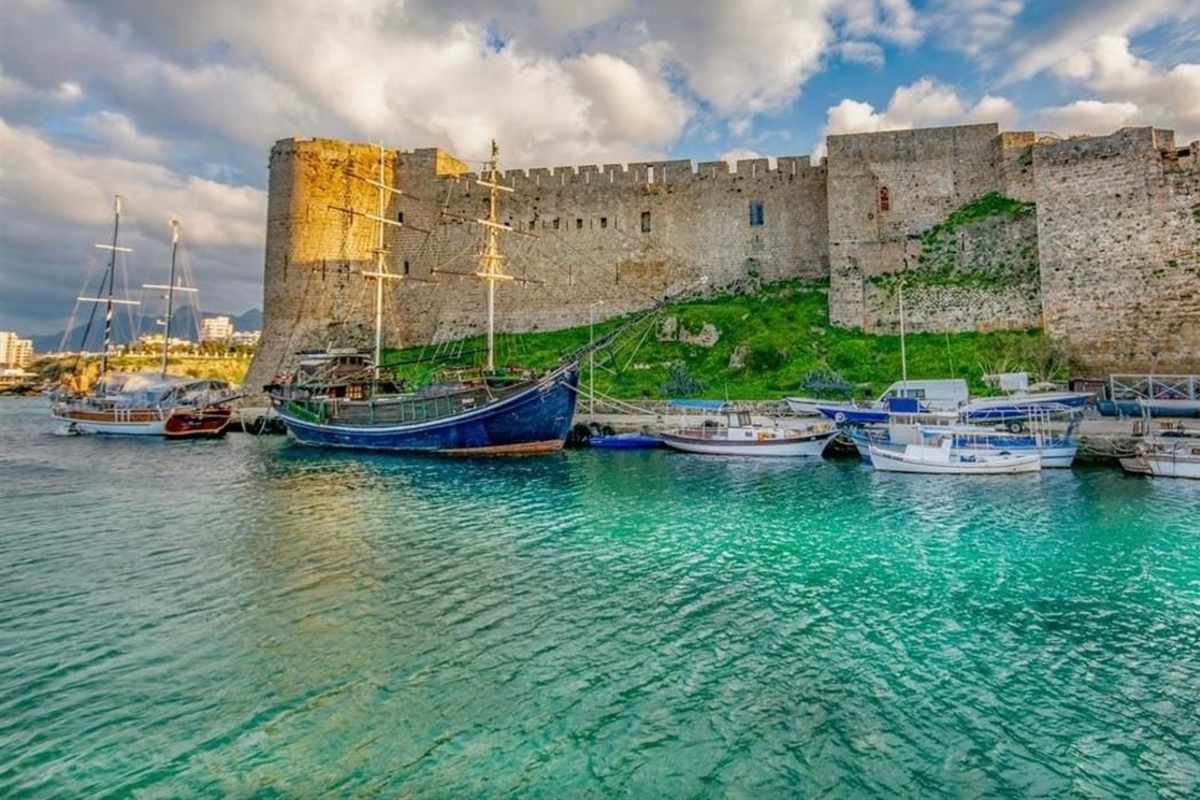
Kyrenia Castle is a 16th-century fortress in the north of Cyprus, built by the Venetians over an older Crusader fortification. The listing for the Kyrenia and Nicosia day trip from Ayia Napa calls the castle visit optional.
The listing places the optional visit beside free time at the same stop. It tags the stop with an extra fee, while another line says entrance fees are included. The operator’s booking page settles which line covers the castle, so read it before you book.
The castle on the Kyrenia and Nicosia day trip from Ayia Napa grew in stages. Research at the site suggests the Byzantines built the first castle in the 7th century. They wanted to guard the city against a new Arab threat from the sea. Richard I of England captured it in the late 12th century.
In the early 13th century, John of Ibelin enlarged the small Lusignan castle. He added a new entrance, towers, openings for archers and dungeons. The Venetians gave it its present look in the 16th century. Thick walls, cannon openings and gun ports on three levels answered the new gunpowder artillery. Kyrenia surrendered to the Ottomans in the same century.
Adding the castle to the Kyrenia and Nicosia day trip from Ayia Napa means entering by the north-west entrance. It opens on a bridge over the old moat. Inside are a cruciform Church of St George and a courtyard lined with guardrooms, stables and living quarters. A small souvenir shop and simple cafe stand at the northern end.
What is the Kyrenia ship, and where is it kept?
The Kyrenia ship is an ancient Greek merchant ship from the 4th century BC. It is on show in the Ancient Shipwreck Museum inside Kyrenia Castle. The tour listing does not name it. So it is a castle fact, not a stop on the Kyrenia and Nicosia day trip from Ayia Napa.
Andreas Cariolou, a diving instructor from Kyrenia, found the wreck in November nineteen sixty-five. He was collecting sponges in a storm, 33 metres down, about two kilometres north-east of the harbour. The wreck lay close to the town that the Kyrenia and Nicosia day trip from Ayia Napa visits.
Cariolou had lost the exact spot, so he made more than 200 dives before he found it again. Michael Katzev of the University of Pennsylvania Museum then led the dig. A team of more than 50 underwater archaeologists, students and technicians worked two summers. More than half of the hull timbers were in good condition.
The ship carried 381 amphoras, or transport jars, holding wine, olive oil and almonds. A total of 340 came from Rhodes. Its 29 millstones lay in three rows over the keel as cargo and ballast. Visitors who add the castle to the Kyrenia and Nicosia day trip from Ayia Napa see the originals. They are about 2,300 years old.
One room off the courtyard holds the Shipwreck Museum. Ask about it if you add the castle to the Kyrenia and Nicosia day trip from Ayia Napa. The hull is 14 metres long, made of Aleppo pine sheathed in lead. It sits in a specially controlled environment with its amphoras. Conservation took place in the early nineteen-seventies.
What is Bellapais Abbey?
Bellapais Abbey is a ruined monastery that canons regular built in the 13th century, about 5 kilometres from Kyrenia. It is the Gothic stop on the Kyrenia and Nicosia day trip from Ayia Napa.
The first known settlers were Canons Regular of the Holy Sepulchre, who fled Jerusalem after it fell to Saladin. Aimery de Lusignan founded the monastery, and the first buildings date from the turn of the 13th century. The White Canons, or Norbertines, took over soon after.
The name has a story. The common explanation starts with the French name Abbaye de la Paix, or Abbey of Peace. After the Italian takeover it was corrupted into Bellapais and read as the Italian phrase Bella Paese.
The Kyrenia and Nicosia day trip from Ayia Napa visits the abbey with a tour leader. The tour listing calls it the finest example of Gothic architecture in the eastern Mediterranean. The main building was built under King Hugh III in the 13th century.
The church is in better shape than the rest of the abbey. Its surviving decorations include an intricately carved pulpit, the bishop’s throne and five chandeliers.
The listing for the Kyrenia and Nicosia day trip from Ayia Napa dates the abbey to the 14th century. That fits the cloisters and refectory, built under King Hugh IV, who lived in the abbey. The cloister has 18 arches, and the Gothic refectory is 30 metres long and 10 metres wide.
Under British rule, soldiers used the refectory as a hospital. Bullet holes from small arms still show in its east wall. The Kyrenia and Nicosia day trip from Ayia Napa visits a site that is also a museum. It has a restaurant and a cafe, and the refectory hosts concerts and lectures.


Who was Lawrence Durrell, and what is Bitter Lemons of Cyprus?
Lawrence Durrell was a British writer who spent three years on Cyprus. His autobiographical book Bitter Lemons of Cyprus describes that time. The Kyrenia and Nicosia day trip from Ayia Napa names the book in its listing.
Durrell was born in British India and was the eldest brother of the naturalist and writer Gerald Durrell. He wrote the Alexandria Quartet, a series of novels that begins with Justine.
The listing for the Kyrenia and Nicosia day trip from Ayia Napa says Durrell lived at Bellapais. He settled in the village, which he spelt Bellapaix in the book to echo its old name, Paix. He also bought a house and first taught English at the Pancyprian Gymnasium.
The listing calls the book a novel, but it is an autobiographical work. It is alternately comic and serious. It follows the people he met and the Enosis movement for union with Greece.
Its comic moments include his house-buying adventure and visits from his mother and his brother Gerald. The book won the Duff Cooper Prize, the second year the prize was awarded.
Durrell later took a job as press adviser to the British governor. He left the island quickly. After a short stay in the UK, he lived in France for the last three decades of his life. The Kyrenia and Nicosia day trip from Ayia Napa visits the abbey, on the north side of his village.
What else do travellers ask about the Kyrenia and Nicosia day trip from Ayia Napa?
How hot does Nicosia get on the Kyrenia and Nicosia day trip from Ayia Napa?
Wikivoyage places Nicosia among the southernmost locations in Europe and calls its climate subtropical and semi-arid. Summers are very hot and dry, it says, with temperatures that regularly rise above 35°C. Early spring and late autumn bring pleasantly warm weather.
Winter is the wettest season, yet only 7 to 8 days of the month see rain. The Kyrenia and Nicosia day trip from Ayia Napa reaches that city first.
What is the Selimiye Mosque in North Nicosia?
Wikipedia calls it a former Christian cathedral, once the Cathedral of Saint Sophia. The Ottomans made it a mosque in the 16th century and added two minarets that year. It occupies the largest and oldest surviving Gothic church in Cyprus, and it can hold 2,500 worshippers.
It was also the coronation church of the kings of Cyprus. It is not a named stop on the Kyrenia and Nicosia day trip from Ayia Napa.
Does the Kyrenia and Nicosia day trip from Ayia Napa climb to St Hilarion Castle?
No. St Hilarion is not on the list of stops for the Kyrenia and Nicosia day trip from Ayia Napa. Wikipedia lists St Hilarion, Buffavento and Kantara as castles that sit astride peaks of the Kyrenia Mountains. Wikivoyage calls St Hilarion a mountaintop castle, built in the 10th century. The Byzantines reinforced it in the 11th.
Wikivoyage adds that a steep, rugged footpath leads from the car park to the Lower Ward. That ward housed the guard and stables. The Middle and Upper Wards were for the royal family.
What does the name Pentadaktylos mean in the Kyrenia Mountains?
Wikipedia gives Pentadaktylos as another name for the Kyrenia Mountains. It means five-fingered, after a peak that resembles five fingers. Tradition says the peak shows the handprint of the Byzantine hero Digenis Akritas. He gripped the mountain to get out of the sea.
The range is made mainly of hard crystalline limestone. It is rugged and rises abruptly from the Mesaoria plain. The only other mountain range in Cyprus is the Troodos Mountains.
Does the Kyrenia and Nicosia day trip from Ayia Napa include a museum in Nicosia?
The Kyrenia and Nicosia day trip from Ayia Napa lists no museum in Nicosia. An Ayia Napa tour agency lists the Byzantine Art museum there, with over 200 icons. It says the collection reaches back to the 5th century.
The same agency lists the Shacolas Observatory, a viewing tower with views across the whole city. It also lists Laiki Yeotonia, the old part of the city with narrow cobbled lanes.